Haplogroup G2a2a1a2

– 6 min read


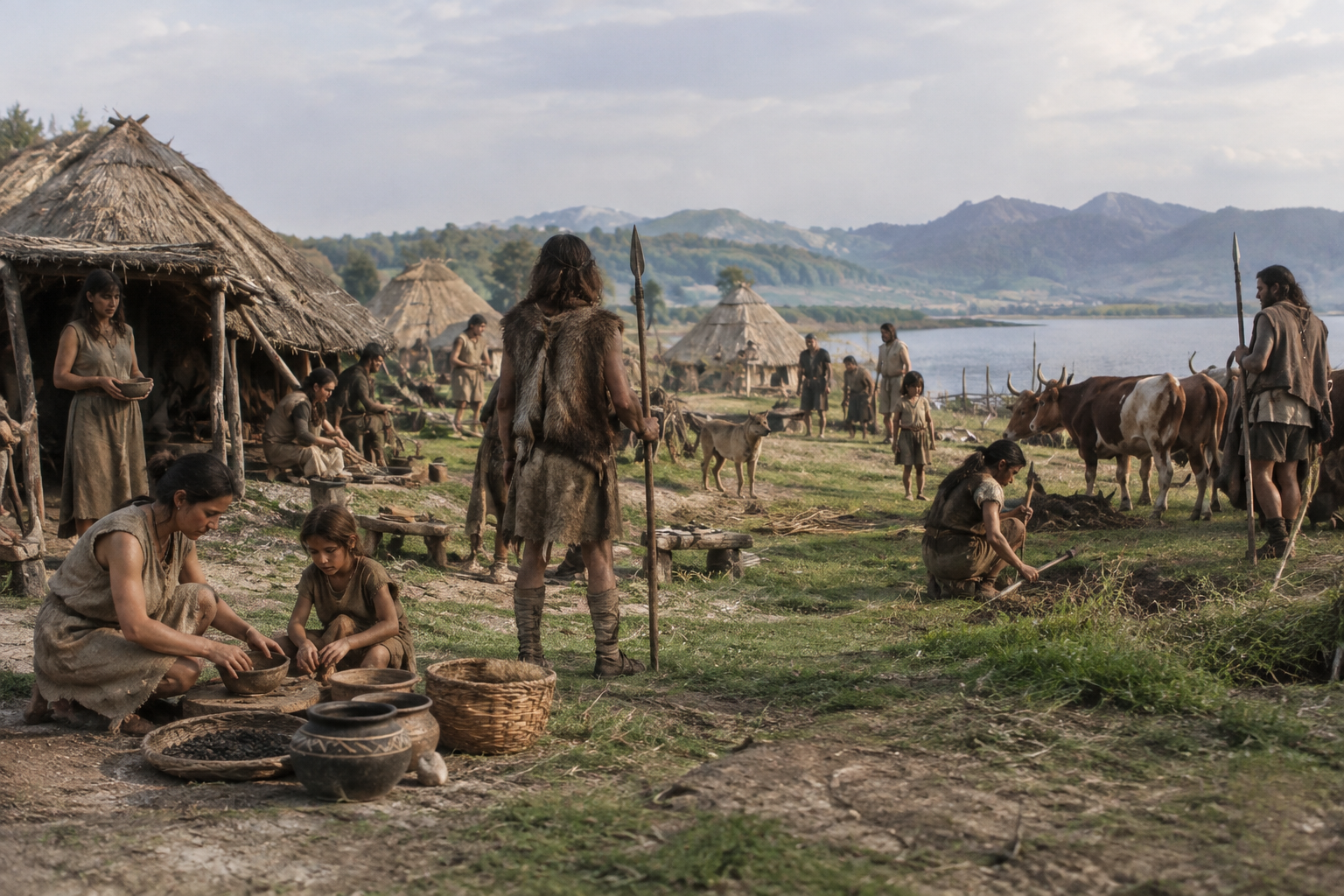
Some Y-DNA haplogroups stride onto the historical stage with trumpets: conquerors, expansions, royal burials, the lot. Haplogroup G2a2a1a2 is more interesting for a subtler reason. It appears, again and again, in the deep archaeological record of the Near East, the Balkans, central Europe, the Aegean, and the Mediterranean. It belongs to a wider branch of Y-chromosome lineages strongly associated with some of the earliest farming communities that moved from Anatolia into Europe, yet the story does not stop in the Neolithic. Ancient DNA shows related paternal lines lingering, shifting, and reappearing in later worlds too.
That is worth pausing over. Y-DNA traces a direct paternal line only: father to father to father. It does not describe a person's whole ancestry, culture, language, or identity. But when a lineage such as G2a2a1a2 turns up across many centuries and regions, it gives us a rare thread to follow through prehistory and history. Not a family tree in the modern genealogical sense, but a long, broken, fascinating chain of male-line descent and survival.
The broader haplogroup G is widely linked in ancient DNA research with early agricultural populations of western Asia and Europe. For a subclade as specific as G2a2a1a2, caution is essential: we should not simply dump the whole history of haplogroup G onto one narrow branch. Still, the supplied ancient samples place this lineage, or very close paternal relatives, in exactly the regions one would expect if part of its history ran through the early farming expansions from Anatolia into southeastern and central Europe.
Two of the earliest clues come from Barcin in northwest Anatolia: I1099 dated to 6250 BC and I1583 dated to 6233 BC. Barcin has become one of the key places for understanding the agricultural pioneers who helped reshape Europe. If you want to see the bigger setting for that transformation, the MyTrueAncestry community article on Neolithic Expansion in the Aegean is a useful companion.
Explore Neolithic Aegean farmers
From there, the trail moves into the Balkans and beyond. At Yabalkovo, Bulgaria, sample I0698 from 5950 BC places this paternal heritage in one of the great corridors by which farming spread into Europe. Nearby in time and region are I11135 from Veliko Tarnovo, Bulgaria dated to 5725 BC and I17835 from Carcea Viaduct, Romania dated to 5750 BC. These are not stray curiosities. They suggest that paternal lines within this branch were present among early and middle Neolithic communities across southeastern Europe.
Then the pattern widens. In central Europe we find TR124 from Trebur, Germany at 4800 BC, I0659 from Halberstadt-Sonntagsfeld at 4979 BC, and I0821 from the same site at 4942 BC. At Asparn Schletz, Austria, the strikingly named Neolithic massacre sample I27793 dated to 5000 BC reminds us that early farming Europe was not a serene Arcadia. These men lived in communities that farmed, traded, built, and sometimes died violently.
One of the strongest features of the evidence is continuity of presence across later prehistoric Europe. In Romania, the cluster from Urziceni is especially revealing: Urzi13, Urzi60, and Urzi65a, all dated to 4000 BC, alongside Chalcolithic Bodrogkeresztur-associated samples I14159, I14161, and I15616, also dated to 4000 BC. This concentration suggests not just a passing appearance but a substantial paternal footprint in Copper Age communities north of the lower Danube.
Central Europe continues the story with I7192 from Makotrasy, Central Bohemia dated to 3602 BC, LEU028a from Leubingen, Germany dated to 3500 BC, and Warburg_2b from Warburg, Germany dated to 3150 BC. Switzerland contributes a remarkable spread of late Neolithic finds: Aesch6 at 2840 BC, Aesch24 at 2890 BC, MX150 at 3180 BC, MX182 and MX183 both at 3190 BC, MX204 at 3100 BC, and SNPRA58 at 2910 BC. That is a fine reminder that paternal lineages can persist through changing archaeological cultures without needing a melodramatic migration every few centuries.
There are also signs that the lineage, or close kin within its branch, did not vanish when steppe-related ancestries became prominent. The sample I18100 from Yamnaya Kunhegyes-Nagyallas-halom, Hajdu-Bihar, Hungary dated to 2750 BC is particularly interesting because it sits in a context often discussed in relation to large Bronze Age population movements. It does not mean G2a2a1a2 was a "Yamnaya haplogroup" in any simple sense. It does mean that prehistoric societies were more mixed, more local, and less tidy than old textbook models suggested.
Read about ancient DNA in the Carpathian Basin
The Adriatic and Mediterranean worlds also matter here. We have I2792 from Vucedol Bronze Age Croatia dated to 2740 BC, I16994 from Vrbicka, Montenegro dated to 2500 BC, and CLL001 from Cueva de las Lechuzas, Iberia dated to 2200 BC. In Sardinia, SEC001 and SEC002 from Sennori dated to 2200 BC suggest that this paternal heritage also found a place in island populations often noted for preserving older genetic layers.
By the Bronze Age Aegean, this is no longer just a story of first farmers. HGC025 from Hagios Charalambos Cave, Crete dated to 1900 BC places the lineage in a Minoan context, while LAZ018 from Aegina, Saronic Islands, Greece dated to 1500 BC carries it into the Mycenaean horizon. These are especially useful samples because they show how an old paternal branch could remain part of later complex societies in the eastern Mediterranean.
The classical world provides two vivid snapshots: I7221 and I7221x, both identified as an Ancient Greek Warrior, First Sicilian War, Himera, Sicily, dated to 480 BC. Add to that MSR002 from Phoenician/Punic Sardinia, Mount Sirai dated to 675 BC and SFI-47 from Saifi, Lebanon dated to 500 BC, and suddenly the old farmer line is moving through Greek, Punic, and Achaemenid-period settings. Not one ethnicity, not one state, not one fixed identity: rather a paternal thread found among several connected Mediterranean worlds.
Readers interested in that wider sea-borne setting might enjoy Paleogenomics of Ancient Italian Islands, which helps place finds from Sicily and Sardinia into a broader island history.
Even later, To_Lav_T1US6 from Torino Lavazza, Italy dated to 550 AD shows that the branch still had a place in the post-Roman world. That matters because it bridges the gap between ancient archaeology and the medieval landscapes where surnames, castles, and documentary lineages begin to appear.
This is where we must be careful, and where history becomes especially intriguing. The supplied noble association is the House of Giddings and Montgomery Castle in Powys, Wales. That does not prove that every Giddings male carried haplogroup G2a2a1a2, nor that a Neolithic farmer from Barcin was anybody's direct ancestor in a paper-traceable way. But it does place the haplogroup's modern interest within a landscape heavy with frontier politics, lordship, and memory.
Montgomery Castle began as a Norman frontier stronghold after the conquest of England. The first motte and bailey was attacked and burned by the Welsh more than once, which is exactly the sort of detail one likes because it punctures any illusion that castles were serene country houses with battlements. A new stone castle was built in the 1220s for King Henry III during the long struggle to control the border. It later became a grand royal fortress, host to councils, treaties, royal visits, and military drama, before declining as the frontier changed. During the English Civil War it was held for Parliament and then slighted in 1649 so it could not be used again. The ruins still dominate the hill above Montgomery.
That setting matters for readers thinking about paternal ancestry. Castles preserve records, place-names, loyalties, and family traditions. DNA preserves something different: much older biological lines that may underlie, outlast, or completely ignore the rise and fall of medieval houses. In Wales and the Marches, those two histories often sit side by side rather than neatly inside one another. For more on the regional world around Montgomery, the community articles on The Princely House of Powys and Welsh Royalty are natural next stops.
So what does haplogroup G2a2a1a2 reveal? First, that some paternal lines with very deep roots in Anatolia and early European farming did not simply disappear when new cultures and new ancestries arrived. Second, that the same broad paternal heritage can turn up in Neolithic villages, Chalcolithic cemeteries, Bronze Age communities, Greek war dead, Punic-era islanders, and late antique Italians. And third, that medieval family history and ancient DNA illuminate different timescales of the past.
If your own Y-DNA belongs to G2a2a1a2, the most sensible response is not to announce yourself a Minoan, a Yamnaya horseman, or a marcher lord of Powys. It is to appreciate that your direct paternal line belongs to one of the old and well-travelled male lineages of western Eurasia, with ancient witnesses scattered from Barcin to Bulgaria, Romania, Germany, Croatia, Sardinia, Sicily, Greece, and Italy.
MyTrueAncestry lets you explore those connections in a grounded way: not as proof that you descend from one excavated individual or one noble house, but as a chance to see where your DNA intersects with the real archaeological record. Upload your results and discover whether your own ancestry shows links to the ancient worlds that carried haplogroup G2a2a1a2 across millennia.






Comments