Haplogroup E1b1b1b2a1a6d1

– 5 min read


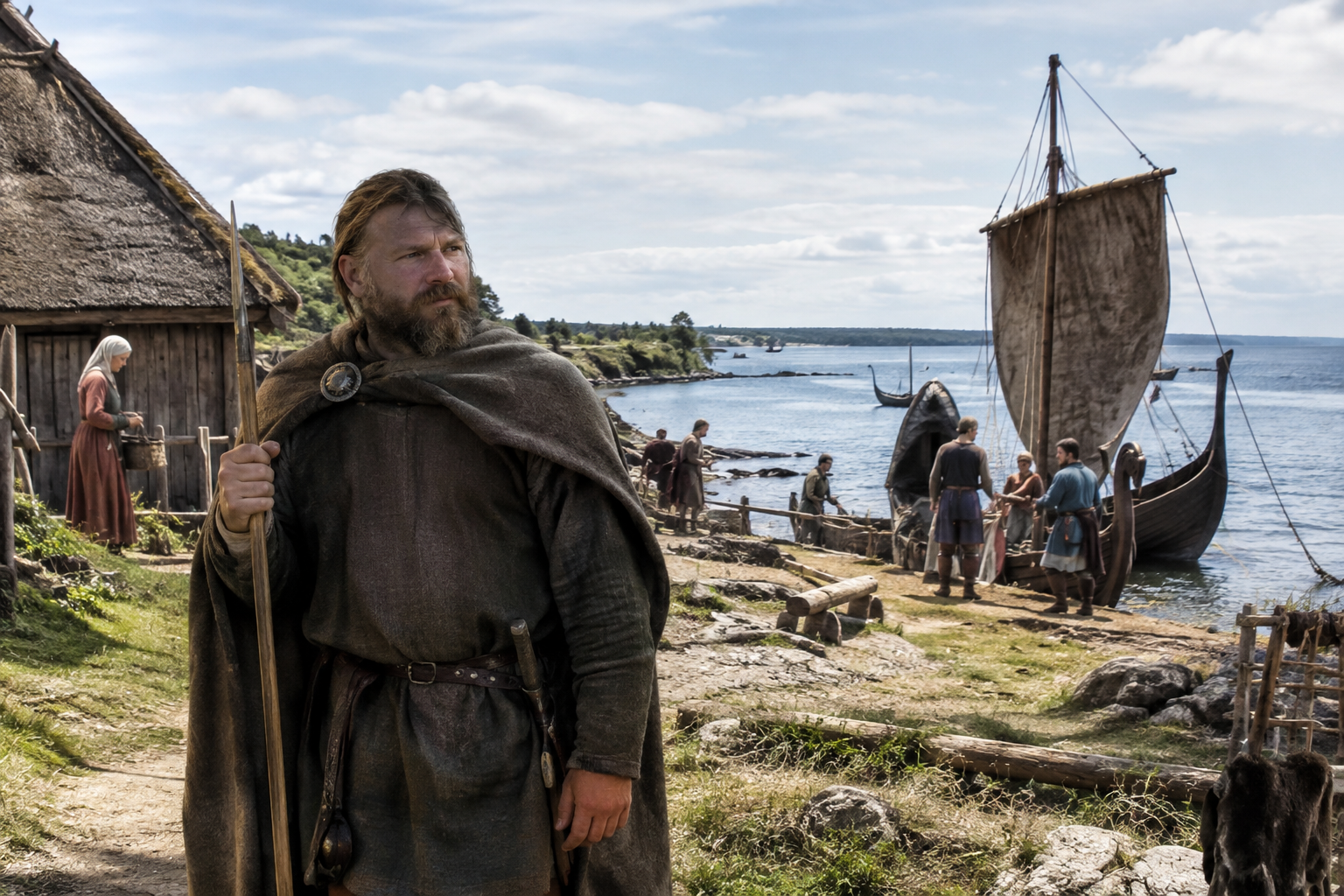
At Kopparsvik on Gotland, one Viking Age burial has a particular knack for unsettling easy assumptions. The individual known as VK474, dated to around AD 975, belonged to a world we often label simply as "Viking" and imagine as genetically uniform, Scandinavian, and straightforwardly northern. Yet this man was reported under the Y-DNA branch E1b1b1b2a1a6d1, a lineage whose deeper roots lie well outside the usual stereotype of a Viking paternal line.
That is exactly why the sample matters. A Y-chromosome lineage traces one direct paternal line only, not a whole person's ancestry or identity, but even that narrow thread can be historically revealing. In late 10th-century Gotland, a trading island tied into the Baltic, Rus', and wider European exchange, VK474 hints at the kind of movement, mixing, and family histories that archaeology has been uncovering for years.
Gotland was not a remote fringe. It sat at the center of Baltic traffic, with strong commercial and cultural links stretching eastward and westward alike. By the late Viking Age, its inhabitants lived in a landscape shaped by trade, seafaring, local power, and changing religious customs.
Kopparsvik, near Visby, has become one of the island's important burial grounds for understanding this period. The date given for VK474, around AD 975, places him in the closing generations of the Viking Age, when Scandinavian societies were deeply entangled with long-distance exchange networks. A lineage like E1b1b1b2a1a6d1 appearing in that setting is not evidence of a single dramatic migration event, but it does fit a world in which men, families, and descendants could move astonishing distances over a few generations.
An ancient DNA study of Viking Age populations, available at https://www.biorxiv.org/content/10.1101/703405v1, helped bring exactly this kind of complexity into focus. One of the broad lessons of such work is that Viking Age communities were not genetically identical blocks. They were networks, and networks have edges, arrivals, marriages, adopted identities, and inherited lineages that do not always match modern expectations.
The formidable string of letters and numbers matters because it is very specific. E1b1b1b2a1a6d1 is not just any branch of Y-DNA haplogroup E; it is a narrow twig on a much larger paternal tree. That larger tree, usually discussed under broader E1b1b or E-M215 labels in genetic literature, has a long history in parts of North Africa, the Mediterranean, and the Near East, with later spread into many parts of Europe.
But one has to be careful here. The presence of VK474 on this precise branch does not let us assign him a simple ethnic label, nor does it mean that every man in this subclade followed one neat migration route into Scandinavia. The historically responsible point is narrower and more interesting: by the late 10th century, at least one paternal line on Gotland belonged to a branch more often associated with southern or southeastern connections than with the classic northern Y-DNA profile people tend to expect from Viking cemeteries.
That distinction between the broad parent haplogroup and the exact subclade is crucial. Broad E1b1b has a vast and varied history. E1b1b1b2a1a6d1 is a much finer assignment, and without a larger cluster of securely published ancient examples on the same branch, it is wiser to treat VK474 as a precise data point rather than the founder of some sweeping historical theory.
If this sounds unexpected, the archaeology of the Viking world says it should not. Scandinavia in the Viking Age was plugged into routes reaching the British Isles, the Frankish world, the Baltic, the rivers of eastern Europe, Byzantium, and the Islamic world. Goods moved along these routes, but so did people: merchants, captives, mercenaries, spouses, servants, settlers, and children born into already mixed communities.
Gotland in particular was famous for its eastern ties. Silver, beads, scales, weights, and other material evidence from the island have long pointed to intense contact across the Baltic and beyond. In that context, a paternal lineage with deeper roots outside Scandinavia is not an anomaly crying out for a fantastic explanation. It is the sort of detail that makes the Viking Age more historically real and less mythic.
One should also remember how lineages travel. A branch like E1b1b1b2a1a6d1 need not represent a recent immigrant arriving directly on Gotland from the Mediterranean or North Africa. The paternal line behind VK474 may have entered northern Europe generations earlier, through continental trade zones, frontier armies, mixed towns, or earlier mobility around the Baltic and eastern Europe. By AD 975, the man buried at Kopparsvik may have been entirely local in language and culture while still carrying a Y-chromosome with a much longer geographic backstory.
It is worth pausing on the island itself. Gotland often appears in popular history as a Scandinavian place par excellence, and of course it was. But islands can be deceptive. They look bounded on maps, while in practice they can function as hubs. Gotland's importance came precisely from being reachable, connected, and commercially useful.
That matters for interpreting VK474. The burial does not stand for all Viking Age Gotlanders, and one sample never defines a whole population. Yet it fits a wider archaeological picture in which the Baltic was not a barrier but a highway. The people buried there were part of communities shaped by exchange over generations, and their genomes can preserve that story even when the grave itself does not announce it in spectacular fashion.
This is one reason ancient DNA has been so transformative for early medieval studies. It does not replace archaeology; it sharpens it. Where older narratives often divided people into tidy blocks such as Scandinavian, Slavic, Finnic, or steppe, genetic evidence keeps reminding us that real communities were messier, more local, and more entangled.
Baltic Connections in the Early Middle Ages
For someone who carries E1b1b1b2a1a6d1 today, VK474 offers something valuable even in isolation: a securely ancient appearance of this paternal branch in Viking Age Sweden, on Gotland, by around AD 975. That is not a claim of close kinship, still less a promise of descent from a named Viking. It is, however, a real historical anchor showing that this lineage had reached one of the most connected places in the Baltic world by the end of the 10th century.
The larger lesson is not that Viking identity belonged to one haplogroup or another. It is that Viking Age societies could absorb and reproduce lineages from far beyond Scandinavia, until those lines became part of local history. VK474 is interesting for precisely that reason: he turns the Viking world from a stereotype into a lived human landscape, full of inherited pasts meeting on one island.
The most distinctive thing about E1b1b1b2a1a6d1 in this case is not grandeur but placement. A late Viking Age man from Kopparsvik, VK474, shows this paternal branch present on Gotland at a time when the island stood at the heart of Baltic exchange. For modern descendants of the same line, that is a useful and concrete historical signal: your direct paternal ancestry belongs to a branch that had already entered the mixed, mobile, and outward-looking world of Viking Age Scandinavia.





Comments