Haplogroup E1b1b1b2a1a1a

– 6 min read


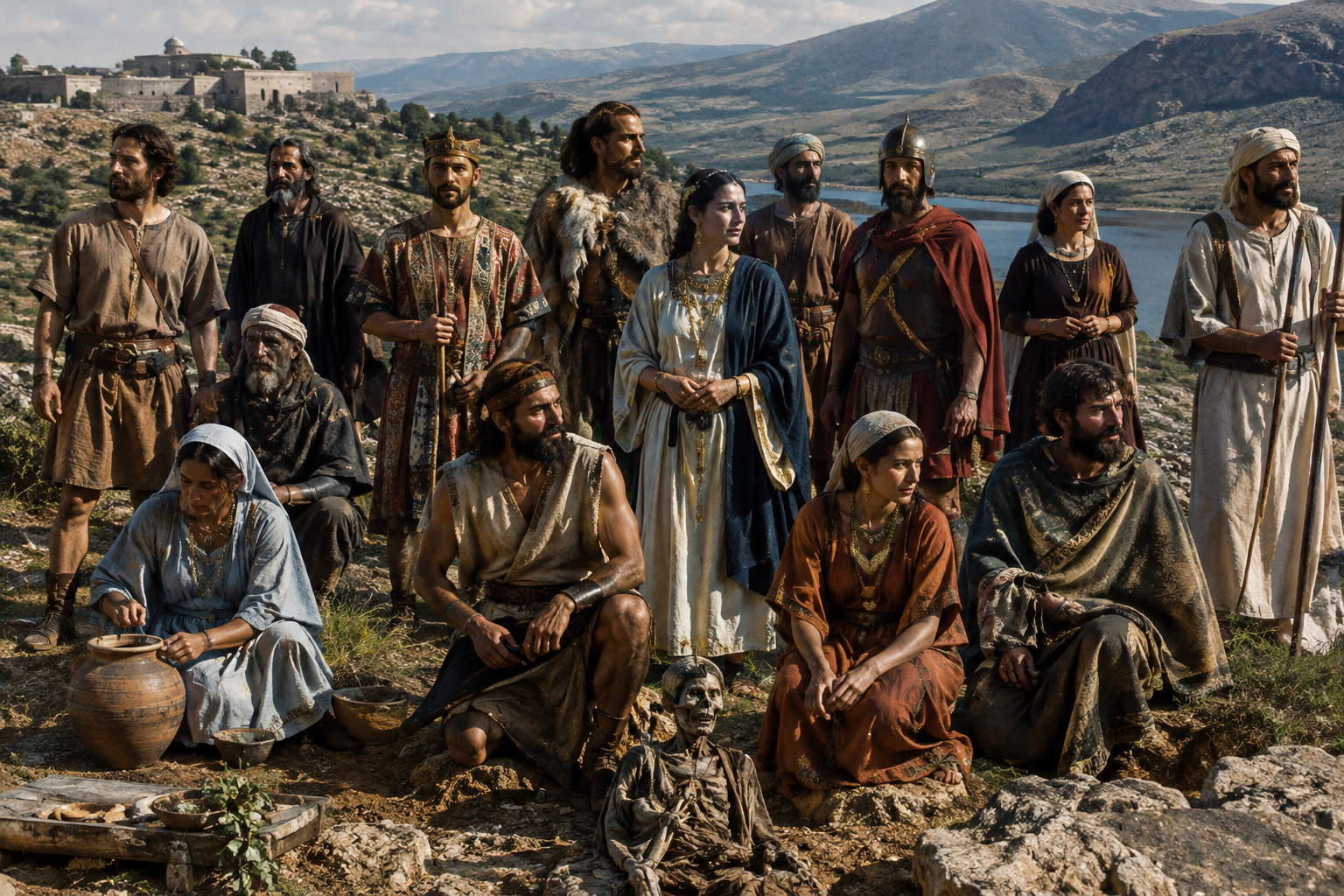
Some Y-DNA haplogroups seem to sit neatly inside a single historical box. E1b1b1b2a1a1a does not. That is precisely what makes it so interesting. When this paternal line turns up in ancient DNA, it appears not in one tidy homeland story, but across a broad arc of the ancient world: Syria, Canaan, Anatolia, Armenia, Sicily, Hungary, Portugal, France, Sardinia, and even farther east in the case of one medieval sample from Skeleton Lake. It belongs to one of those lineages that reminds us how badly human history resists simple borders.
It is worth saying at once what a Y-DNA haplogroup can and cannot do. A Y haplogroup traces one direct paternal line only: father to father to father. It does not describe a person's whole ancestry, culture, language, or identity. Nor does a match to a haplogroup prove descent from a famous dynasty. Still, paternal lines are powerful historical clues. They can reveal movement, survival, and regional continuity in ways that written records often cannot.
E1b1b1b2a1a1a is a very specific downstream branch within the wider E1b1b family, itself part of a major Y-chromosome lineage with deep importance in Africa, the Mediterranean, and western Eurasia. For a narrow branch like this one, caution is essential: we should not simply pour the whole history of broad E1b1b into it as if nothing changed along the way. But the ancient evidence supplied here does suggest something important. This branch, or closely related paternal lines, was present in societies linked to the eastern Mediterranean, the Near East, the South Caucasus, and later parts of Europe.
That matters because the ancient world was full of corridors rather than compartments. Merchants, soldiers, migrants, captives, pilgrims, and ruling elites all moved along routes joining the Levant, Anatolia, Armenia, the Aegean, Italy, Iberia, and beyond. A haplogroup such as E1b1b1b2a1a1a seems to have travelled in that sort of world: one shaped by cities, empires, frontier zones, and maritime exchange.
If you want a broader introduction to how ancient DNA helps reconstruct such long and complicated stories, MyTrueAncestry's article on archaeogenetics is a useful companion.
The oldest anchors in this dataset come from the Bronze Age Near East and South Caucasus, and they are striking. Sample ETM010 from Middle Bronze Age Ebla, Tell Mardikh, Syria, dated to 2600 BC, places this paternal lineage in one of the great urban settings of the ancient Near East. Ebla was not an isolated village. It was a palace-centered kingdom tied into diplomacy, trade, and the movements of people across Syria and Mesopotamia.
Then there is I10770 from Elite Grave II, Late Bronze Age Canaanite Megiddo, dated to 1500 BC. Megiddo, famous in both archaeology and historical memory, was a place of power, war, and administration. The word "elite" in the burial context matters. It does not prove a dynasty, still less a modern family connection, but it does show that this paternal line could be found in socially prominent settings.
Another early appearance comes from I4614, Early Bronze Age Southeast Anatolia, Tatika, dated to 2100 BC. Add to that the Armenian samples I15732 from Pre-Urartian Late Bronze Age Armenia, Nerkin-Getashen Gegharkunuk, dated to 1368 BC, and R11675 from Bronze Age Armenia, Beniamin, dated to 1420 BC. These finds suggest that related paternal lines were not fleeting arrivals in one single place, but part of a broader zone linking northern Mesopotamia, eastern Anatolia, and the South Caucasus over many centuries.
This is the sort of evidence that makes grand ethnic labels look rather clumsy. What we can say responsibly is that E1b1b1b2a1a1a appears in regions central to Bronze Age state formation, long-distance exchange, and cultural contact.
Readers interested in that Caucasus background may enjoy this related study of regional continuity and change.
Read South Caucasus DNA History
By the Iron Age and classical world, the pattern becomes even more Mediterranean. Sample I20444 from Parthian Empire Armenia, Sarukhan, dated to 75 BC, shows continuity or renewed presence in Armenia under imperial conditions. Armenia at this date was not some sealed mountain refuge. It stood between Roman, Parthian, and older local traditions, absorbing influences from several directions.
Then comes I24556 from Carthaginian Italy Sicily Birgi, dated to 542 BC. This is one of the most revealing samples in the set because Sicily was one of the great meeting grounds of the ancient Mediterranean: Phoenician and Punic networks, Greek colonists, indigenous communities, and later Roman power. A lineage turning up in a Carthaginian context at Birgi fits beautifully with a world of maritime connectivity rather than local isolation.
That does not mean one can label the haplogroup "Carthaginian" or "Phoenician" in any simple sense. Haplogroups do not belong to civilizations in that tidy way. But the Birgi sample does show that this paternal line had reached, or persisted in, the central Mediterranean by the first millennium BC.
For readers who want more on that Punic setting, this MyTrueAncestry piece is a natural next stop.
The later samples show something equally important: survival and movement into post-Roman and medieval Europe. MFC017, from Post Roman Period Pannonia Arrabona Menfocsanak Barbaricum Hungary, dated to 550 AD, appears in a frontier world shaped by the collapse of Roman structures and the reshuffling of peoples in central Europe. Again, this does not identify an ethnicity. It does show that the paternal line was present in a zone where Roman, post-Roman, and so-called barbarian populations mixed in complicated ways.
CGG023722 from Early Medieval France Burgundy Camp du Chateau, dated to 733 AD, pushes the story westward into Francia. Burgundy in this period stood at the crossroads of Roman inheritance, Frankish rule, and local continuity. I12221 from Medieval La Palma Sardinia, dated to 941 AD, adds an island context in the western Mediterranean, while LP115_6 from Medieval Portugal Umayyad Caliphate Loule Quinta da Boavista, dated to 1250 AD, brings the lineage into Iberia during the era of Muslim and Christian political overlap.
That Portuguese sample is especially evocative. Loulé in the Algarve lay in a region shaped by Islamic rule, trade across the western Mediterranean, and then the Christian advance. A Y-line appearing there in 1250 AD sits neatly within the known historical reality of Iberia as a place of layered ancestry and cultural encounter.
The most geographically unexpected sample in the list is I3346, Skeleton Lake Sindhi Worshipper, dated to 830 AD. One should be careful here: a far-flung appearance does not automatically map a continuous single migration route. But it is a reminder that some paternal branches could travel surprisingly far across interconnected premodern worlds.
For more on Iberia's layered past, especially where Roman and later histories overlap, this article is well worth exploring.
Explore Roman Hispania's Legacy
The supplied noble connection brings us to the House of Curiel and the Castle of Curiel de Duero in Castile. Here one must keep one's head. A historical association between a family and a haplogroup is not proof that every bearer of the surname, still less every branch of the family, shared one exact Y-DNA line. Medieval lineages were never genetically simple. Adoption, illegitimacy, collateral branches, and documentary confusion all have their part in aristocratic history as much as in any other.
Still, Curiel de Duero offers a splendid historical frame for thinking about this lineage in Iberia. The castle stands above the Duero valley and claims a past reaching back to Roman times, though its role becomes clearer in the early Middle Ages when it formed part of the frontier between Christian and Muslim powers in Castile. That frontier setting is the key. This was a zone of contest, negotiation, rebuilding, and lordship, not a fixed edge on a modern map.
Rebuilt and strengthened across the centuries, the castle passed through the hands of kings, nobles, and powerful lineages. Later it became associated with the counts of Penafiel and other magnates. In other words, this was a place where military strength, landholding, and family ambition all met. By the modern period its strategic role declined, and like many Iberian castles it went through ruin, reuse, and restoration. Yet its survival still preserves the memory of a region shaped by long political and cultural change.
That makes Curiel de Duero a useful companion to the medieval Portuguese sample LP115_6. Not because one proves the other, and certainly not because an ancient or medieval haplogroup can identify a specific noble house, but because both belong to the same broad Iberian story: a peninsula where paternal lines from older Mediterranean and Near Eastern-connected worlds could persist, merge, and reappear under Roman, Islamic, and Christian rule.
Readers who want the fuller family and regional context can continue with MyTrueAncestry's dedicated feature on the house itself.
Read About the House of Curiel
E1b1b1b2a1a1a is interesting not because it delivers a single neat origin story, but because it refuses one. The ancient samples supplied here place it in Bronze Age urban Syria, elite Canaanite Megiddo, Anatolia, Armenia, Punic Sicily, post-Roman Hungary, early medieval France, Sardinia, medieval Portugal, and beyond. That distribution suggests a paternal line at home in networks of movement across the Near East and Mediterranean, and later in parts of Europe touched by empire, trade, and frontier society.
For family historians, that is both exciting and sobering. A haplogroup can illuminate one direct paternal thread across immense stretches of time, but it cannot by itself tell you your civilization, your ethnicity, or your noble house. What it can do is place your paternal line in a wider human story, one that written pedigrees alone rarely capture.
If your own Y-DNA belongs near this branch, or if your autosomal DNA shows affinities with the kinds of ancient populations discussed here, MyTrueAncestry can help you explore those connections through ancient DNA comparisons. Such matches do not prove direct descent from ETM010, I10770, LP115_6, or the House of Curiel. But they can offer a remarkable sense of where your ancestry sits in the long, untidy, fascinating history of the ancient world.






Comments