Haplogroup E1b1b1b1a1c12

– 6 min read


Some Y-chromosome lineages announce themselves with a vast archive of ancient samples and famous royal identifications. Others are more elusive, turning up in places that remind us how complicated the past really was. Haplogroup E1b1b1b1a1c12 belongs to that second category. It is a very specific branch within the wider E1b1b family, a paternal lineage whose broader story is often associated with parts of North Africa, the Mediterranean, and the Near East, but whose narrower branches can appear in very particular regional and historical settings.
That is worth pausing over, because Y-DNA can be both illuminating and misleading if handled carelessly. A Y-haplogroup traces one direct paternal line only: father to father to father. It does not describe a person's whole ancestry, culture, language, or identity. Still, when a branch like E1b1b1b1a1c12 appears in ancient DNA, it gives us one very sharp line of evidence for male-line movement across landscapes, ports, kingdoms, and households that written history often records only imperfectly.
The wider E1b1b family has long interested population geneticists because of its strong associations with the southern and eastern Mediterranean world. In broad terms, branches of E1b1b have been discussed in connection with movements linking North Africa, the Balkans, the Aegean, southern Italy, and the Levant. But one of the first rules of good archaeogenetics is not to pour the whole history of a large haplogroup into a tiny downstream twig. A branch as specific as E1b1b1b1a1c12 may represent a much later and more local paternal history than the older parent lineage from which it descends.
That is exactly why such subclades are so interesting. They remind us that the Mediterranean was not a neat mosaic of isolated peoples. It was a zone of sailors, soldiers, traders, scholars, converts, mercenaries, captives, and families making new lives in new ports. Sicily, southern Iberia, and parts of Britain all sat, in different ways, at the edges of that connected world.
Explore North Africa's Deep Genetic History
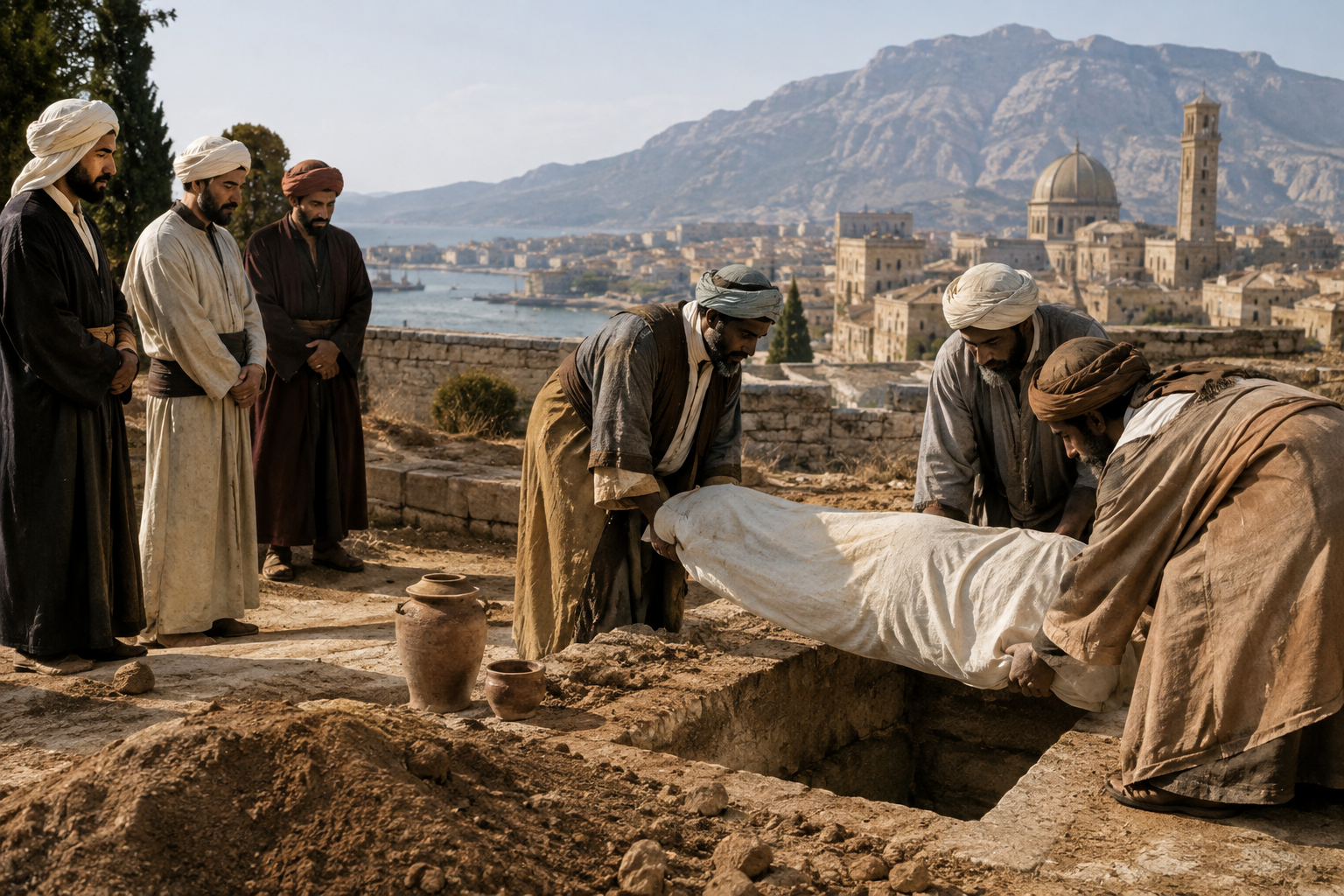
The most important anchor point supplied here is an ancient individual from Sicily: Ancient Individual:Medieval Sicily Palermo La Gancia Islamic Burial Year:828 AD ID:GABN5b. Even at first glance, that description opens a remarkable historical window.
Palermo in the early ninth century was entering one of the most transformative moments in its history. The Islamic conquest of Sicily began in 827, and Palermo would soon become one of the great cities of the medieval Mediterranean. A burial from 828 AD, especially one explicitly described as an Islamic Burial, belongs to that unsettled, dynamic frontier when political power, religion, language, and population were all in motion.
Sample GABN5b matters because it places this paternal branch, or a lineage associated closely enough with the target haplogroup for inclusion here, in exactly the kind of cosmopolitan setting where we would expect male-line diversity to become visible. Palermo was not merely "Arab" in any simple ethnic sense. It was a city shaped by local Sicilian populations, Byzantine legacies, newcomers from across the Islamic world, and long-standing Mediterranean exchange. Ancient DNA from such burials does not let us assign a tidy label to one man. What it does allow is something more interesting: it shows how paternal lines moved within real historical transformations.
That is especially useful with a lineage like E1b1b1b1a1c12. Rather than imagining a single heroic migration, it is better to think in terms of overlapping routes: maritime corridors, garrison networks, commercial settlements, and the ordinary reproductive histories of men who lived in port cities. One burial in Palermo cannot tell the whole story, but it can show that this line belonged to the human mixture of medieval Sicily.
Discover Medieval Sicily's Multi-Faith DNA
If one wanted to design a place for testing how paternal lineages survive and mingle through conquest, trade, and religious change, one could hardly do better than Sicily. Greeks, Phoenicians, Romans, Byzantines, Muslims, Normans, and later Latin Christian elites all left their mark there. The result was not a clean replacement of one population by another, but repeated episodes of layering and reshaping.
That makes Sicily especially important for understanding the wider context of E1b1b-related paternal lines. Some branches of the broader haplogroup have often been linked, in general terms, with Mediterranean and Balkan distributions. In Sicily, ancient DNA has increasingly shown that these broad distributions were not abstract map patterns. They were lived realities in households, cemeteries, and neighborhoods where ancestry could be mixed and identities situational.
The sample GABN5b therefore stands not as proof of a direct line to any later family, but as evidence that one male lineage associated with this haplogroup was present in a strategic island crossroads at a time when the central Mediterranean was being politically reconfigured. That is already a great deal.
Read About Genetic Diversity in Medieval Sicily
At first sight, the supplied noble connection seems to come from another world entirely: the House of Berkeley and Berkeley Castle in Gloucestershire. Yet the medieval world was full of such apparent contrasts. Sicily and Gloucestershire were not neighbors, but they were both drawn into the great reshaping of the eleventh and twelfth centuries by Norman expansion.
Berkeley Castle began as a Norman motte and bailey stronghold after 1067. Later, from the late twelfth century, it was rebuilt in stone by Robert Fitzharding, whose family became the Berkeleys and held the castle for most of its history. The place is famous above all as the prison of Edward II in 1327, and tradition long maintained that he died there, though historians still argue over the details. Like so many important castles, Berkeley was never only a military structure. It was a statement of lordship, continuity, ambition, and survival.
Over the centuries the castle was fortified, altered, and partly slighted after the English Civil War, yet it endured as a great aristocratic house rather than collapsing into picturesque ruin. That survival matters. Berkeley Castle preserves the physical memory of a family line embedded in the politics of the English crown, the fortunes of Norman and post-Norman aristocracy, and the long negotiation between violence and domesticity that shaped elite life.
Now, to be very clear, the existence of the House of Berkeley alongside this haplogroup input does not prove that the Berkeley male line carried E1b1b1b1a1c12, nor that any ancient Sicilian individual was ancestrally connected to them in a documented genealogical sense. That would be far too strong a claim. But the pairing is still suggestive in a broader historical way. Norman networks linked England, southern Italy, and Sicily into a larger political world. The same medieval centuries that gave us Palermo's mixed Islamic and post-Byzantine population also gave us aristocratic houses in England whose fortunes were shaped by continental and Mediterranean currents.
There is a temptation, always, to turn a haplogroup into a family badge. But history is less tidy than heraldry. Castles such as Berkeley preserve names, properties, documents, and political memory. Y-DNA preserves one narrow biological thread. The excitement lies in bringing those archives into conversation without pretending they are the same thing.
An ancient burial like GABN5b shows that a paternal lineage related to the target haplogroup existed in an Islamic burial context in Palermo in 828 AD. A castle like Berkeley shows how later medieval elite families anchored themselves in stone, landholding, and record-keeping. Between the two lies the real work of historical interpretation: mobility, continuity, conversion, marriage, service, and migration across many generations.
That is why Y-DNA haplogroups are so useful when treated carefully. They do not prove that one is descended from a king, a Norman lord, or a man buried in medieval Sicily. They do, however, reveal that paternal ancestry has a geography and a history. Some lines remained regionally stable for long periods. Others crossed seas and political frontiers. E1b1b1b1a1c12 is interesting precisely because its wider family points us toward the Mediterranean world, while the evidence here places us in one of that world's most revealing crossroads.
Readers interested in how Norman-period population change played out in England may also enjoy the growing body of ancient DNA work on post-Conquest Britain, where written history and biological evidence do not always line up as neatly as older narratives assumed.
So what does E1b1b1b1a1c12 reveal? Not a single origin myth, and not a shortcut to aristocratic descent. Something better, in fact: a glimpse of how one paternal branch belongs to the complicated making of the Mediterranean and medieval worlds. Through the sample GABN5b, we can place this lineage in Palermo at a moment of profound transition. Through the Berkeley connection, we can reflect on how later medieval power was rooted in castles, dynasties, and written record, even while deeper paternal histories often ran far beyond what those records could see.
That is one of the best lessons of archaeogenetics. DNA does not replace history. It gives history new witnesses.
If your own Y-DNA belongs to a rare or highly specific branch, MyTrueAncestry can help place it beside ancient individuals, archaeological sites, and historical populations. Those comparisons may offer striking clues about the deep past of your paternal line, even when they do not prove direct descent from any one ancient person or noble house.






Comments