Haplogroup E1b1b1a1b1a6a1c

– 9 min read


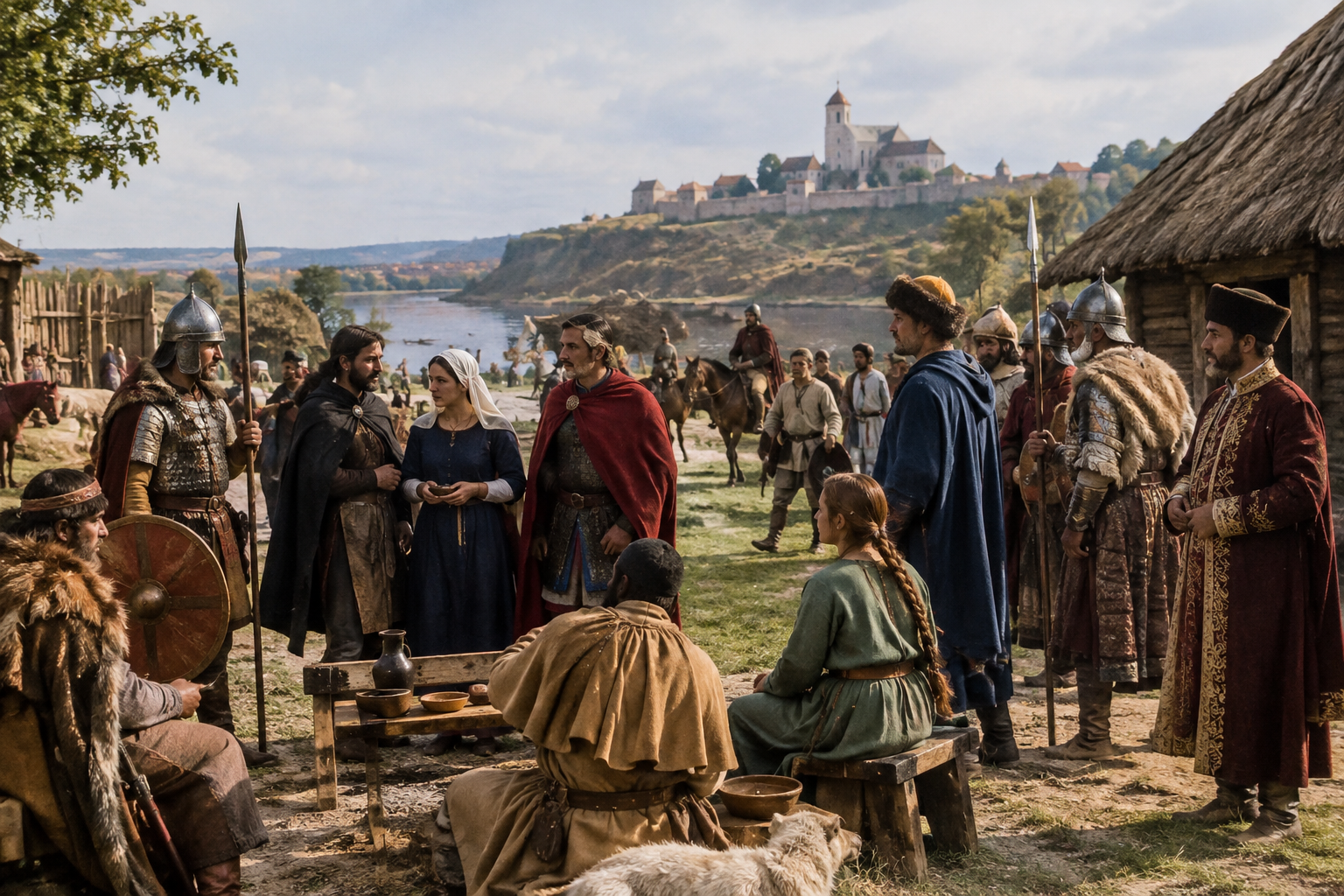
Some Y-DNA haplogroups announce themselves with a trumpet blast. Others appear more like a trail of footprints half-hidden in the mud of history: a burial in Roman Serbia, a man on the Carolingian frontier, a late antique individual in Spain, two brothers of the Hunyadi line. Haplogroup E1b1b1a1b1a6a1c belongs to that second category. It is interesting not because it can be tied neatly to one people, one kingdom, or one migration, but because the evidence we have places it in exactly the sort of crossroads where history was made.
That is worth pausing over. Y-DNA haplogroups trace a direct paternal line only: father to father to father across many generations. They do not describe a person's whole ancestry, culture, language, or identity. Still, paternal lineages can be extraordinarily useful. They let us watch one narrow thread pass through changing worlds, and in the case of E1b1b1a1b1a6a1c, that thread turns up in the Balkans, the Carpathian Basin, Central Europe, Iberia, and even in documented late medieval dynastic remains.
This haplogroup sits inside the wider E1b1b family, one of the major Y-chromosome lineages with a long and complicated history across parts of Africa, the Mediterranean, and Europe. For a branch as specific as E1b1b1a1b1a6a1c, however, it would be careless simply to pour the whole grand history of E1b1b into it and call the matter settled. What the narrower branch really offers is a more focused historical problem: how did this paternal line come to be represented across such a broad swathe of late ancient and medieval Europe, with one sample also appearing farther east in Central Asia?
The safest answer is that this is a lineage associated with zones of contact. The sample list does not point to one isolated homeland. Instead, it suggests circulation through regions shaped by imperial frontiers, trade routes, military movement, migration-period reshuffling, and medieval political consolidation. The Balkans and the Carpathian Basin stand out especially strongly, but not alone.
Explore Ancient DNA and Archaeogenetics
Begin in the Roman and post-Roman Balkans, because that is where this haplogroup becomes especially vivid. The sample I15495, from the Late Roman Empire Viminacium Serbia Pirivoj Necropolis, dated 150 AD, places the lineage in one of the great military and administrative landscapes of the Roman Danube. Viminacium was not a sleepy village at the edge of nowhere. It was a serious frontier center, connected to soldiers, merchants, officials, and migrants moving through the empire.
Then there is I27297 from Post Roman Era Serbia Kormadin Jakovo, dated 450 AD, and I15537 from Medieval Era Serbia Timacum Kuline Ravna Village, dated 900 AD. Taken together, these do not prove uninterrupted descent from one man to another; ancient DNA almost never allows such easy storytelling. But they do show the same paternal branch turning up in the same broad region across the Roman, post-Roman, and medieval periods. That is precisely the kind of pattern that makes historians sit up. It suggests either long regional persistence, repeated arrivals from nearby populations carrying the same lineage, or a combination of both.
North of the Balkans, the Carpathian Basin offers another cluster. Hung148 and Hung152, from Scythian Age Hungary Kesznyeten-Szeruskert and Western Scythian Hungary Kesznyeten-Szeruskert, both dated 150 BC, show this paternal line in Iron Age Hungary. One should be cautious here: sharing a haplogroup with individuals from a Scythian Age context does not make the lineage "Scythian" in any simple ethnic sense. But it does place it in the steppe-facing world of the eastern Carpathian Basin well before the Middle Ages.
That same region reappears in the early medieval period with AHPS206W from Medieval Hungary Carolingian Border Bodajk Homoki dulo, dated 800 AD. The phrase "Carolingian Border" matters. Borders are where armies assemble, where settlers arrive, where loyalties shift, and where local and incoming populations are folded into new political orders. If one were looking for a setting in which an old paternal lineage might persist while the world around it changed names and rulers, this would do nicely.
Read About Iron Age Scythian Elites
The lineage does not stay put. Two individuals from the Early Medieval Austria Csokorgasse Vienna Basin, CSK001 and CSK002, both dated 650 AD, place it in the Vienna Basin, another classic transit corridor between the Danube world, Central Europe, and the lands to the southeast. If the Balkans and Hungary show continuity across time, the Austrian samples show how easily that same paternal line could belong within the mixed populations of the early medieval frontier zone.
To the west, I20400 from Late Roman Early Migration Spain Girona Sarria de Ter Pla de lHorta, dated 475 AD, is a reminder that late antiquity was not merely a story of "Romans" replaced by "barbarians." It was a period of startling human mobility. A paternal lineage found in the Balkans and Central Europe also turns up in northeastern Iberia during the age when imperial rule was fragmenting and new powers were emerging.
And then there is BRC043x, from Migration Period Roman Outlier Germany Saxony-Anhalt Bruecken, dated 500 AD. The label "Roman Outlier" is wonderfully suggestive. It hints at a man whose ancestry or paternal background did not fit the local norm, and that is exactly the point. Ancient DNA keeps showing us that migration-period Europe was not made up of sealed ethnic boxes. It was full of people whose family histories ran across older imperial routes.
Most surprising of all is KNT001 from Otyrar culture Konyr Tobe, dated 300 AD. That does not mean this whole haplogroup "came from Central Asia," nor that every western occurrence must be explained from the east. But it does show that by late antiquity, related paternal branches could be present across a huge arc of Eurasia. For anyone interested in steppe corridors, frontier trade, and military networks, that eastern sample is a useful warning against tidy maps.
Discover Roman Hispania's Genetic Legacy
The most dramatic named historical association in this dataset comes much later, with Johannes Corvinus (CJM, 1504 AD) and Christopher Corvinus (CKM, 1506 AD) of the Hunyadi Dynasty. Here the haplogroup stops being only an archaeological pattern and enters the documented world of dynasty, inheritance, and political ambition.
That is a rare pleasure in ancient DNA: the moment when bones from a grave can be discussed alongside named figures from written history. Still, care is needed. A genetic association with these individuals does not prove that every member of the Hunyadi family carried this same paternal line, and it certainly does not mean that everyone with this haplogroup descends from the Hunyadis. What it does provide is a firmly historical anchor for the lineage in the late medieval Kingdom of Hungary.
The architectural counterpart to that story is Corvin Castle, also called Hunyadi Castle, at Hunedoara in Transylvania. Much of what stands today was built in the fifteenth century by John Hunyadi after his rise to power in the Kingdom of Hungary. The castle developed from an older fort into a Gothic and Renaissance stronghold with towers, halls, bridges, and a striking courtyard. It was both noble residence and defensive fortress, which tells you something important about the world the Hunyadis inhabited: politics was not conducted from drawing rooms alone, but from fortified landscapes where rank, warfare, and lordship were physically built into stone.
Over the centuries the castle suffered damage from fires, wars, and neglect, then acquired much of its romantic appearance through nineteenth-century restoration. Legends attached themselves to it too, including the doubtful but famous tale that Vlad the Impaler was once imprisoned there. Whether or not one believes the legend, the castle remains a monument to the kind of late medieval power structure into which this paternal lineage unexpectedly enters the record.
Explore the Royal House of Hunyadi
Once the ancient and early medieval evidence is set out, it is worth noting that this paternal lineage also brushes up against the far better documented world of later aristocratic history. That does not turn genetics into a medieval family tree, and it does not erase all the usual cautions. But it does allow one of those rare moments when a haplogroup can be discussed not only through cemeteries and sample codes, but through a dynasty whose ambitions and residences are recorded in the written sources.
The clearest later historical association here is the Hunyadi Dynasty, one of the most important ruling houses of the late medieval Kingdom of Hungary. In this case, the connection rests on the reported paternal-line evidence from Johannes Corvinus and Christopher Corvinus, which links this haplogroup to two documented members of the Hunyadi line. That is significant not because it turns the haplogroup into a dynastic label, but because it places the lineage within a family that stood at the center of power in the Carpathian Basin and Transylvania.
The Hunyadis are historically compelling precisely because they rose in a frontier world. Their story belongs to the lands between the Balkans and Central Europe, where military service, noble office, and regional lordship could transform a family into a dynasty. John Hunyadi, the great military figure of the line, became one of the defining statesmen and war leaders of fifteenth-century Hungary. His family operated in a political landscape shaped by Ottoman expansion, shifting aristocratic alliances, and the defensive burdens of a kingdom whose southern approaches mattered to all of Europe.
The later Corvinus branch, represented by Johannes and Christopher in the genetic record, gives this haplogroup an unusually tangible place in late medieval history. Instead of dealing only with anonymous men from burial grounds, we are suddenly in the presence of named aristocrats connected to inheritance, legitimacy, and dynastic memory. Even so, the responsible conclusion is a limited one: this haplogroup is associated with documented members of the Hunyadi paternal line, not automatically with every bearer of the Hunyadi name, nor with all noble families of Hungary more broadly.
What makes the Hunyadi connection so interesting is that it fits the larger pattern already seen in the ancient DNA. The lineage appears repeatedly in the Balkans and the Carpathian Basin long before the late Middle Ages, and then reappears in a dynasty rooted in that same broad historical zone. That is not proof of a simple unbroken pedigree from antiquity to the Hunyadi court. It is, however, a striking example of how one paternal branch can remain visible across very different layers of European history.
The most important stronghold associated with this haplogroup through the Hunyadi connection is Corvin Castle in Hunedoara, Romania. Begun in the fifteenth century by John Hunyadi on the site of an older fort, it grew into one of the great Gothic and Renaissance castles of Transylvania. That alone tells us something useful. The Hunyadis were not minor local gentry tucked away in a provincial manor; they were a family whose authority could be expressed through one of the region's most imposing fortified residences.
Castles are often treated as if they were simply picturesque backdrops, but in the medieval kingdom of Hungary and in Transylvania they were instruments of power. Corvin Castle was both a noble residence and a fortress. It stood for lordship, military preparedness, and control over surrounding territory. In other words, it was exactly the kind of place from which a rising dynasty could project rank and authority in a contested political landscape.
Over the centuries, Corvin Castle passed through decline as well as prominence. It served for generations, later fell into neglect, and was restored in the nineteenth century, helping create the dramatic landmark seen today. That long afterlife matters because it has preserved a real architectural setting for a family now discussed not only in chronicles and royal politics, but also in Y-DNA terms through Johannes Corvinus and Christopher Corvinus.
None of this means that a castle proves a genetic link. Stones are not chromosomes. But places like Corvin Castle provide something archaeology and genetics cannot supply on their own: a physical sense of the world inhabited by a dynasty associated with this lineage. For readers exploring paternal ancestry, it offers a rare and memorable point where documentary history, noble residence, and genetic evidence briefly meet.
If we gather the evidence together, E1b1b1a1b1a6a1c looks less like the badge of one people than the signature of a connected zone stretching through the Balkans, the Carpathian Basin, Central Europe, and beyond. Its appearances in Roman Serbia, post-Roman and medieval Serbia, Iron Age and medieval Hungary, early medieval Austria, migration-era Germany, late antique Spain, and the Hunyadi dynasty suggest a paternal history shaped by movement and survival in politically unstable but deeply connected regions.
That is one of the great lessons of Y-DNA. Written genealogy usually begins late and favors the powerful. Ancient DNA starts earlier and is democratic in a quite ruthless way: soldier, border settler, noble heir, cemetery outlier, all can appear in the record if their remains survive and their DNA can be read. But ancient DNA also has limits. A shared haplogroup is not proof of close kinship. It cannot by itself assign language, identity, or noble status. What it can do is show that the men of the past carried lineages through upheavals that written history only partly records.
For MyTrueAncestry users, that is where the fascination lies. You may not find a neat story with a single origin point and a straight road to a castle gate. You may find something more interesting: a paternal line that moved through Roman cemeteries, medieval borderlands, and dynastic households, leaving clues in places where archaeology and history meet.
If you want to see whether your own DNA shows links to ancient individuals like I15495, Hung148, AHPS206W, or the later Hunyadi-associated samples CJM and CKM, upload your results to MyTrueAncestry. Ancient DNA matches can offer remarkable historical context for your ancestry, even when they do not prove direct descent from a named family or ruler.


Comments