Haplogroup E1b1b1a1b1a5a1

– 5 min read


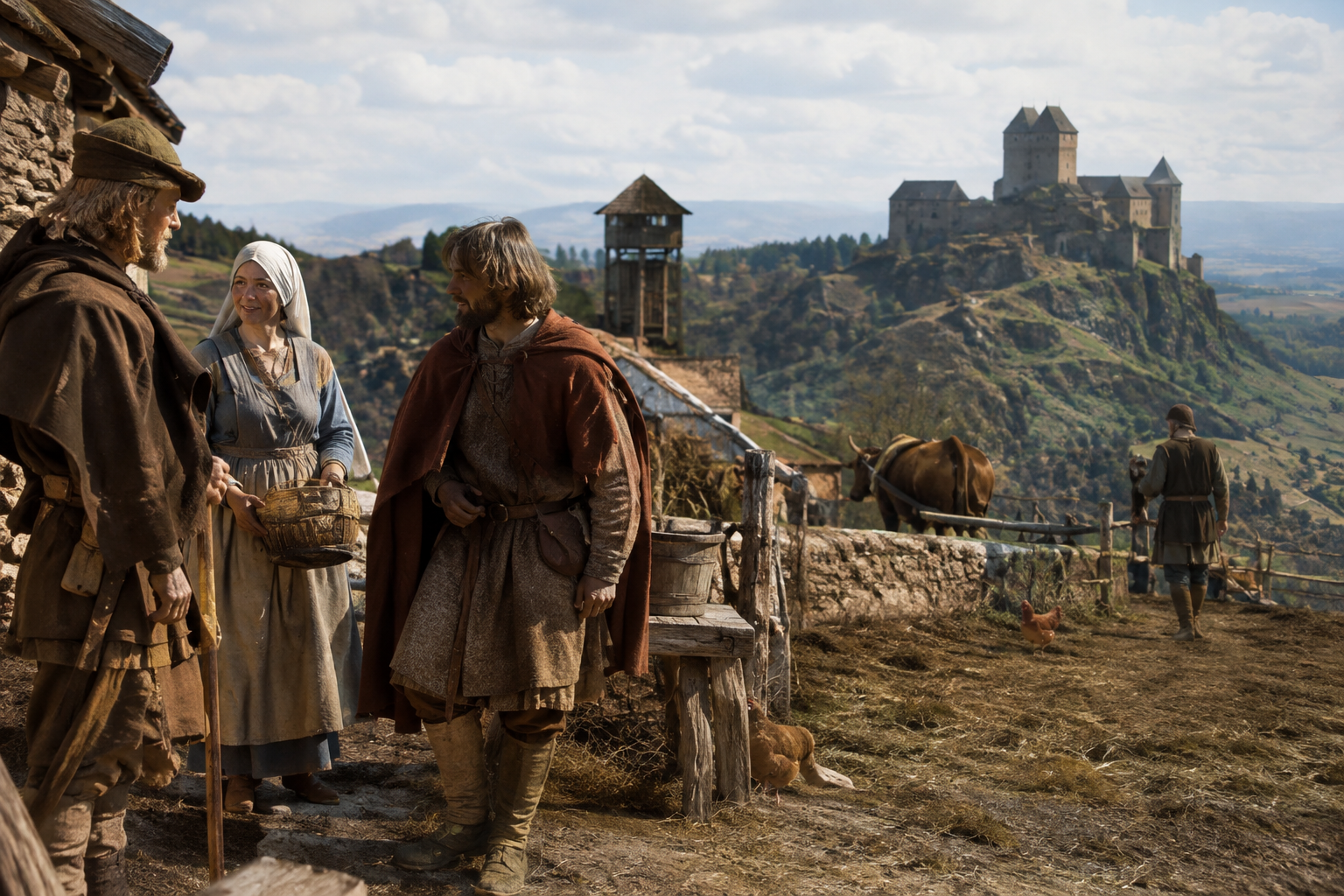
At Krakauer Berg near Peissen in medieval Germany, one excavated individual stands out for anyone tracing the paternal line E1b1b1a1b1a5a1: sample KRA005, dated to around AD 1140. It is a small, specific point on the map rather than a grand dynasty or a famous king, but that is precisely what makes it useful. Ancient DNA is often most revealing when it turns up in ordinary burial grounds, where lineage meets the lived reality of a community.
KRA005 matters because this is a lineage more often discussed in broad continental terms than in the grounded context of a named medieval cemetery in central Europe. The haplogroup label here, E1b1b1a1b1a5a1, describes one narrow branch on the Y chromosome, tracing a direct paternal line only. It does not sum up a person's whole ancestry, language, identity, or social role; what it does offer is a sharply focused thread running through the male line.
Peissen lies in a region that sat within the busy historical zone of central Germany, where early and high medieval communities were shaped by older Roman frontiers to the west, Slavic-speaking populations to the east, expanding Christian institutions, and the steady reworking of settlement across centuries. By the 12th century, this was not an empty frontier but a deeply inhabited landscape of villages, churchyards, estates, and market connections.
In that context, KRA005 is valuable not because he can be made to represent everyone, but because he shows that a paternal line associated with the wider E1b1b family was present in a medieval German burial population. That should not surprise us as much as older popular narratives might suggest. Medieval Europe was full of mobility, local continuity, remarriage, migration, military service, trade, and the slow folding together of populations whose ancestors had arrived by very different routes.
An ancient DNA study examining medieval and earlier burials from the region can be found here. For this article, the key point is modest but important: the evidence places this paternal branch in a documented medieval central European context, not in the realm of guesswork or family legend.
Germanic languages and genomics
The longer the haplogroup name, the narrower the branch. In practical terms, E1b1b1a1b1a5a1 sits inside the broader and much older E1b1b family, a major paternal lineage with deep roots outside northern Europe and a long history around the Mediterranean, the Balkans, and parts of Africa and western Asia. But one must be careful here: the history of the parent branch is not automatically the history of this exact subclade.
That distinction matters. A man carrying E1b1b1a1b1a5a1 in medieval Germany does not by himself prove a recent migration from any one homeland, nor does he reduce neatly to a modern national story. What he does show is that by about AD 1140, this direct paternal line had already been woven into the population history of central Europe strongly enough to appear in a local burial assemblage.
That is often how archaeogenetics advances: not by announcing a single dramatic origin, but by forcing us to give up tidy maps. Haplogroups that modern people like to label as "southern," "Balkan," or "Mediterranean" can appear in medieval Germany because medieval Germany itself was a place of long-term mixture and movement.
There is a temptation to dismiss one sample as too little evidence. Yet a single well-provenanced burial can be historically eloquent if we ask the right question. KRA005 does not tell us that all men at Peissen shared the same paternal ancestry, but he does show that the local community included at least one male line from this branch during the high medieval period.
That matters especially in central Europe, where written history often privileges rulers, bishops, and monasteries, while ancient DNA restores some attention to the broader population beneath them. The burial ground at Krakauer Berg belonged to a world of parish religion, agricultural settlement, and regional exchange. A Y-chromosome lineage found there is part of that social fabric, not an exotic footnote hovering outside it.
For descendants today, this is often the most useful lesson. If your paternal line falls under E1b1b1a1b1a5a1, the ancient evidence does not force your story into one modern ethnicity. Instead, it suggests that this lineage could already be fully embedded within medieval European communities that would have looked, sounded, and lived locally.
One of the most useful corrections provided by ancient DNA is to the old fantasy of neatly bounded medieval peoples. The lands of what is now Germany were shaped by Roman-era contacts, post-Roman political change, missionary networks, dynastic expansion, colonization of rural land, and contact zones with western Slavic populations. That does not mean every individual was a recent migrant. It means the population as a whole had been forming for a very long time.
In that setting, an E1b1b-derived paternal line is entirely plausible. Similar broader patterns have appeared elsewhere in Europe, where burials associated with local communities contain a range of Y-chromosome lineages rather than one exclusive "ethnic" signature. The lesson is less about surprise than about scale: lineages move over centuries, then become ordinary.
Central Europe is especially good at teaching this because it sits at a crossroads. Rivers, trade routes, ecclesiastical networks, military obligations, and marriage patterns all helped move people across regions. By the time we meet KRA005 in the 12th century, any older movement that introduced his paternal line may already have been many generations in the past.
There is a sensible way to use a result like this and a less sensible one. The sensible way is to say that E1b1b1a1b1a5a1 has at least one documented ancient appearance in medieval Germany at Krakauer Berg Peissen, through sample KRA005, around AD 1140. That gives the lineage a real archaeological foothold in central Europe.
The less sensible way would be to leap from that foothold to a precise personal origin story, or to imagine a straight line from one medieval man to a named tribe, knightly house, or modern nationality. Archaeology is rarely that obliging. What it gives us instead is context: this paternal branch was present among real medieval people living in a settled German landscape, and that is already historically significant.
It is also worth noting that this sort of evidence sits comfortably beside other recent studies showing diverse origins in medieval and post-Roman populations across Europe. The more ancient genomes we recover, the less convincing the old idea of isolated, biologically uniform peoples becomes.
The most distinctive thing about this haplogroup, in light of the current evidence here, is not a royal claim or a heroic migration tale. It is the quiet fact that a narrow paternal branch under E1b1b appears in a named medieval cemetery in Germany, attached to a specific individual, KRA005. For someone researching their own direct male line, that is a reminder that paternal ancestry can be both geographically far-reaching in deep time and thoroughly local in the historical periods that shaped recorded families.
If this is your haplogroup, the safest historical reading is that your paternal line belongs to a wider lineage with a long and complicated history, but one that was certainly present in at least one medieval central European community by the 12th century. That is not the end of the story. It is the point where archaeology begins to make the lineage human.






Comments