Haplogroup E1b1b1a1b1a2a

– 6 min read


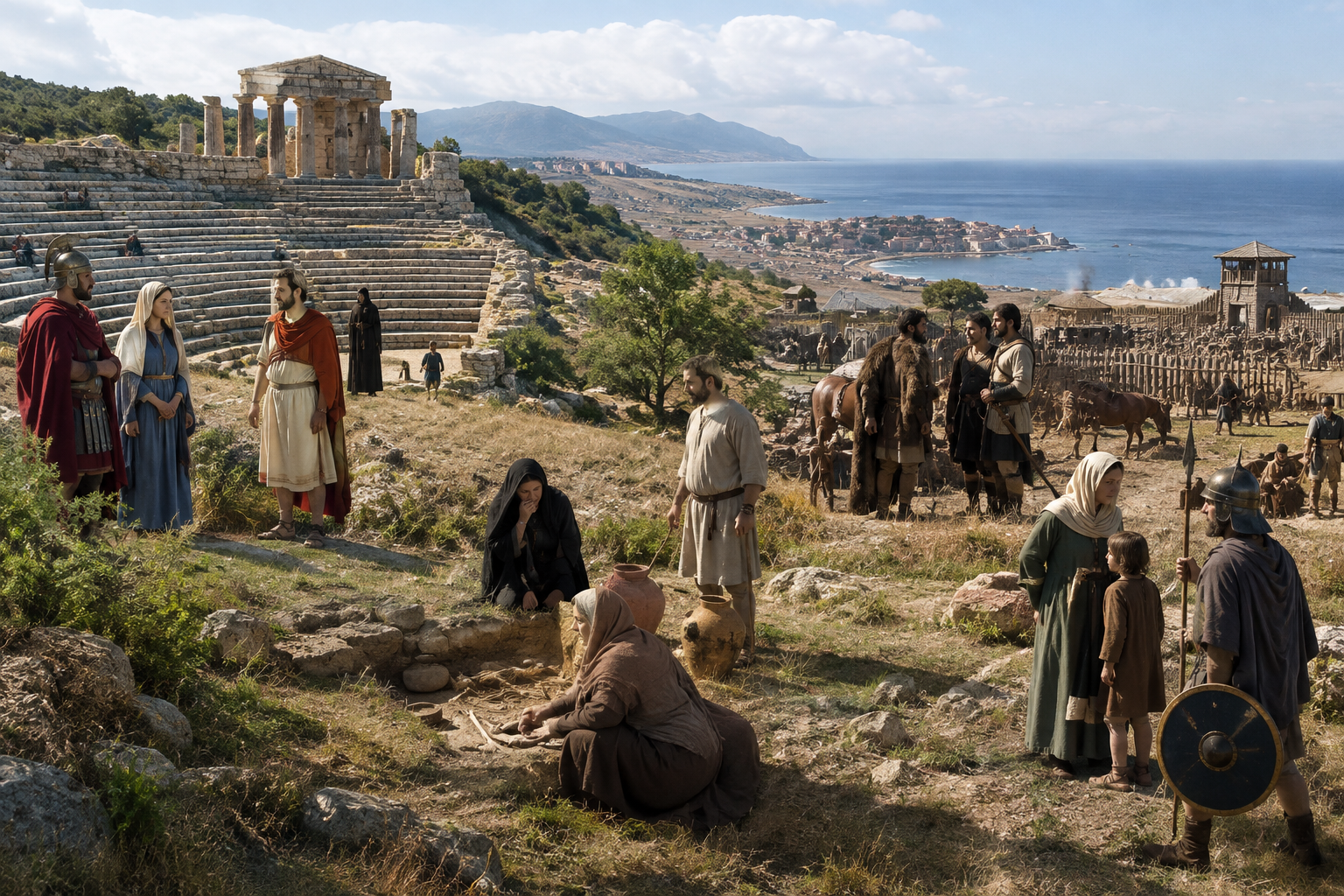
Some Y-chromosome lineages announce themselves with a neat national label. E1b1b1a1b1a2a does not. It turns up instead in places that remind us how untidy male-line history really is: Roman Serbia, post-Roman Pannonia, Sicily under Muslim rule, early medieval Croatia, Viking Age Denmark, Anglo-Saxon Kent, and even a twentieth-century burial from Crete. That is precisely what makes it interesting. This is a paternal lineage best approached not as the badge of one people, but as evidence of movement, mixture, settlement, and survival across the Mediterranean and wider Europe.
As always with Y-DNA, a note of caution matters. A Y-haplogroup traces one direct paternal line only: father to father to father. It does not summarize a person's whole ancestry, language, identity, or culture. Nor does sharing a haplogroup with an ancient individual prove direct descent from him. What it can do, however, is offer a remarkable way of following the long afterlife of particular male lines through archaeology, burial grounds, frontier towns, courts, and castles.
E1b1b1a1b1a2a belongs to the wider E1b1b family, one of the major Y-chromosome branches with deep importance in Africa, the Mediterranean, and parts of Europe and western Asia. Broadly speaking, many branches of E1b1b are often associated in prehistoric and historic discussions with the southern and eastern Mediterranean world, the Balkans, and later population movements around the Roman and post-Roman seas. But one must be careful not to pour the whole history of broad E1b1b into this narrower subclade as if nothing changed along the way.
What the sample list here suggests, quite strongly, is that this branch - or closely related paternal lines around it - had a notable presence in the Balkans and central Mediterranean during late antiquity and the early Middle Ages, and then appears in highly mixed medieval settings farther west and north. In other words, this is not a story of a single migration wave marching in a straight line. It is more like a series of deposits left by armies, traders, settlers, converts, elites, and ordinary communities living under very different political flags.
Explore North Africa's Deep Genetic History
If one wanted a stage set for this haplogroup's historical drama, the Roman Balkans would do nicely. Several of the most revealing samples come from Serbia, especially the great late Roman center of Viminacium and the sites around Timacum. At Viminacium, individuals I15490 and I15525, both dated to 200 AD, and I15504, I15507, I15513, and I15518, all dated to 250 AD, place this paternal line in a major imperial landscape of roads, garrisons, towns, and cemeteries. These were not isolated villagers at the edge of nowhere. They lived in one of the empire's busy connective zones.
Nearby Timacum adds continuity across a turbulent period. I15544 from Timacum Slog Necropolis is dated to 261 AD, while I15553 and I15554 from Timacum Kuline Ravna Village date to 400 AD and 410 AD. Put simply, the same paternal signature appears before and after the western empire's political unravelling. That does not prove unbroken descent from one local family line, but it does suggest that the lineage was not a fleeting curiosity. It had found a place in Balkan populations under Roman rule and in the late imperial world that followed.
That matters because Roman frontier provinces were famous not for ethnic purity but for churn. Soldiers moved in, merchants followed, local communities adapted, and graves quietly recorded the results. A lineage found repeatedly in these contexts may reflect long-standing Balkan residence, Mediterranean connections, or both.
Read About DNA on Rome's Balkan Frontier
The post-Roman centuries do not simplify the picture. They complicate it wonderfully. In Hungary and its surrounding regions, this haplogroup appears again and again in cemeteries associated with shifting political worlds: late Roman, post-Roman, Longobard, Avar, and Carolingian.
At Arrabona Szechenyi Square, GYS032, GYS044, and GYS008 are dated to 425 AD. At Savaria Szeleste Barbaricum, SZL047, SZL053, SZL058, SZL062, SZL071, and SZL086 cluster around 525 AD in Migration Period, Post Roman Period, and Longobard Period contexts. MFC014 from Arrabona Menfocsanak Barbaricum, dated to 550 AD, continues the pattern. Then come RKF026 and RKF027 from Rakoczifalva in 650 AD, SzKper239 from Late Avar Hungary in 680 AD, and AHS56 from Zalavar Varsziget in 850 AD under the Carolingian sphere.
This is a formidable spread. It suggests not a single "tribal" signature but a paternal line present in the mixed societies of the Carpathian Basin as Roman administration gave way to successor powers. The same impression comes from CGG021897, dated to 375 AD, from an Ostrogoth-Gepid context at Madaras, and from later western finds such as Alh_154 in Merovingian Bavaria, BRC014x in Saxony-Anhalt, and IND009 in North Rhine-Westphalia. These burials sit in exactly the kind of zones where people from the Balkans, Danube frontier, Germanic-speaking groups, and imperial remnants met and intermarried.
One of the nicest correctives ancient DNA offers is that labels like "Goth," "Longobard," or "Avar" were political and cultural umbrellas, not tidy biological containers. A paternal lineage like E1b1b1a1b1a2a appearing in such settings helps show how varied these communities really were.
Discover Post-Roman DNA in Pannonia
The chronology stretches back still farther in the Black Sea world. Two Bosporan Kingdom samples from Crimea, CGG021473 and CGG021475, both dated to 200 BC at Chernoseus Taurica, show that related paternal lines were already present in a Hellenic and Scythian-influenced coastal environment long before the medieval period. Again, that is not a claim that this exact subclade began there, only that the wider historical geography of the lineage includes the northern Black Sea as well as the Balkans.
Then the Mediterranean takes over. Medieval Sicily is particularly revealing. GABN2a from Palermo La Gancia Islamic Burial, dated to 925 AD, places the haplogroup in Sicily's Islamic period. SGBN10 from Teatro di Segesta, dated to 1220 AD, and SGBN19 from Segesta Muslim Grave, dated to 1250 AD, continue the story into the high Middle Ages. This is exactly the sort of evidence that suits Sicily: a place where Byzantine, Arab, Berber, Greek, Latin, Jewish, and Norman histories all overlap in ways that make simple ancestry stories collapse on contact.
Other outlying finds sharpen that point. I7498 from Cordoba Caliphate, dated to 1050 AD, shows the lineage in Islamic Iberia. VEM022 from early medieval Croatia, PCA0400 from Piast-era Santok on the Lubusz-Greater Poland border, VK362 from Viking Age Langeland in Denmark, EAS006 from the Saxon palace site at Eastry in Kent dated to 480 AD, and even R1219 from the Cancelleria Basilica in 1440 AD all show how widely a paternal line can travel once it is caught up in the circulations of empire, religion, warfare, and trade.
Even sample 276_2, the 1941 war victim from Rethimno in Crete, is a useful reminder that haplogroups are not relics pinned to one ancient age. They persist into recent history, carried by men whose lives were shaped by very modern tragedies.
Explore Medieval Sicily's Multi-Faith DNA
The supplied noble connection is not a claim of proven genetic descent from these ancient individuals, and it should not be treated as one. But it does give us a wonderfully English counterpart to the deeper archaeological story. House Percival is associated here with Cannington Court in Somerset, a place whose architecture preserves several historical worlds at once.
Cannington Court began as a medieval priory linked to nearby Glastonbury Abbey. That alone sets it in one of the most symbolically charged landscapes in England, where monastic wealth, local authority, and rural life were long intertwined. After Henry VIII's dissolution of the monasteries, the estate passed into private hands and was rebuilt as a grand Tudor house. Over the centuries it was repeatedly altered, reflecting changing fashion, status, and practical need.
That layered history is what makes the house useful in an article like this. A haplogroup tells us about one paternal line moving through deep time. A house like Cannington Court tells us how later societies remembered, reused, and refashioned the landscapes in which families lived. Monastic Somerset became Tudor Somerset, then educational and community Somerset, without ever quite losing the marks of what came before. Castles, manor houses, and priories do not prove haplogroups, but they do preserve the social settings in which lineages were remembered, claimed, and sometimes reinvented.
For readers interested in the broader family context, the MyTrueAncestry community also has material on The Percival Family, which makes a natural companion to the architectural and regional story of Cannington Court.
E1b1b1a1b1a2a is a good lesson in how paternal history works when you stop trying to force it into modern national boxes. The evidence supplied here points toward repeated appearances in the Balkans, the Danubian world, the Black Sea sphere, Mediterranean islands, and later medieval western and northern Europe. Roman military mobility, post-Roman mixing in Pannonia, the cosmopolitan worlds of Sicily and Iberia, and later medieval settlement all help explain why.
That does not mean every modern man with this haplogroup descends from a Roman soldier, a Sicilian Muslim, or a Pannonian frontier settler. It means that his direct paternal line belongs to a branch that was present in exactly those kinds of historical settings. Ancient DNA is so valuable because it gives us actual men in actual graves: I15544 in Roman Serbia, SZL086 in Longobard-period Hungary, GABN2a in Islamic Palermo, SGBN10 in medieval Segesta. They are not mythic founders. They are evidence.
And when that evidence is set beside later family landscapes such as Cannington Court, the result is not a fairy tale of guaranteed noble descent. It is something better: a grounded sense that paternal lines move through real places, survive regime change, and become part of histories far larger than any single surname.
If your own Y-DNA belongs to a lineage like E1b1b1a1b1a2a, MyTrueAncestry can help place it in this wider human story - comparing your DNA with ancient individuals and historical populations while keeping the difference clear between genetic similarity and documented genealogy.






Comments