Haplogroup E1b1b1a1b1a10b

– 8 min read


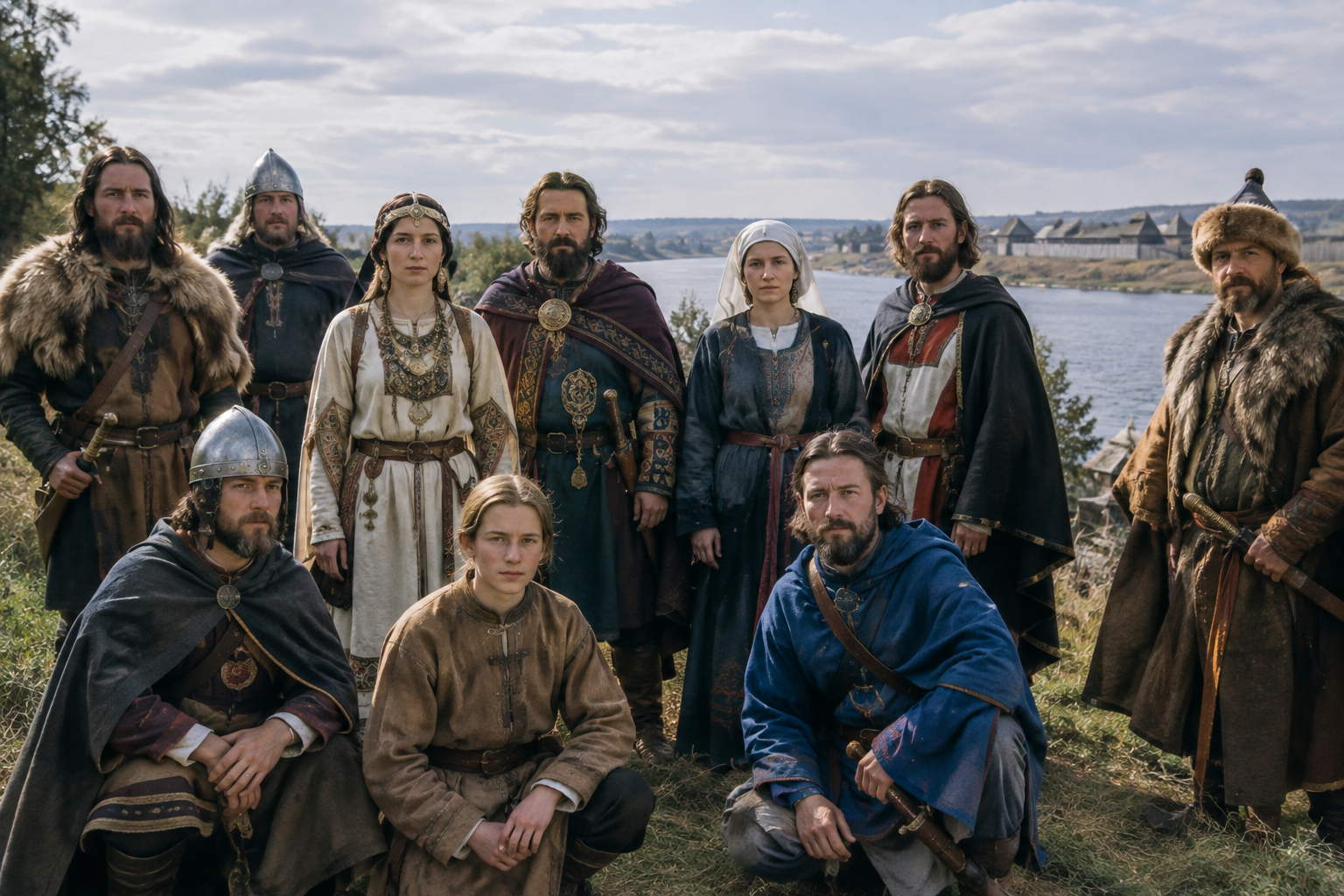
Some Y-chromosome lineages announce themselves with a great fanfare of royal pedigrees or sweeping migration legends. E1b1b1a1b1a10b is more interesting for the opposite reason. It appears in the historical record not as a single tidy story, but as a series of glimpses: a man in Late Antique Romania, burials in the Vienna Basin, an Avar elite grave in Hungary, a medieval burial in Croatia, individuals in early medieval Germany, a Piast-era sample in Poland, and later medieval Ukraine and Slovakia. That scatter is precisely what makes it worth attention.
As a Y-DNA haplogroup, E1b1b1a1b1a10b traces one very specific line of inheritance: the direct paternal line, father to son to son. It does not describe a person's full ancestry, culture, language, or identity. But when the same branch or closely related branches turn up across centuries and regions, they can illuminate something that written sources often hide: the movement and persistence of male lineages through changing political worlds.
E1b1b1a1b1a10b belongs within the wider haplogroup E-M35 family, one of the major Y-chromosome lineages with deep roots outside as well as within Europe. Broad branches of E1b1b have long been associated, at different times and in different proportions, with parts of the Mediterranean, the Balkans, and southeastern Europe, as well as regions farther south and east. That broad background matters, but it must be handled carefully: the history of the larger E1b1b family is not automatically the history of this exact downstream branch.
For a specific subclade like E1b1b1a1b1a10b, ancient DNA is especially valuable because it gives us fixed points in time. Rather than relying on modern maps alone, we can watch this paternal signal appear in real archaeological settings from the fifth to the thirteenth century. What emerges is not a tale of one people marching across Europe under a banner, but something more historically plausible: a lineage present in frontier zones, mixed societies, elite networks, and medieval kingdoms from the Lower Danube to Central Europe and beyond.
One of the earliest supplied anchors is Arg5_1, from Late Antique Early Byzantine Argamum Orgame Romania, dated to 480 AD. That alone places this lineage in a fascinating world: the old Roman frontier on the Black Sea edge, where imperial administration, military movement, local communities, and post-Roman reshaping all met. A sample like Arg5_1 does not prove that E1b1b1a1b1a10b was common there, but it shows the lineage was present in a zone where empires and mobile populations overlapped.
Move west into the former Roman lands of Central Europe and the picture becomes denser. In the Vienna Basin, CSK016 from Early Medieval Austria Csokorgasse Vienna Basin and MGS006 from an Avar Period Grave Austria Moedling-An der Goldenen Stiege Vienna Basin, both dated to 650 AD, place the lineage in a region that was anything but quiet. The Vienna Basin was a crossroads between former Roman provinces, incoming groups, and the Avar political sphere. Nearby, RKC041 from Avar Elite Hungary Rakoczifalva, also dated to 650 AD, adds another important detail: this paternal line was not confined to one social level or one local community.
That is the sort of evidence that reminds us how misleading neat ethnic labels can be. "Avar," "Byzantine," "Slav," and "Germanic" are historical categories, political formations, or archaeological designations, not genetic boxes. A Y-lineage can pass through them all, because men marry, migrate, serve rulers, settle new districts, and leave descendants under new names.
Read Post-Roman Central Europe
The lineage also appears in early medieval Germany in two telling contexts. OBM013, from the Thuringii Tribe Germany Obermoellern, dated to 500 AD, and RTW003, from Migration Period Germany Rathewitz Saxony-Anhalt, also dated to 500 AD, suggest that this paternal branch was present in the turbulent centuries when Roman authority had collapsed in the west and new regional powers were forming. Again, that does not make E1b1b1a1b1a10b a "Germanic haplogroup" in any simple sense. It means men carrying this lineage were part of those societies.
Farther south and east, I28388 from Medieval Croatia Nustar dated to 850 AD, and CGG018923 from Medieval Slav Avar Slovakia Cifer-Pac dated to 950 AD, continue the pattern. These are precisely the kinds of regions where archaeologists and historians see overlapping influences: Slavic settlement, steppe-linked polities, older provincial populations, and shifting Christian and post-nomadic worlds. The lineage seems to travel not along one simple route, but through the lived geography of central and southeastern Europe.
By the high medieval period, the branch is still visible. PCA0255, from Piast Dynasty Greater Poland Poznan Srodka Lad dated to 1100 AD, places it within the orbit of the Piast realm. That is especially intriguing because dynastic Poland was bound into a larger network of marriage, ecclesiastical reform, warrior elites, and frontier expansion. Likewise KRW002, from the Principality of Halych-Volhynia Ukraine Korolivka dated to 1250 AD, shows that the lineage remained present in the medieval east-central European world.
What these finds collectively suggest is continuity through mobility: the same paternal line appearing repeatedly across the lands between the Danube, the Carpathians, the Elbe region, the Balkans, and medieval eastern Europe. That is not proof of one unbroken noble pedigree. It is better than that. It is proof that real men bearing this lineage lived in these historical settings.
The story of a paternal lineage does not end in burial grounds and laboratory reports. Once written records become thicker, we can also ask how later families and lordships sat within the same long history of male descent, while keeping clear the difference between documented genealogy and broader historical association.
One later historical name associated with this discussion is Clan Douglas, among the most powerful noble kindreds of medieval and early modern Scotland. The Douglases emerged in the borderland and Lowland politics of the Scottish kingdom, where landed families could become military powers in their own right. Their rise belongs to a world very different from the Late Antique Danube or the Avar sphere described above, but it illustrates the same fundamental point about Y-DNA: paternal lines continue through changing political landscapes, even when the identities attached to them alter completely.
The historical importance of the Douglas family lies not simply in noble rank, but in their repeated prominence during some of Scotland's most formative struggles. They became one of the great aristocratic houses of the realm, bound up with warfare, lordship, royal service, and rivalry. In public memory, the clan is particularly tied to the fierce contests of the Wars of Scottish Independence, when the name Douglas entered national legend.
In the context of this haplogroup, the clan should be treated with care. The supplied association makes Clan Douglas historically relevant to readers interested in paternal-line heritage, but it does not prove that all Douglases, or any specific medieval Douglas, belonged to E1b1b1a1b1a10b. That distinction matters. Noble surnames and clans often gathered cadet branches, adopted heirs, and complex lines of descent that do not reduce neatly to a single Y-chromosome story.
Still, families such as the Douglases help make an important historical bridge. Ancient DNA shows us lineages moving through the early medieval centuries; later noble history shows how some male lines became anchored to territories, surnames, and political memory. The two are not the same evidence, but together they remind us that paternal ancestry belongs both to archaeology and to the documented worlds of castles, lordships, and dynasties.
The chief stronghold associated here is Douglas Castle in South Lanarkshire, the historic seat of the Douglas family from the 13th century. It stood at the center of one of Scotland's most formidable noble lordships, and its history is suitably turbulent. During the Wars of Scottish Independence, the castle was burned and fought over many times, a sign not just of its military value but of the strategic importance of the Douglas lands themselves.
For readers interested in how paternal-line history meets real places, Douglas Castle offers something tangible. This was not an abstract family name in a pedigree chart, but a defended seat from which power was projected, alliances maintained, and territory contested. In that sense, castles do for later history what burials do for ancient DNA: they fix human stories to a particular landscape.
The medieval fortress did not survive unchanged. It was later replaced by a grand 18th century house, also called Douglas Castle, which acquired the memorable nickname Castle Dangerous. That name preserves the afterlife of noble reputation as much as the building itself. Following a fire in 1938, much of the later structure was demolished, so what remains is partial rather than complete.
That damaged survival is historically apt. Castles linked to great families often come down to us in fragments, rebuilt, renamed, or reduced by time and disaster. Even so, Douglas Castle remains a useful point of connection for anyone exploring the wider historical world of paternal descent. It does not prove a genetic claim by itself, but it anchors the Douglas name to an actual place where lineage, lordship, and memory were all once concentrated.
It is tempting, when looking at a lineage found across medieval Europe, to leap straight to castles and noble houses and declare a direct connection. Historians should resist that temptation, and geneticists should too. A shared haplogroup, especially at a broader level, is not the same thing as documented descent.
Still, historical families matter here because they inhabited the same long-settled landscapes through which such lineages endured. Clan Douglas, for example, belongs to a later medieval Scottish world very different from Avar Hungary or Early Byzantine Romania, yet one built on the same underlying truth: male lineages persist, branch, and reappear in unexpected places. The great Douglas stronghold, Douglas Castle in South Lanarkshire, became the seat of one of Scotland's most formidable noble families. The site was made famous in the Wars of Scottish Independence, when English forces held it until Sir James Douglas retook it in 1307 in the violent surprise attack remembered as the Douglas Larder.
The castle was rebuilt and ruined more than once, and the medieval fortress was eventually replaced in the later seventeenth and early eighteenth century by the grand house later nicknamed Castle Dangerous after Walter Scott's novel. Mining damage in the twentieth century brought much of that later building down, leaving fragments and earthworks. It is a fine reminder that noble memory often survives in broken stone and stubborn names, not just in intact pedigrees.
Can E1b1b1a1b1a10b be assigned to Clan Douglas from the information supplied here? No. That would go beyond the evidence. But Douglas Castle helps frame the broader point. By the medieval period, Europe was full of old paternal lines embedded in new political identities. Genetics can sometimes illuminate that background, while written genealogy preserves only the better-documented branches.
E1b1b1a1b1a10b matters because it shows how ancient DNA complicates lazy historical storytelling. Instead of tidy claims about a haplogroup "belonging" to one nation or one tribe, the evidence here points to a lineage moving through frontier provinces, post-Roman societies, Avar contexts, Slavic-associated settings, dynastic Poland, and medieval Ukraine. In other words, it belonged to history as it was actually lived: mixed, layered, political, mobile.
That is also why Y-DNA is so useful when treated properly. It does not tell you everything about who you are. It does not confer a castle, a crown, or a tribal label. But it can connect your direct paternal line to a much older human map, one in which men carrying related lineages stood in burial grounds from Argamum to Rakoczifalva, from Obermoellern to Poznan.
If you want to explore how ancient DNA and historical movement intersect more broadly, the wider MyTrueAncestry community has excellent reading on related themes, including the Black Sea and steppe-connected world.
For anyone carrying E1b1b1a1b1a10b, or simply curious about how paternal lines appear in archaeology, the real excitement lies in comparison. Ancient DNA can show whether your results resemble lineages found in medieval kingdoms, frontier cemeteries, or long-vanished communities. That does not prove direct descent from a particular buried individual or noble family, but it can place your ancestry in a far bigger historical landscape.
Upload your DNA to MyTrueAncestry and see how your story compares with ancient individuals like CSK016, MGS006, RKC041, Arg5_1, PCA0255, and others from Europe's changing past.

Comments