Haplogroup E1b1b1a1b1a10a1a

– 5 min read


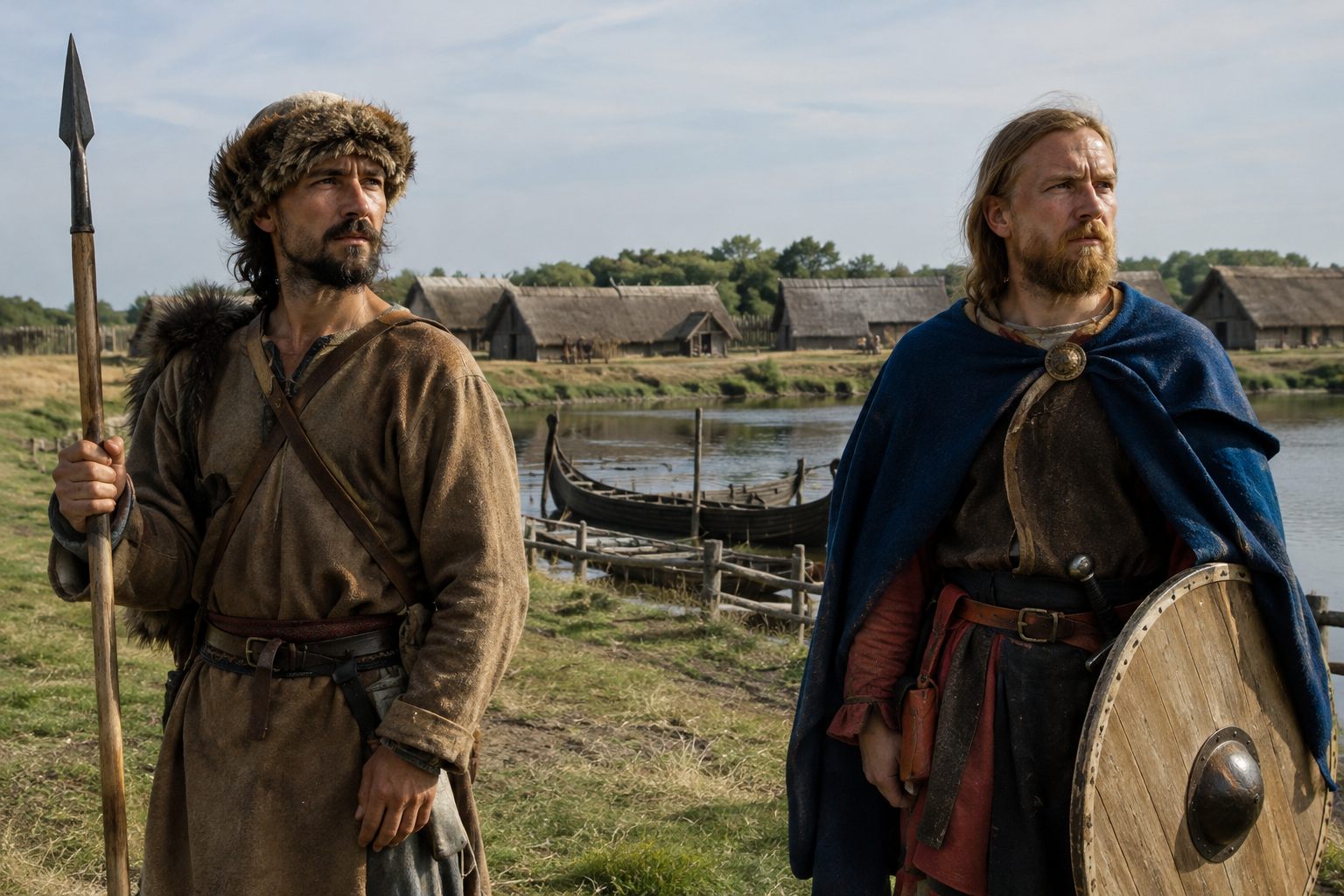
One of the clearest clues for the Y-DNA haplogroup E1b1b1a1b1a10a1a in this small ancient record comes from early medieval Hungary: sample HNJ025, dated around AD 650 at Hajdúnánás in the Carpathian Basin. It is a modest-looking data point on paper, but historically it sits in a very busy landscape indeed: post-Roman, post-Hunnic, shaped by Avar power, and connected to routes running from the Balkans to the steppe and deep into central Europe.
That is exactly why this lineage is interesting. Not because one burial can tell us everything, but because a direct paternal line appearing in both Pannonian Hungary and later Viking Age Denmark hints at a branch moving through very different societies over several centuries. Y-DNA traces one father's father's line rather than a person's whole ancestry, but even that narrow thread can be historically revealing when it turns up in places that were crossroads rather than isolated worlds.
The Hajdúnánás individual HNJ025 belongs to a period when the Carpathian Basin was anything but static. Around AD 650, this region lay within the orbit of the Avar Khaganate, a polity famous in textbooks for cavalry, treasure, and diplomacy, but better understood archaeologically as a mixed and changing population. Cemeteries from this world often show that political labels and biological ancestry do not line up neatly. An "Avar-period" burial is a date and cultural context, not a simple ethnic identity.
So where does E1b1b1a1b1a10a1a fit? Broadly speaking, the larger E1b1b1 family is well known in parts of the Balkans, the Mediterranean, and northeast Africa, with complicated prehistoric and historic branches spreading in many directions. But that broader pattern should not be pasted mechanically onto this very narrow subclade. What HNJ025 shows, safely and usefully, is that a paternal line associated here with E1b1b1a1b1a10a1a was present in the early medieval Carpathian Basin, in a region where local continuity, migration, and imperial mobility all overlapped.
An ancient DNA study of the broader region, published on early medieval population history in the Carpathian Basin, helped make precisely this larger point: post-Roman central Europe was full of movement, mixture, and reassembled communities. For readers with ancestry from this branch, Hajdúnánás is therefore best seen not as a point of origin story, but as evidence that this paternal line had entered one of Europe's great early medieval contact zones.
Long haplogroup names tempt people into thinking they must correspond to a single tribe, kingdom, or heroic migration. Usually they do not. A lineage like E1b1b1a1b1a10a1a is a technical label for one twig on a much larger paternal tree, and ancient evidence for such a twig is often sparse. Two ancient men carrying related paternal signatures may be separated by many generations, different languages, and completely different political worlds.
That said, rarity can be informative. When a branch appears in two quite separate settings, it encourages us to ask not "Which famous people belonged to it?" but "What kinds of historical environments carried it forward?" In this case, both known contexts are remarkably connected ones: the Carpathian Basin in the seventh century and Denmark at the end of the Viking Age. These are not remote backwaters. They are places tied to exchange networks, military service, maritime traffic, and shifting identities.
The second sample, CGG100653, comes from Tjærby in Randers Municipality, Denmark, dated around AD 1100. By then, Denmark was changing fast. The classic raiding age had passed; kingdoms were more centralized; Christianity had become established; and local communities were increasingly drawn into the institutional world of parish churches, royal administration, and North Sea commerce.
That makes this sample especially useful. It places the same article haplogroup in a Scandinavian setting several centuries after the Hungarian find. One should be careful here: this does not mean that the man from Tjærby was descended from the Hajdúnánás individual, nor that the branch was "Viking" in any exclusive sense. It means that by the late Viking or early post-Viking period, a paternal line assigned here to E1b1b1a1b1a10a1a was present in Denmark, inside a society already shaped by centuries of overseas movement and continental contact.
The dating matters too. Around AD 1100, Scandinavia was not simply exporting people; it was also absorbing them, marrying them, baptizing them, and burying them in settled Christian communities. A lineage found there at this date might reflect older mobility around the Baltic, links through trade and service, or much earlier routes by which southern or southeastern European paternal lines entered the north. The ancient record here is too thin to pick one route with confidence, but not too thin to show that the route existed.
Post-Viking Christian Scandinavia
If we set these two samples side by side, a broader historical picture begins to emerge. The seventh-century Carpathian Basin was linked southward to the Balkans and eastward to steppe corridors. The eleventh-century Danish world was linked across the Baltic, into the British Isles, and down river and sea routes toward the continent. These are different maps, but they overlap through centuries of migration, mercenary service, marriage, pilgrimage, trade, and slavery.
This is one reason E-lineages in medieval Europe deserve careful attention. They do not fit older cartoon versions of European population history, where paternal lines are imagined as tidy badges of fixed peoples. Instead they remind us that Europe, especially medieval Europe, was full of men whose paternal ancestry had roots or relatives elsewhere, yet who lived and died entirely within local historical communities. A man buried in Denmark did not need to be a recent arrival to carry an uncommon paternal line. Equally, a man buried in Avar-period Hungary might belong biologically to a lineage with deeper southeastern ties while culturally participating in the life of the Carpathian Basin.
Research still in preprint form has also widened the Scandinavian ancient DNA picture, including later first-millennium and medieval material from Denmark and neighboring regions; for that broader context, see this study of ancient individuals from Denmark. The key point for this haplogroup is not that one paper proves a grand migration tale, but that northern Europe keeps turning up evidence of more varied paternal histories than older national narratives allowed.
Ancient DNA articles often become too eager to chase beginnings. But for E1b1b1a1b1a10a1a, the more interesting question may be about survival through connected worlds. HNJ025 shows this paternal line in an early medieval frontier empire of the Carpathian Basin. CGG100653 shows it again centuries later in a Danish setting shaped by the afterlife of Viking mobility and the consolidation of medieval society.
That combination suggests a lineage able to persist across very different historical landscapes rather than one confined to a single ethnic block. For someone researching this haplogroup today, the ancient evidence does not hand over a neat tribal badge or a guaranteed homeland. What it does offer is something better: a glimpse of a paternal line already participating in the complicated human traffic of medieval Europe, from the Hungarian plain to the Scandinavian north.
So the distinctive lesson of E1b1b1a1b1a10a1a is not grandeur but reach. In the present evidence, it appears in two places that mattered enormously to medieval movement: the seventh-century Carpathian Basin and Viking Age Denmark. That is enough to suggest a paternal history bound up with circulation, contact, and long-term continuity across changing political worlds, even if the exact path between those worlds remains to be filled in by future discoveries.






Comments