Haplogroup E1b1b1a1a1c1b1

– 6 min read


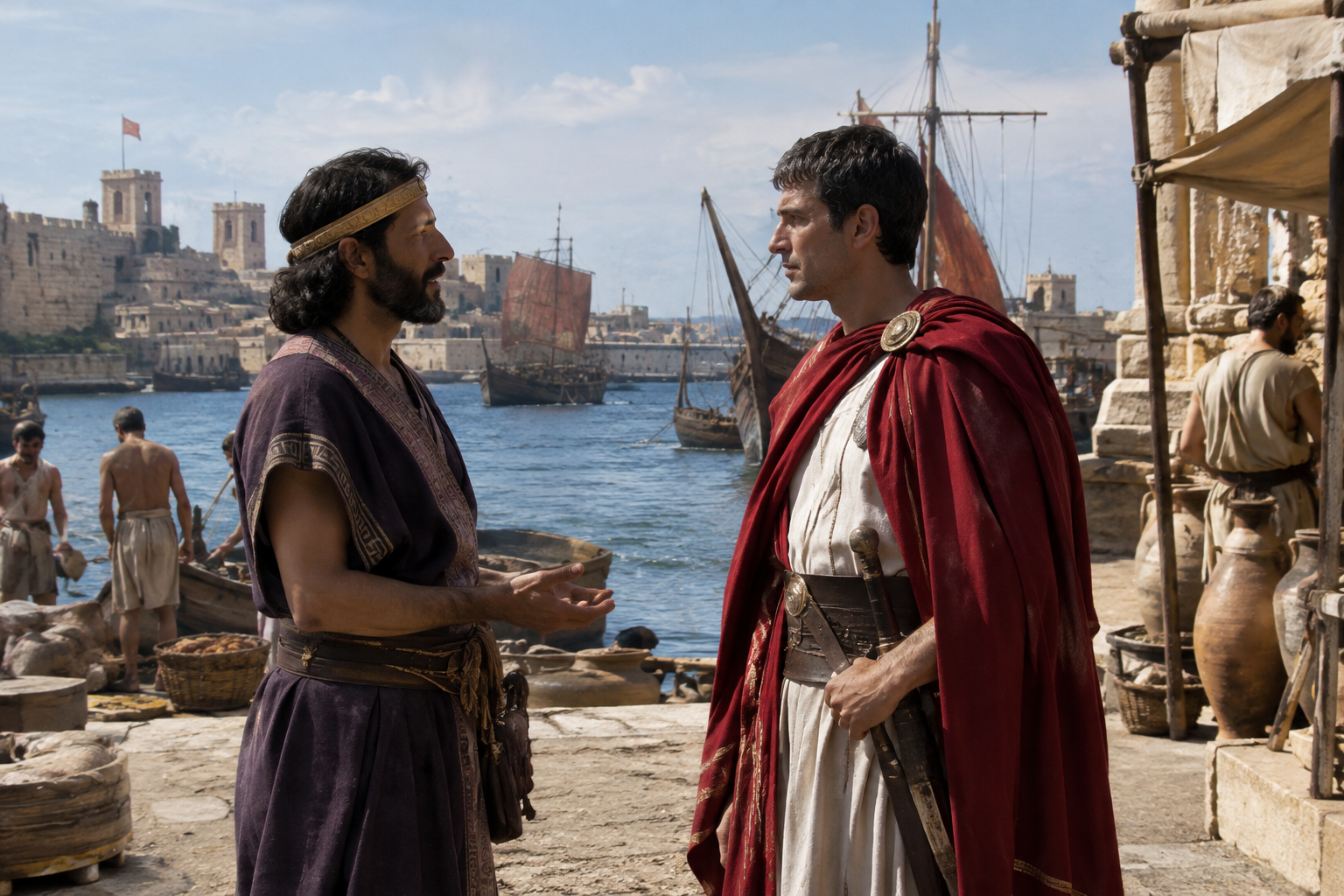
Some Y-chromosome lineages arrive in the historical record like kings with banners. Others appear more obliquely, in the bones of a man buried at an eastern Mediterranean port, or in the DNA of someone living under Roman rule far from the homeland his paternal line may once have known. Haplogroup E1b1b1a1a1c1b1 belongs to that second sort of story: less a single national label than a clue to long male-line movements across the Mediterranean world.
As ever with Y-DNA, a small caution is in order. A Y-haplogroup traces one direct paternal line only: father to father to father. It is not the whole of anyone's ancestry, still less a badge of fixed ethnicity. But it is extraordinarily useful for reconstructing how particular male lines moved, persisted, and sometimes surfaced in unexpected places. For a branch like E1b1b1a1a1c1b1, nested within the wider E1b1b family, that means looking especially toward the Mediterranean, the Near East, and the historical corridors that linked them to Europe.
The broader E1b1b family has deep importance in the population history of North Africa, the Near East, and parts of southern Europe. But one must be careful here: the history of the great parent clade is not automatically the history of every tiny downstream twig. What we can say responsibly is that a lineage such as E1b1b1a1a1c1b1 sits within a branch long associated, in broad terms, with Mediterranean and adjacent populations, and that its significance lies in helping us track paternal links across coastal networks, empires, and settlements.
This matters because the Mediterranean was not a tidy map of separate peoples. It was a machine for movement. Sailors, merchants, mercenaries, colonists, administrators, pilgrims, captives, and craftsmen all crossed it. Ports in the Levant connected to Cyprus, Sicily, North Africa, Iberia, and beyond. A Y-line found in one place might therefore reflect local continuity, recent arrival, or some older episode of mobility folded into a later community.
Explore How Ancient DNA Decodes History
That is exactly why ancient DNA is so useful. It lets us test old historical assumptions against real individuals. Instead of talking vaguely about "Mediterranean influence," we can point to particular burials, particular dates, and particular places where paternal lines appear in the archaeological record.
One of the most evocative samples here is I11794, listed as Phoenician Achzib Coastal Israel Acre Year:585 BC. Even without embroidering beyond the evidence, the setting is suggestive. Achzib, on the coast of what is now Israel, belonged to the maritime zone associated with Phoenician cities and their trading world. This was a landscape of harbors, ship traffic, and outward-looking coastal communities. A paternal lineage from this environment immediately places our attention in one of antiquity's great contact zones.
What makes a sample like I11794 interesting is not that it "proves" a modern person descends from Phoenicians, still less that it defines Phoenician identity in some simplistic way. Rather, it shows that a branch connected with this haplogroup's story was present in the eastern Mediterranean at a historically meaningful place and time. In other words, it gives us a real anchor in the Levantine coastal world from which so many later Mediterranean connections radiated.
The second sample, R113, is listed as Carthago Outlier Roman Empire VP Year:100 AD. This is a splendid reminder that Roman North Africa was no provincial backwater. Carthago under the Roman Empire was one of the major urban centers of the Mediterranean, layered with Punic, Roman, African, and wider imperial connections. The word "outlier" in the description is itself intriguing, suggesting an individual who stood apart in some genetic or contextual sense within the studied group.
Taken together, I11794 and R113 do not give us a simple straight-line genealogy. They do something more historically interesting. They place related paternal signals at two ends of a connected sea: the Phoenician Levant and Roman Carthage. That is the sort of pattern historians of the Mediterranean would expect to find, because the sea joined these regions long before modern national borders tried to separate them.
Readers interested in that western Mediterranean side of the story may also want to explore the Phoenician and Punic context more broadly. Ancient DNA is increasingly showing that these communities were not genetically uniform colonies stamped out from a single mold, but socially and biologically mixed populations shaped by movement and exchange.
How might a lineage in this wider sphere end up relevant to later Europe, and even to Ireland? The answer is not a melodramatic lost-prince tale. It is the ordinary untidiness of history. Roman expansion, post-Roman migration, medieval trade, ecclesiastical travel, mercenary service, and later settlement all moved men and their paternal lines across enormous distances. Some branches remained concentrated around the Mediterranean; others travelled further afield.
This is where genetic evidence and written history complement one another. Written records tend to notice elites, wars, charters, and property. DNA notices people who left bones. Sometimes those overlap; often they do not. A Y-line may persist across centuries without leaving a single named ancestor in a parchment roll. Equally, a famous noble pedigree tells us nothing certain about haplogroups unless specific genetic evidence exists.
The story, then, is not that E1b1b1a1a1c1b1 "belongs" to a single civilization. It is that this paternal branch fits comfortably into a Mediterranean historical frame in which Levantine, North African, and European populations were repeatedly brought into contact.
Explore Roman Iberia's Genetic Legacy
That wider Roman and post-Roman movement is particularly worth keeping in mind when thinking about western Europe. The Mediterranean was not cut off from Atlantic Europe; it fed people, goods, and ideas into it for centuries.
The later medieval connection supplied here takes us to Munster, and to Clan Roche at Blackwater Castle in Castletownroche, County Cork, Ireland. The site began as a Norman fortress around 1190, built by the Roches above the River Awbeg. That alone tells us a great deal about the world we are now in: lordship, conquest, settlement, and the remaking of Irish landscapes by incoming aristocratic families.
Blackwater Castle was not static. It passed through centuries of conflict, changing ownership, and rebuilding. Much of the medieval structure was replaced in the early 19th century by a Gothic Revival house, which is very often what happens with such places: the fortress of one age becomes the picturesque inheritance of another. In the 20th century the site became associated, through family connections, with George Boole, the Irish statesman and scientist, and in recent decades it has had further afterlives in heritage and events. It stands, in other words, as a monument not to one frozen medieval moment, but to repeated reinvention.
Now, we must be exacting here. The historical association of Clan Roche with this haplogroup does not prove that every Roche male carried E1b1b1a1a1c1b1, nor that the family descends directly from the ancient men represented by I11794 or R113. That would be far too much to claim. What we can say is that Blackwater Castle offers a vivid medieval setting in which to think about how paternal lines, wherever they originated centuries earlier, became folded into the aristocratic and landed histories of Ireland.
And there is something rather pleasing in the contrast. On one side, a Phoenician coastal burial and a Roman-era individual at Carthago. On the other, a Norman-founded stronghold in County Cork, altered by war, ownership, architecture, and memory. Genetics does not flatten these differences; it helps us appreciate how very long and circuitous the making of historical populations has been.
Haplogroup E1b1b1a1a1c1b1 is interesting not because it hands us a neat identity label, but because it opens a Mediterranean dossier. The ancient samples supplied here point toward eastern and central Mediterranean settings with strong maritime and imperial connections. The later family association in Ireland reminds us that paternal lines can travel astonishing distances across the centuries, sometimes ending up in places very far from where their earlier archaeological traces appear.
That is the real lesson of Y-DNA. It can illuminate continuity, migration, and regional links, but it rarely behaves like a fairy tale pedigree. Shared haplogroups do not prove close kinship. Ancient matches do not certify descent from a named noble house. Yet when used carefully, they let us place our own family lines inside the broader history of ports, empires, castles, colonization, and survival.
If you want to see how your own DNA might connect with ancient individuals, historical populations, and the deeper story behind lineages like E1b1b1a1a1c1b1, MyTrueAncestry can help you explore those links. You may discover genetic similarities to ancient samples and forgotten worlds - not as proof that you are a Phoenician merchant or a medieval lord of Munster, but as a fascinating new way of understanding where your ancestry fits into human history.






Comments