Haplogroup E1b1b1a1a1c1

– 8 min read


Some Y-chromosome lineages are easy to pin to a single familiar historical stage. Others are more elusive, and for that very reason more interesting. Haplogroup E1b1b1a1a1c1 belongs to the wider E1b1b family, a major paternal branch with deep roots in parts of Africa, the Mediterranean, and the Near East. When this very specific subclade appears in ancient DNA, it does not hand us a neat label or a tidy national story. Instead, it opens a window onto mobility: seaways, frontier zones, churchyards, river corridors, and the long afterlife of ancient paternal lines.
That is worth stressing at the outset. A Y-DNA haplogroup traces one direct paternal line only: father to father to father. It is not the same thing as a person's total ancestry, culture, language, or identity. But precisely because it follows that narrow line, it can be remarkably revealing. In the case of E1b1b1a1a1c1, the evidence supplied here places related paternal ancestry in Phoenician-era coastal Israel, medieval Italy, medieval Nubia, and eastern Africa. That is not a single people marching across a map. It is something more human and more historical: connected worlds.
The wider haplogroup E1b1b is well known in studies of ancient and modern populations around North Africa, the Horn of Africa, the eastern Mediterranean, and southern Europe. Within that broad family tree, narrower branches such as E1b1b1a1a1c1 must be handled carefully. We should not simply pour the entire history of E1b1b into one small downstream line. Still, the pattern matters. This is a paternal lineage that makes historical sense in zones shaped by Mediterranean exchange, African population history, and later imperial and post-imperial movement.
That matters because the Mediterranean was never a sealed basin. It was a restless corridor. Men carrying related E-lineages could appear in merchant communities, farming settlements, garrison populations, ports, monasteries, and villages far from any supposed point of origin. The narrower story of E1b1b1a1a1c1, as far as the supplied evidence allows us to tell it, seems to belong to that sort of world: not isolation, but circulation.
One of the clearest places to begin is the Phoenician coast. Two ancient individuals from Phoenician Achzib Coastal Israel Acre are especially striking: I11788, dated to 650 BC, and I11794, dated to 585 BC. Achzib sat in exactly the kind of landscape where paternal lineages could travel widely without losing local continuity: a Levantine coast tied to trade, shipping, colonial ventures, and the everyday movement of people around the eastern Mediterranean.
The temptation, of course, is to make Phoenician identity itself into a genetic essence. That would be too simple. Ancient port towns were socially mixed places. But these two Achzib samples are still valuable because they show this paternal line in a historically plausible eastern Mediterranean setting before the Roman period and long before medieval Europe. They remind us that when later branches of related ancestry appear elsewhere, we are not looking at something that sprang into being in the Middle Ages. The line was already present in the old maritime world.
Achzib also helps explain why small paternal lineages can turn up in surprising places. Seaborne connectivity does not only move goods and ideas. It moves families, soldiers, captives, craftsmen, migrants, and their descendants.
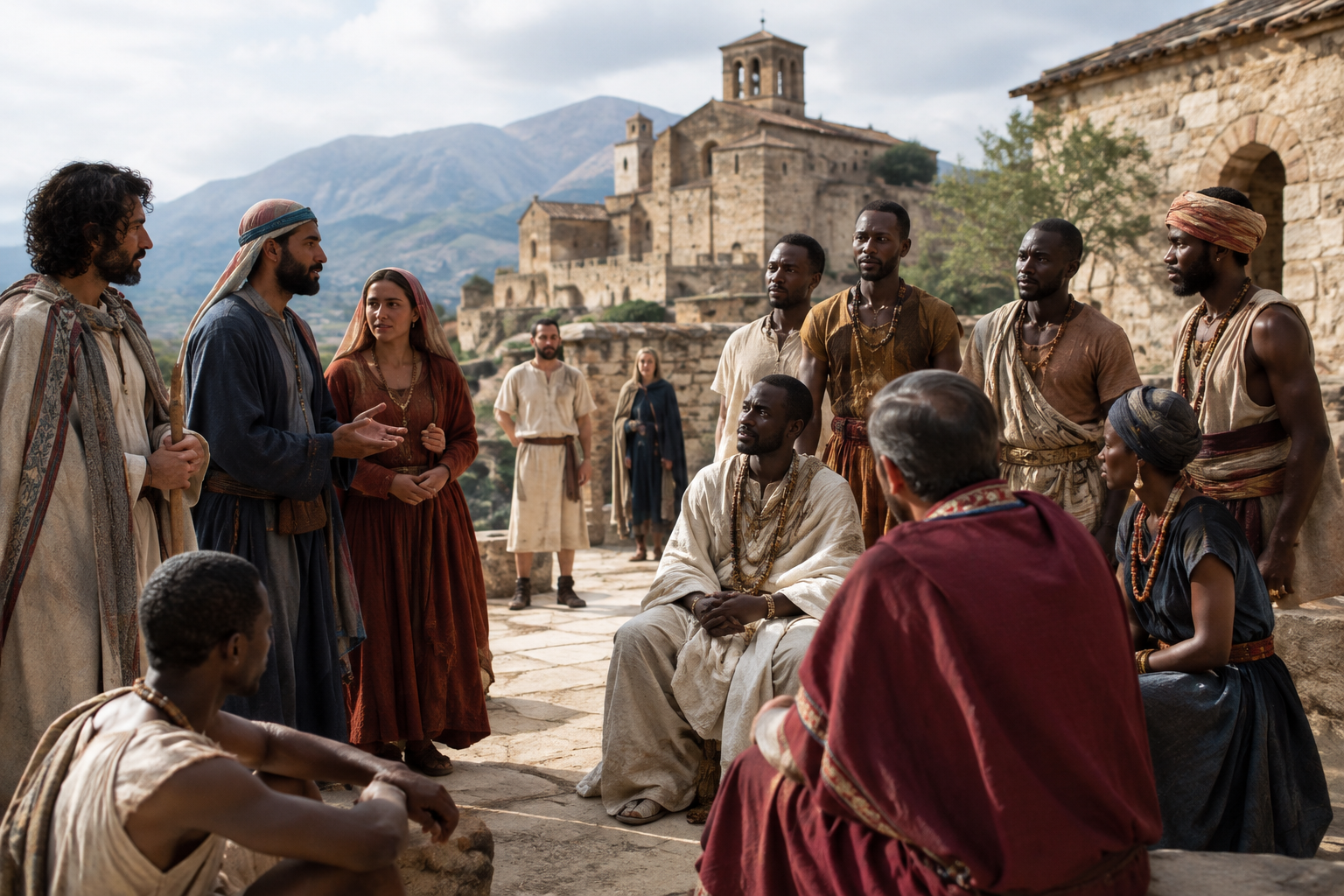
The supplied samples then shift the story southwards in a rather dramatic way. At Kulubnarti in Makurian Nubia, several individuals belong to this haplogroup context: I19015 and I19138 from 810 AD, I6336 from 870 AD, I6252 from 790 AD, and the earlier Makurian individuals I18514, I18610, and I18612, each dated to 750 AD. There is also I8904 from Kenya Kokurmatakore PIA, dated to 600 AD.
This cluster is important because it shows that the haplogroup was not merely a Mediterranean curiosity. It also belonged in African historical settings south of Egypt. Medieval Nubia was no backwater. Makuria was a Christian kingdom tied into Nile traffic, regional diplomacy, and long-distance contact. The appearance of multiple Kulubnarti individuals suggests not a lone outsider but the presence of this paternal ancestry within a real community across generations.
That does not mean every Kulubnarti man was closely related in any simple genealogical sense, nor does it prove a single migration event from the Levant or elsewhere. But it does suggest durability. A paternal line associated with the broad E1b1b world could be thoroughly at home in medieval Nubia.
The Kenya sample, I8904, broadens that frame again. Taken together, these finds make E1b1b1a1a1c1 look less like a branch confined to one modern region and more like part of a belt of paternal ancestry stretching through northeastern Africa and into connected Mediterranean zones.
Explore North African Population History
Then the trail reaches Italy. Two supplied individuals are especially useful here: R59 from Medieval Villa Magna Italy, dated to 905 AD, and ASM_S23 from High Medieval Italy Abruzzo Amiternum Santa Maria in Civitate, dated to 1087 AD.
These are precisely the kinds of finds that make ancient DNA so valuable. Written history can tell us that medieval Italy was politically fragmented and deeply connected: Lombard legacies, papal territories, Byzantine influence in some regions, trade across the Adriatic and Mediterranean, and local continuity from Roman and post-Roman populations. But a Y-lineage like this gives us a very specific paternal clue within that complexity.
The Italian samples do not prove a direct line from Phoenician Achzib to Amiternum, still less from medieval Italy to any later aristocratic family. Yet geographically and historically they are suggestive. Italy was one of the great meeting grounds of Mediterranean ancestry. A paternal lineage with older eastern Mediterranean and African associations appearing in medieval Italian contexts is entirely plausible and historically illuminating.
In particular, ASM_S23 from Amiternum anchors the story in central Italy's early medieval world, where Roman inheritance, Christian institutions, and shifting political authority all met. Readers interested in that local backdrop may want to explore more in MyTrueAncestry's piece on Amiternum.
The documentary world of later noble families belongs to a very different kind of evidence from ancient burials, but it can still add an interesting second layer. Where ancient DNA gives us deep paternal history in scattered places, aristocratic records show how later families curated descent, property, status, and memory across centuries.
The principal later family supplied here is the House of Howard, one of the most prominent aristocratic houses in English history. The Howards rose to immense political and social importance in medieval and early modern England, becoming closely associated with the high nobility and the workings of the crown. In historical terms, they belong to a world very far removed from Phoenician ports or Makurian churchyards, yet that contrast is part of what makes the comparison useful. Haplogroups move through time in one way; noble families preserve themselves in another.
Any reported association between a later noble house and a Y-DNA haplogroup must be treated with care. It does not mean that every historical Howard male carried the same paternal signature, nor does it establish a documented genealogical bridge from the ancient individuals discussed above to the family itself. Surnames, inheritance, non-paternity events, cadet branches, and incomplete testing all complicate the picture. Still, the Howard name provides an important example of how interest in paternal descent extends beyond archaeology into the better-documented worlds of heraldry, landed power, and family tradition.
For readers exploring this haplogroup, the House of Howard is therefore best understood not as proof of a direct line from antiquity, but as a later historical association that shows how one paternal lineage can sit beside the grand architecture of noble memory. Ancient DNA tells us where this branch appears in the buried record. Families such as the Howards remind us how later societies turned lineage into institutions, titles, estates, and public prestige.
The associated ancestral seat supplied here is Castle Howard in North Yorkshire. Despite its name, it is not a medieval fortress in the classic sense but a great aristocratic country house, and that is precisely why it is historically revealing. Built from 1699 for Charles Howard, it was designed mainly by Sir John Vanbrugh with Nicholas Hawksmoor. The result was a grand Baroque residence that advertised the Howard family's wealth, taste, and standing in unmistakable architectural terms.
Castle Howard helps anchor the Howard name in a real landscape. Aristocratic houses of this kind were not merely private dwellings. They were seats of influence, places where family history was staged through design, collections, portraiture, and ceremonial space. In that sense they are valuable companions to genealogical inquiry, because they show how lineages were displayed and remembered in the centuries before modern genetics.
The house also had its own dramatic later history. A major fire in 1940 caused serious damage, after which the building was restored. Today it is widely known for its architecture, its art collections, and its appearances in film and television. For anyone interested in the historical families sometimes associated with particular Y-DNA lineages, Castle Howard offers a tangible surviving setting: not evidence of genetic descent in itself, certainly, but a vivid reminder that paternal lines were also lived out in estates, landscapes, and built monuments that still shape the historical imagination.
What, then, of later aristocratic Britain? Here we need to be especially careful. The supplied noble association is the House of Howard, linked with Castle Howard in North Yorkshire. That does not, by itself, prove that the Howard paternal line was E1b1b1a1a1c1, nor that any ancient sample discussed above was ancestrally connected to the family in a documented genealogical sense. Genetics and genealogy are not interchangeable.
But the Howard connection is still historically evocative. Castle Howard, begun in 1699 for Charles Howard, later the 3rd Earl of Carlisle, was designed chiefly by Sir John Vanbrugh with Nicholas Hawksmoor. It was built in a bold baroque style meant to impress as much as to house. That point is deliciously telling. Noble residences are not only homes; they are arguments in stone about memory, status, and inheritance.
The house rose on the site of the old village of Henderskelfe, which was cleared away, and over time became famous for its dome, vistas, gardens, temples, and collections. A disastrous fire in 1940 wrecked the central dome and many state rooms, yet the building was slowly restored and remained in Howard hands. In other words, Castle Howard is not a medieval fortress in the narrow sense, but an ancestral seat that dramatizes how families curate the past.
That is where it joins the story of haplogroups. Noble houses preserve lineage through documents, marriages, titles, portraits, and estates. Ancient DNA preserves lineage through bone and tooth. The two records are different, sometimes complementary, sometimes stubbornly unrelated. Yet both ask the same old question: who came before, and how do we know?
For readers interested in the family itself, MyTrueAncestry has a dedicated article on the Howards that sits neatly beside this wider paternal-line discussion.
E1b1b1a1a1c1 is historically interesting not because it can be pinned to one grand label, but because it resists one. In the supplied ancient evidence, related paternal ancestry appears in Phoenician coastal Israel, medieval Nubia, Kenya, and medieval Italy. That distribution suggests a lineage at home in zones shaped by African and Mediterranean movement over very long periods.
It also shows why ancient DNA is so useful for public history. Traditional genealogy tends to begin with surnames, charters, heraldry, and parish records. Ancient DNA begins elsewhere: cemeteries, churches, river islands, ruined settlements, and forgotten burials. Neither method on its own tells the whole story. But together they can reveal a world far more mobile, mixed, and connected than older nationalist histories liked to admit.
If your own Y-DNA falls within a branch like E1b1b1a1a1c1, that does not make you Phoenician, Nubian, Italian, or Howard by simple right. What it may do is place one line of your ancestry within the same broad historical networks that linked the Levant, Africa, and Europe across centuries.
Upload your DNA to MyTrueAncestry to explore whether your results show connections to ancient individuals like I11788, I11794, ASM_S23, R59, or the Kulubnarti burials. These matches can offer remarkable historical perspective, even when they do not prove direct descent from a specific ancient person or noble family.


Comments