Haplogroup E1b1a

– 6 min read


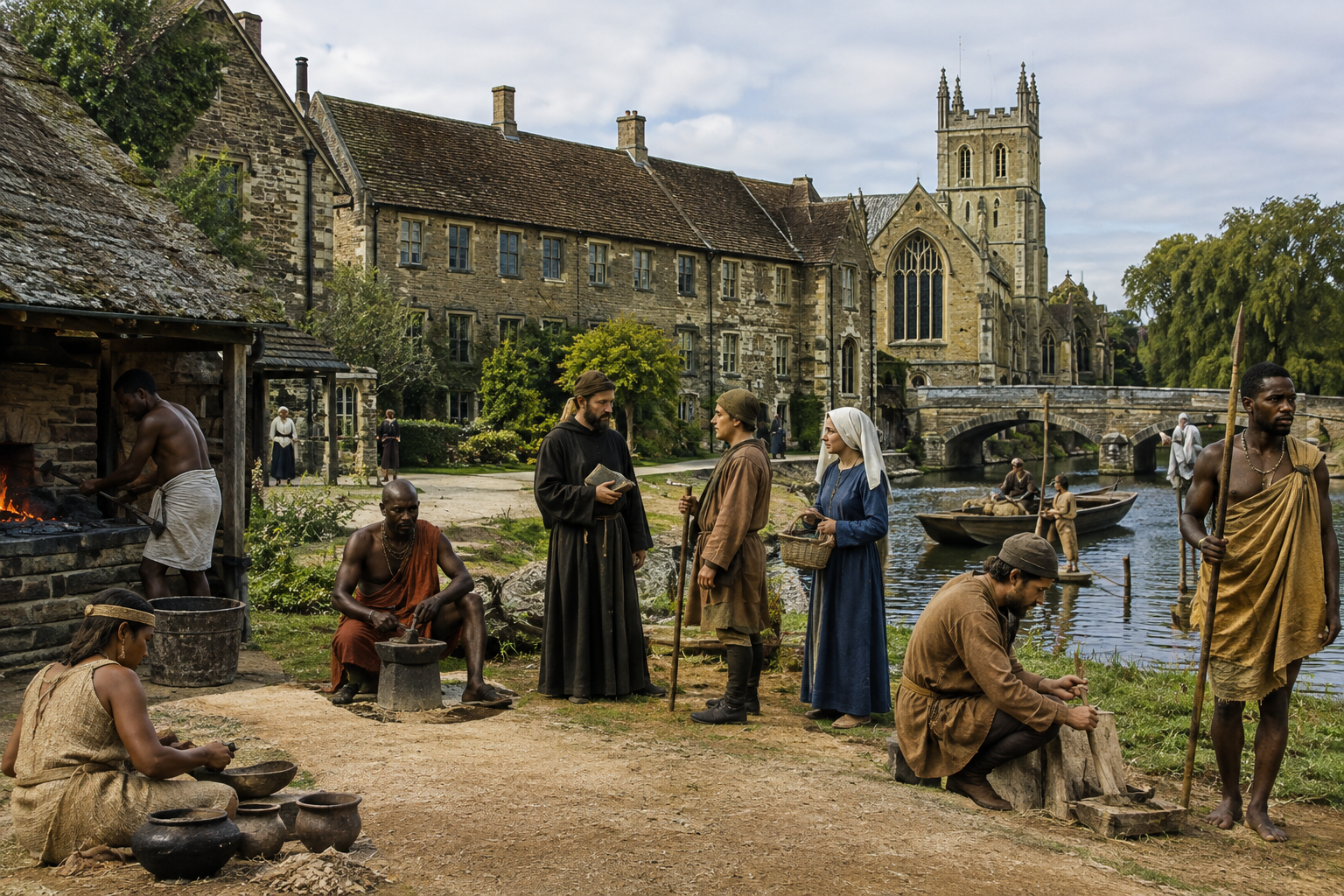
Some Y-chromosome haplogroups turn up in the historical record like the repeated appearance of a family name in a parish register: here, then there, and then unexpectedly somewhere far away. E1b1a is one of those lineages. It is especially important because, in broad terms, it is one of the major paternal branches associated with large parts of sub-Saharan African population history, and ancient DNA is now letting us watch parts of that history unfold in real archaeological contexts rather than in abstract genetic diagrams.
That matters because Y-DNA traces only one line of descent: the direct paternal line, father to son to son. It does not describe a person's whole ancestry, culture, language, or identity. But as a narrow historical tool, it can be remarkably revealing. In the case of E1b1a, the evidence supplied here places this paternal lineage in strikingly different worlds: Bronze Age Romania, Iron Age Botswana, medieval Tanzania, medieval England, and even among the remains of an enslaved laborer in antebellum Maryland. That is not one simple story. It is a reminder that human history is rarely tidy.
Within the wider Y-chromosome tree, E1b1a belongs to haplogroup E, a major African branch with deep importance in the study of paternal ancestry. E1b1a itself is best known in broad population-genetic terms for its strong presence across much of sub-Saharan Africa, especially in connection with later population expansions within and beyond West and Central Africa. Exactly how its many downstream branches spread, and how particular subclades moved at different times, remains a matter of detailed research rather than a single settled tale.
That caution is important. A broad haplogroup such as E1b1a can contain many branches with different local histories. So we should not lazily pin one migration, one ethnicity, or one civilization onto the entire lineage. What we can say is that ancient DNA increasingly shows E1b1a-associated paternal lines in a range of African settings, and occasionally in Europe and the wider Atlantic world, where they speak to mobility, contact, settlement, enslavement, and the complicated business of human movement over centuries.
The wider background is worth exploring in the Balkan context too, because one of the most intriguing samples in this set comes from Bronze Age Romania. Readers interested in deeper regional prehistory may also enjoy this related MyTrueAncestry article on Balkan population history.
The earliest sample in this group is GAS004, listed as Bronze Age Romania Gambas Wietenberg Culture Year:1631 BC. The Wietenberg Culture belongs to the Middle Bronze Age in Transylvania and nearby regions, a world of fortified settlements, metalwork, and regional exchange. An E1b1a lineage here is arresting precisely because it does not fit old-fashioned ideas of neatly bounded ancient populations. One sample cannot tell us the whole route by which that paternal line arrived in Bronze Age Romania, and it certainly does not prove mass migration. But it does show that the Carpathian world could include men whose direct paternal ancestry linked into a much wider genetic map.
If we move south into Africa, the picture becomes less surprising in one sense and more illuminating in another. TAU001, from Taukome Botswana Iron Age Year:950 AD, places E1b1a in an Iron Age southern African setting. Here the lineage sits in a region transformed by farming, metallurgy, and linked communities spread across the subcontinent. Likewise I19548, from Medieval Tanzania Songo Mnara Year:1430 AD, belongs to the Swahili coast's brilliant mercantile world of coral-built towns, Indian Ocean trade, and mixed local and overseas connections. In these African contexts, E1b1a is not an exotic curiosity but part of the living demographic fabric.
Then comes a sample with a very different moral weight: I15341, listed as Enslaved Laborer Catoctin Iron-Working Furnace Antebellum Maryland Year:1810 AD. Here the haplogroup is no longer simply about deep population history. It enters the documentary age of coercion, forced migration, and slavery in the Atlantic world. A paternal line with older African roots appears in North America not as an abstract marker of dispersal, but in the remains of a man caught in a system of exploitation. Genetics cannot restore his name or biography on its own, but it can help place him back into the human history from which slavery tried to sever him.
For readers interested in how genetics can illuminate industrial and laboring populations in Britain and beyond, this related article offers an excellent companion piece.
Read DNA and the Industrial Age
The English medieval samples are perhaps the most unexpected cluster in the list. They include ATP_PSN_225 and ATP_PSN_25 from Medieval England Cambridge St Johns Hospital Year:1250 AD, ATP_PSN_193 from the same institution dated 1209 AD, ATP_PSN_742 from Late Medieval England All Saints Year:1150 AD, ATP_PSN_517 from Medieval England Augustinian Friars Year:1290 AD, and ATP_PSN_1270 plus ATP_PSN_1267 from Late Medieval England Clopton Cambridgeshire Year:1300 AD.
What are we to make of this? Not, certainly, that medieval England was somehow full of one easily defined "E1b1a population." Nor should we leap from a haplogroup to assumptions about appearance, social standing, or precise geographic origin. But these samples do underline something now increasingly clear from medieval DNA studies: English towns, hospitals, friaries, and churchyards could contain men from a variety of paternal backgrounds. Some may reflect long-settled family lines in Britain, others more recent movement from elsewhere in Europe or beyond, and some perhaps the afterlife of earlier mobility under Roman, post-Roman, or medieval trade networks.
Cambridgeshire in particular has become an unusually rich laboratory for this kind of work, where burial grounds reveal not a frozen "medieval English type" but a population full of local continuity mixed with movement and diversity. If that surprises us, it may say more about modern stereotypes than about the Middle Ages.
Readers who want more on these Cambridgeshire burials should have a look at this related study.
Explore Medieval Cambridgeshire DNA
What makes E1b1a so interesting is not that it belongs to one kingdom or one people, but that it keeps appearing where human connections were busy and complicated: Bronze Age exchange zones, Iron Age farming landscapes, coastal trading towns, religious institutions, colonial labor sites. It is a salutary lesson in how paternal ancestry travels through history. Sometimes it spreads through demic expansion; sometimes through marriage and household formation; sometimes through trade; sometimes through violence and enslavement.
That also means we must be careful with later family history. The prompt supplied no specific noble family or castle data to anchor a responsible discussion of aristocratic lineages here. So it would be quite wrong to invent a grand medieval dynasty for E1b1a or attach the haplogroup to some castle-owning house without evidence. Genetic history is most useful when it resists that temptation.
What we can say is that the medieval and early modern worlds preserved in noble genealogies represent only a tiny, unusually documented fraction of the people who carried lineages like E1b1a. Ancient DNA widens the frame. It restores farmers, friars, hospital burials, townsmen, merchants, and enslaved workers to the story. Written pedigree is only one form of memory; genetics and archaeology preserve another.
For a broader view of how ancient DNA has revealed mixed origins and population diversity in medieval and early historic settings, this related article is well worth reading.
Discover Diverse Medieval Origins
E1b1a reminds us that paternal history is both precise and limited. Precise, because a Y-chromosome lineage can connect archaeological finds across wide distances and long periods. Limited, because sharing a broad haplogroup does not make two men close relatives, and it does not prove direct descent from an excavated individual, still less from any noble house. The man buried at Songo Mnara, the individual from Taukome, the medieval burials from Cambridge, and the laborer from Maryland are not chapters in a single family tree that we can simply draw in ink.
Yet they do belong in the same historical conversation. Together they show how one paternal branch can illuminate African population history, Eurasian contact, medieval mobility, and the Atlantic slave system. That is a great deal for a single haplogroup to carry. And perhaps the real fascination lies there: not in claiming too much, but in seeing how a thin line of paternal descent intersects with the full untidy scale of human history.
If your own Y-DNA includes E1b1a, or a downstream branch beneath it, MyTrueAncestry can help place that paternal line in a wider archaeological setting. You may discover genetic similarities to ancient individuals or historical populations discussed here and elsewhere on the site. Those matches do not automatically prove direct genealogical descent or membership in a particular historical family, but they can offer a vivid new way of understanding where your ancestry fits into the human past.






Comments