Haplogroup E

– 5 min read


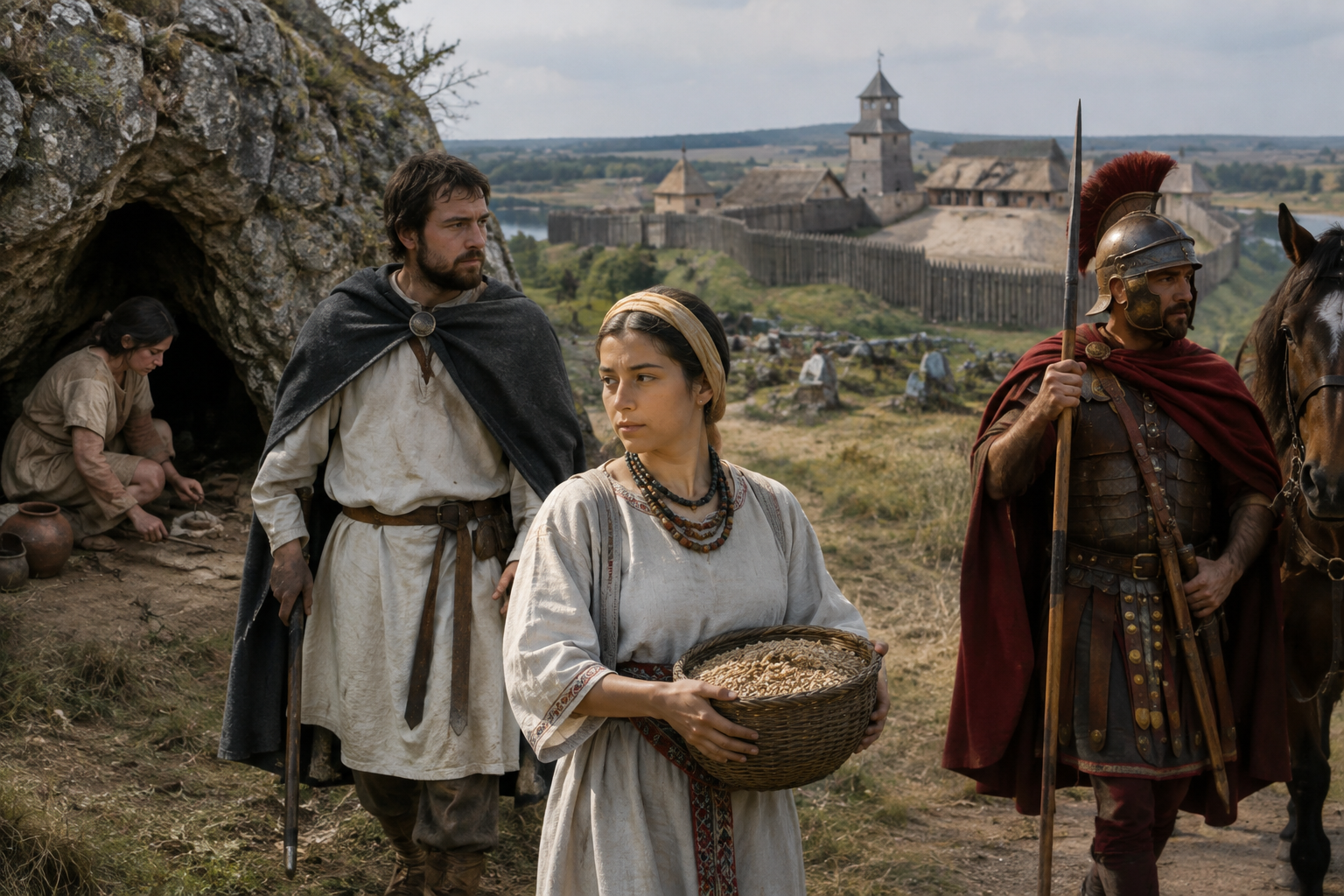
At Verteba Cave in western Ukraine, one ancient male known as I3151 was living or being buried around 3800 BC, in the world archaeologists associate with the Trypillian horizon. That matters because Verteba is not just any cave site: it has become one of the best-known windows into the farming communities of prehistoric eastern Europe. In this setting, the broad Y-DNA haplogroup E appears in a very early agricultural landscape far from the regions where many people first expect to encounter it.
That is the useful surprise of haplogroup E in ancient DNA. On the Y chromosome, it traces one direct paternal line only, not a person's whole ancestry. But when a lineage this broad turns up in places as different as Neolithic Ukraine, post-Roman Croatia, and medieval Poland, it reminds us that Europe's paternal history was never a neat map of isolated peoples. It was movement, mixture, resettlement, and continuity all at once.
The oldest sample here, I3151, comes from Verteba Cave, a major site connected with the Trypillian cultural sphere of the fourth millennium BC. This was the age of large farming settlements, striking ceramics, and expanding village life in parts of what are now Ukraine and Moldova. A male from this context reported under haplogroup E places that paternal line within one of Europe's important Neolithic societies.
What should we make of that? First, not too much and not too little. It does not mean all Trypillians belonged to haplogroup E, nor does it turn haplogroup E into a uniquely "Trypillian" lineage. But it does show that this branch was present among early farming populations in eastern Europe, where communities were already the product of earlier movements from the southeast and ongoing contact across the north Pontic zone.
A broader ancient DNA study touching this prehistoric region can be found in this research on genomic ancestry and migrations in the North Pontic area. Even without forcing one sample into a grand migration tale, Verteba helps anchor haplogroup E in a real archaeological landscape of houses, caves, ritual deposits, and farming communities that were anything but static.
North Pontic ancestry and migrations
There is an important technical point here. The article haplogroup is E, which is a very broad parent lineage with a deep history reaching far outside Europe. For these ancient men, the evidence provided here supports discussing the parent branch E itself; it does not justify inventing a more precise terminal subclade unless a source explicitly gives one.
That matters because broad haplogroups can travel through many different historical settings. By the time we meet E in prehistoric and medieval Europe, we are not necessarily looking at one recent migration or one ethnic group. We are looking at a paternal line that had already branched and spread long before these individuals lived, and which could enter a region through several different episodes of population movement.
In other words, the story is not "haplogroup E arrived once and stayed put." The story is that real men carrying branches of E appear in very different communities over thousands of years, and archaeology lets us see those communities on their own terms.
The sample R3547, dated to around AD 580, comes from Novo selo Bunje in Croatia, in the unsettled centuries after Roman imperial rule in the western Balkans had fractured. This is one of the most interesting moments to encounter haplogroup E, because the sixth century AD was an age of local survival, imperial pressure, frontier change, and incoming populations.
Post-Roman Croatia was no empty stage waiting for one people to replace another. Communities in the region lived among the remains of Roman provincial life while new political and cultural identities were taking shape. A paternal lineage classified under E in this setting shows that older and wider Mediterranean-Balkan connections persisted within populations that were themselves changing.
That point fits well with research on long-term population history in the region, including a genetic study of ancient Croatia that examined continuity and changing paternal lineages. R3547 should not be turned into a mascot for any single ethnic label, but he is exactly the sort of individual who makes the post-Roman Balkans archaeologically vivid: a man from a local burial ground whose Y-DNA hints at the layered human history beneath later national stories.
Croatia's shifting paternal lineages
The third sample, PCA0236, is from medieval Greater Poland, at Poznan, dated around AD 1100. Now we are in the Piast-era world of emerging towns, Christian institutions, and increasingly formal political structures in central Europe. Haplogroup E here is a useful corrective to any simplistic picture of medieval Poland as genetically uniform.
Poznan was one of the key centers of early Polish state formation. A man carrying haplogroup E in that environment tells us that paternal diversity was part of medieval society in this region too. That diversity could reflect older population layers, movement along trade and ecclesiastical networks, contacts through warfare, or the long-term incorporation of people from different backgrounds into expanding medieval communities.
Crucially, a single man in medieval Poznan does not prove a foreign colony, a merchant diaspora, or elite descent from some distant founder. What it does show is that lineages with deep roots beyond the usual shorthand of "Slavic Europe" were entirely capable of being part of medieval Polish populations on the ground, in ordinary burial contexts.
Medieval Polish genetic origins
At first glance, Trypillian Ukraine, post-Roman Croatia, and medieval Poznan do not look like one story. But for haplogroup E they form a sensible archaeological sequence. They show the lineage in three very different historical worlds: early farmers in eastern Europe, populations living through the collapse and reshaping of Roman order in the Balkans, and medieval societies in the north where states and cities were consolidating.
That is valuable because ancient Y-DNA is most interesting when it breaks tidy assumptions. Haplogroup E is often discussed in very broad continental terms, yet these samples show why ancient evidence has to stay local. A cave associated with Neolithic farmers, a sixth-century burial in Croatia, and a man in medieval Greater Poland are not footnotes to one master narrative. They are separate moments in which one paternal branch appears inside very different communities.
Seen together, they also underline a basic lesson of archaeogenetics: Europe's past was full of paternal lineages that moved farther, earlier, and more irregularly than older ethnic maps suggested. The archaeological context is what stops the genetics from becoming vague.
Deep Balkan roots and medieval admixture
For someone who discovers Y-DNA haplogroup E in a modern test, these ancient cases offer a grounded way to think about the result. They suggest that your direct paternal line belongs to a branch with a long, mobile history, one that could appear in early farming societies, in the Roman and post-Roman Balkans, and in medieval central Europe without belonging exclusively to any one language, kingdom, or people.
The most distinctive lesson from these samples is not prestige or certainty, but range. Haplogroup E in ancient Europe is a reminder that paternal ancestry can preserve traces of movements much older and more complicated than later surnames or national identities. That is precisely why ancient DNA matters: it puts real men, in real places, back into the history of a lineage.






Comments