Haplogroup D1a1a1a1b2

– 5 min read


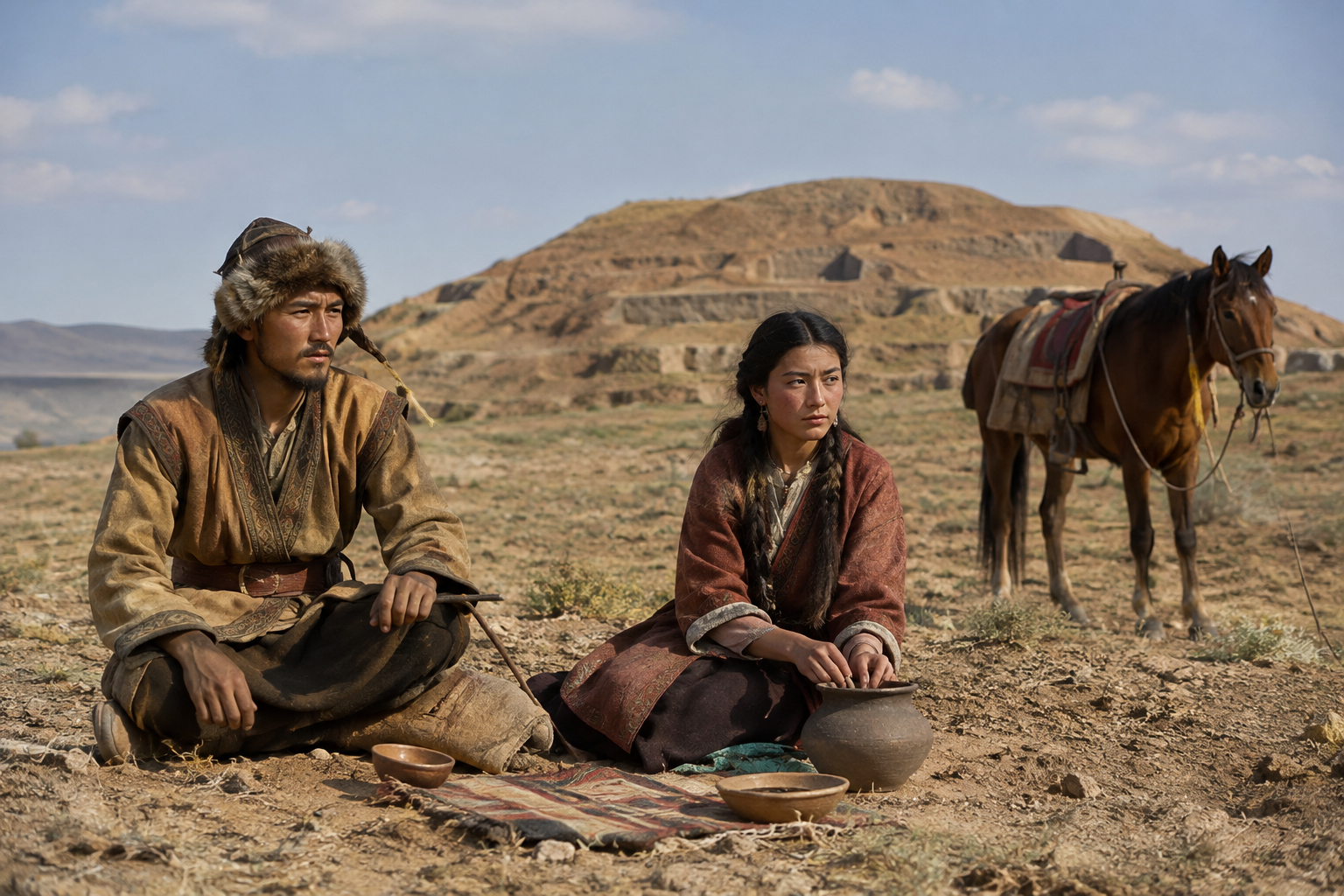
At Konyr Tobe, part of the Otyrar oasis in southern Kazakhstan, one ancient male identified as KNT004 offers a small but striking clue to a much larger story. Dated here to around AD 300, he belongs to a settlement world that sat at a crossroads: riverine agriculture, caravan exchange, and the long political afterlife of the steppe all met in this region. The Y-DNA branch associated with him is D1a1a1a1b2, a notably specific paternal lineage whose appearance in Central Asia is interesting precisely because it is not the branch most people would expect to encounter there.
That is the first thing to keep in view. Y-DNA follows one direct paternal line only, not a person's whole ancestry, language, or identity. But even one paternal line can be historically revealing when it turns up in the right place. In the case of KNT004, the value lies less in grand claims than in the setting: an oasis settlement in the wider Syr Darya zone, where the ancient world of Central Asia was never neatly divided into "steppe" and "civilization", but was instead a busy and sometimes unruly mixture of both.
Konyr Tobe belonged to the archaeological landscape of the Otyrar culture, a regional tradition linked to the middle Syr Darya basin. This was a world of towns, fortified settlements, cultivated land, and exchange routes that connected Central Asia with lands farther east and west. By around AD 300, the region had already seen centuries of contact among Iranian-speaking oasis populations, mobile steppe groups, and the merchant traffic that later writers would fold into the broad idea of the Silk Roads.
KNT004 matters because a lineage like D1a1a1a1b2, however we frame its deeper history, appears here in a place shaped by movement. Not movement in the simplistic sense of one tribe marching from one dot on the map to another, but movement through marriage, local integration, trade, military service, seasonal mobility, and political upheaval. A single male line preserved in ancient DNA can survive those processes even while everything else around it changes.
An ancient DNA study investigating population history across Inner Eurasia, published in Science Advances, helped underline just how mixed and regionally varied these Central Asian populations could be. That broader point is important here: when a rare or unexpected paternal branch appears at an oasis site, it fits a landscape where ancestry was often layered rather than uniform.
Haplogroup D is one of the older and more geographically distinctive branches in the human Y-chromosome tree. In present-day populations, its best-known concentrations are not in Central Asia's western oases but farther east and northeast, with important branches found among populations in East Asia and, in different sub-branches, in places as far apart as Tibet and Japan. That does not mean every subclade has the same history, and it would be a mistake to project the entire story of haplogroup D onto the narrower label D1a1a1a1b2.
What can be said responsibly is that D1a1a1a1b2 is a very fine-grained paternal classification, and its presence in an ancient Central Asian context points to a male line with connections outside the most familiar western Eurasian Y-DNA patterns. That does not tell us whether KNT004 saw himself as Sogdian, local oasis dweller, frontier settler, trader, soldier, or something else again. Archaeology and history insist on caution here. But the haplogroup does sharpen the sense that Central Asia's settled communities were often more cosmopolitan than older textbook maps suggested.
The date matters. Around AD 300, southern Kazakhstan stood in a long zone of interaction between the great sedentary centers of Transoxiana and the wider steppe sphere to the north and east. Political labels shifted over time, and local archaeology does not translate neatly into the names of peoples known from classical or Chinese texts. Yet the underlying fact remains: this was a frontier in the richest sense of the word, not a border fence but a corridor.
In such places, paternal lines can travel surprisingly far without requiring mass migration. A lineage may arrive with one man or one family generation, then become locally rooted. Or it may reflect older layers of population history that were already present in the region before the date of the burial. With only KNT004 in hand here, the honest historical approach is to keep several possibilities open.
That said, the Otyrar oasis was no backwater. Its position in southern Kazakhstan placed it near routes that linked the steppe, the Tian Shan approaches, and the urban centers of Central Asia. In other words, if one were looking for a place where an uncommon paternal branch might surface in a settled archaeological context, this is exactly the sort of region one would expect to be productive.
Readers are sometimes disappointed by single-sample evidence, as if history only begins when a cemetery yields dozens of matching men. But archaeology is often built from exactly these fragments. KNT004 does not prove that D1a1a1a1b2 was common in the Otyrar culture, and it certainly does not prove a ruling dynasty or a named tribe. What he does provide is a documented ancient occurrence, fixed to a time and place, that anchors this haplogroup in the historical landscape of southern Kazakhstan.
That anchor matters for descendants and researchers alike. Modern paternal-line studies often begin with present-day distributions and then work backward, which can tempt people into drawing straight arrows across the map. Ancient DNA disrupts that habit. It shows that lineages now associated with one region may have had a wider or at least more complicated ancient spread, especially in contact zones.
Central Asia repeatedly produces this sort of corrective. The region was not merely a bridge between civilizations; it was itself a generator of new local combinations. Men carrying different Y-DNA branches could end up living in the same town, participating in the same economy, and being buried within the same cultural horizon while having very different paternal deep histories.
There is another reason KNT004 is valuable. He reminds us how badly older historical habits can mislead. Archaeologists may speak of an "Otyrar culture", historians may discuss Iranian, Turkic, Saka, Kangju, or Hunnic spheres, and geneticists may identify a very specific Y-chromosome branch. These are not interchangeable labels. Material culture, language, political allegiance, and paternal descent each tell different parts of the story.
So a man from an Otyrar cultural setting with Y-DNA D1a1a1a1b2 should not be turned into a mascot for any single ethnic narrative. Better to see him as evidence of the human reality of Inner Eurasia: communities formed through overlap, absorption, and continuity as much as through conquest. That is a more interesting picture anyway, and rather closer to what archaeology usually finds when the dust settles.
For comparison with another Central Asian case where ancient DNA helps untangle identity and mixture in a historically connected region, see this post on Sogdian ancestry and Silk Road admixture. It deals with a different setting and period, but the broader lesson is similar: old trade worlds were full of biological and cultural complexity.
For someone who belongs to D1a1a1a1b2 today, KNT004 does not offer a ready-made pedigree. What he does offer is something more solid than romance: evidence that this paternal branch, or a lineage associated with it, was present in the Otyrar region of southern Kazakhstan around AD 300. That places your direct male line, at least in one documented case, within the mixed oasis-and-steppe world of ancient Central Asia, where settled life and long-distance mobility were constantly entangled.
It is a modest finding, but a good one. Ancient DNA is often at its best not when it confirms a legend, but when it restores the real historical texture of a place. KNT004 does exactly that.





Comments