Haplogroup C2b1a1b

– 5 min read


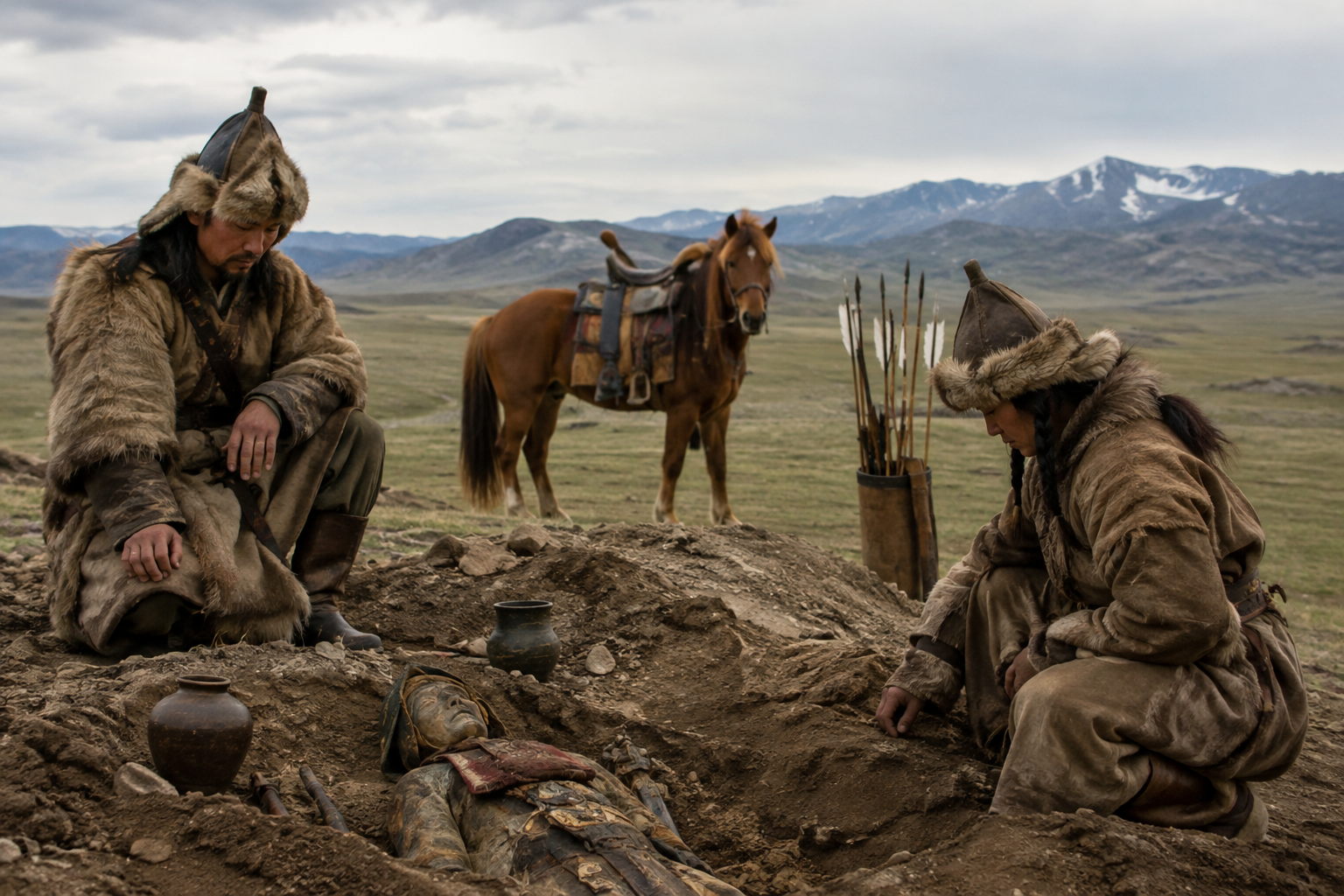
At Khovd in western Mongolia, one excavated burial stands out because it puts a very specific paternal line into the heart of the Xiongnu world. The individual labelled SBB010, dated to around AD 100 and described as an elite grave associated with an archer, has been linked in MyTrueAncestry's ancient DNA material to the Y-DNA haplogroup C2b1a1b. That is immediately interesting, not because one grave can explain an empire, but because the Xiongnu were never a simple, single-ancestry people.
What a Y-DNA line captures is only one strand of a man's ancestry: his direct paternal line, father to father to father. But in steppe archaeology that narrow thread can be extraordinarily revealing, especially when it turns up in a burial assigned elite status. In the case of C2b1a1b, the value lies less in grand myth-making than in watching how a paternal branch appears in one of the most politically important steppe confederations of the late Iron Age and early historic period.
The Khovd region sits in western Mongolia, a landscape of corridors, uplands, and routes rather than tidy borders. By around the first centuries BC and AD, this was part of the immense zone influenced by the Xiongnu Empire, the confederation that looms so large in Chinese historical writing and increasingly in archaeogenetics. The sample SBB010 matters because it anchors C2b1a1b not in a modern surname project or a speculative dynasty, but in an actual excavated person from that world.
We should be careful with the label "elite grave archer." It tells us something about archaeological interpretation and social rank, but not everything people often rush to imagine. It does not mean that SBB010 was a king, that his paternal line ruled the whole Xiongnu Empire, or that every man buried nearby belonged to the same branch. What it does show is that this paternal lineage was present in a socially prominent funerary context in western Mongolia at a time when Xiongnu power connected communities across the eastern steppe.
A recent ancient DNA study on the Mongolian steppe, published in Science Advances, has helped sharpen this larger picture: Xiongnu-period populations were genetically diverse, with different local histories feeding into imperial structures. That broader finding is exactly the sort of setting in which a branch like C2b1a1b becomes historically meaningful.
Haplogroup C2 in its wider sense is one of the major paternal lineages of northern and eastern Asia, and it appears repeatedly in discussions of steppe and Inner Asian population history. But this article concerns the narrower branch C2b1a1b, not the whole parent haplogroup. That distinction matters. A broad C2 history stretching across vast regions and many millennia cannot automatically be assigned to this exact subclade without specific evidence.
So the responsible claim is modest and solid. In the MyTrueAncestry material, SBB010 is associated with C2b1a1b, placing that branch in a Xiongnu-period elite burial in western Mongolia around AD 100. That does not by itself identify an original homeland, a tribal name, or an unbroken line of famous descendants. It does, however, place the branch inside a real historical setting shaped by mounted warfare, alliance-building, and imperial expansion across the steppe.
For anyone researching this haplogroup today, that is no small thing. Many Y-DNA articles are tempted to sprint from a branch name straight to sweeping civilizational claims. Here, the more interesting story is narrower and therefore stronger: C2b1a1b appears in the paternal landscape of a Xiongnu-connected elite, in a region where power depended on mobility and networks rather than fixed capitals and neat ethnic boxes.
One of the most important corrections supplied by ancient DNA is that steppe empires were not biologically uniform blocs marching across the map with a single origin story. The Xiongnu confederation drew together people and communities from different backgrounds. Archaeology had already hinted at this through burial variation, regional differences, and the scale of the political system. Genetics has reinforced it.
That makes SBB010 more valuable, not less. A single high-status burial with C2b1a1b does not stand for every Xiongnu man; instead, it shows one paternal thread woven into a wider imperial fabric. In historical terms, that is exactly how steppe polities often worked. Power could be concentrated, prestigious, and hereditary in some contexts, while the confederation itself remained mixed and shifting.
This is also why it is risky to treat any one lineage as "the Xiongnu haplogroup." Ancient empires do not behave like modern family trees. A man with C2b1a1b buried in elite circumstances tells us about one paternal presence within the Xiongnu sphere, and perhaps about the kinds of lineages that could be incorporated into its upper ranks, but not about a single bloodline controlling the whole enterprise.
Western Mongolia is not just a peripheral backdrop. It is one of the great contact zones of Inner Asia, linking the Mongolian steppe with the Altai and wider trans-Eurasian routes. A burial there can speak to more than local history. It hints at how lineages, allegiances, and military roles moved across an imperial landscape that reached far beyond a single valley or cemetery.
An "archer" designation also fits the larger military culture of steppe polities, where mounted archery was central to warfare and political power. We should not embroider that into a romantic saga of horse-lords and clan banners, because the grave summary we have is brief. Still, the association is historically apt: this was the kind of world in which martial skill, mobility, and elite status could be closely tied.
When a paternal line like C2b1a1b appears in this context, it becomes part of a bigger question about how steppe aristocracies formed. Were elite paternal lines long-established in one region, or were they drawn into power through alliances and imperial integration? One grave cannot settle that debate, but it places this lineage squarely inside it.
There is another reason not to dismiss a lone sample. Ancient DNA from eastern and Inner Asia is still unevenly distributed across time and region. Every securely placed burial helps refine the map. SBB010 gives C2b1a1b a firm archaeological foothold in a period when empires on the steppe were reorganising people on a large scale.
That does not mean modern carriers of C2b1a1b descend from this one man, nor that their family history must run through Mongolia in a simple line. But it does mean their paternal branch is compatible with a history in the wider northern and eastern Asian world that included powerful steppe societies. In genealogical terms, this is the difference between fantasy and evidence: not a named ancestor, but a documented historical setting.
Readers interested in the deeper paternal picture for East Asia may also want to look at broader work on ancient Y-chromosome patterns, because regional histories were shaped by multiple inland and steppe-linked movements rather than one single expansion.
Ancient East Asian Y-Chromosomes
The strongest ancient clue for C2b1a1b here is not a legendary founder or a royal pedigree, but the excavated man SBB010 from an elite Xiongnu-context grave in Khovd around AD 100. That places this paternal branch in the political and military world of Inner Asian steppe empires, where status, mobility, and mixed origins all mattered. For someone exploring this haplogroup today, the responsible takeaway is a good one: your direct paternal line has a documented connection to the archaeology of the Xiongnu age, one of the most dynamic periods in the history of the Mongolian steppe.






Comments