Haplogroup C2a1a1b1

– 5 min read


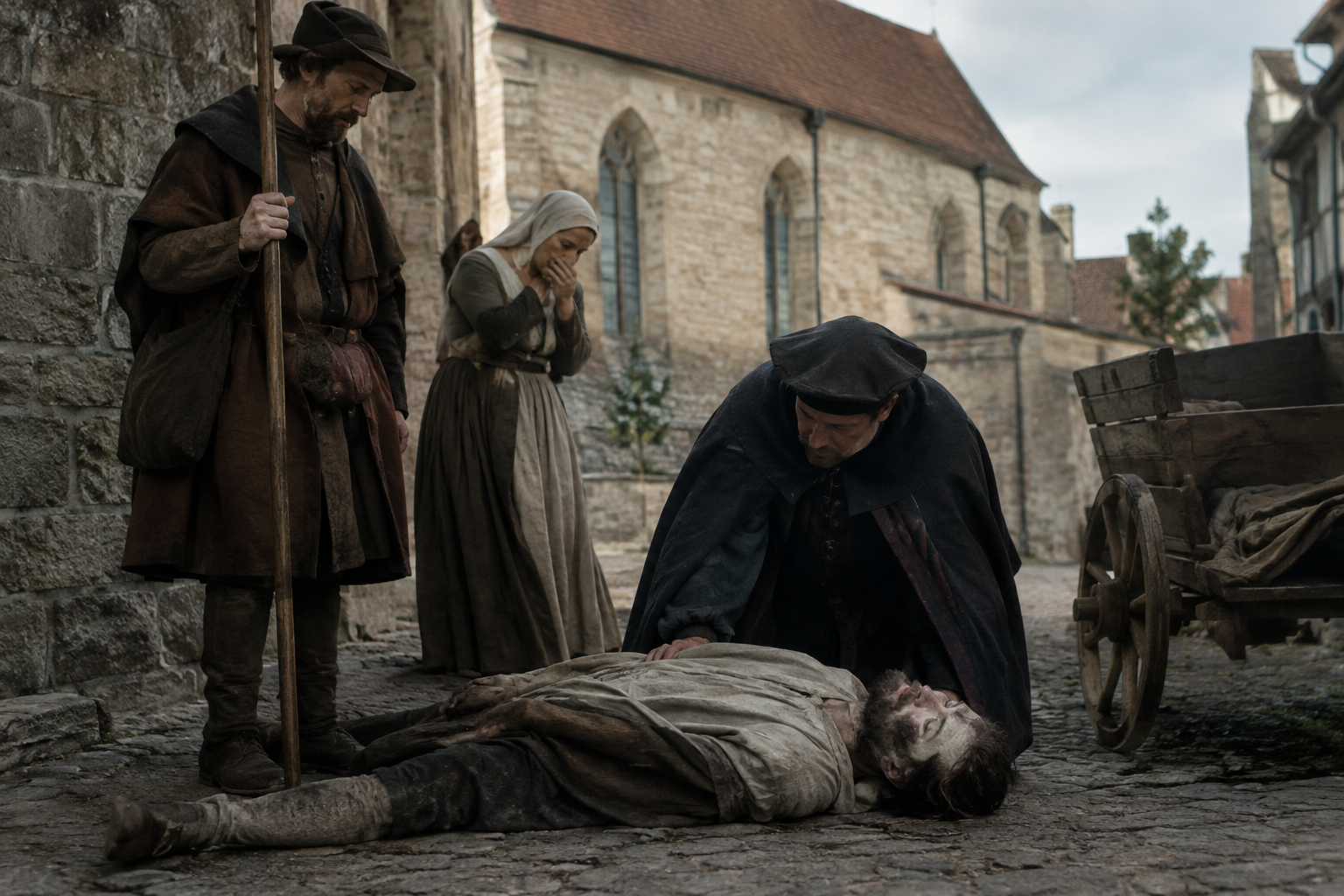
In Ellwangen, in southern Germany, one of the most arresting genetic discoveries from a post-medieval burial ground came not from a prince or a warrior, but from a plague victim. The individual identified as ELW037, dated to around AD 1550, belongs to a cemetery associated with an outbreak of epidemic disease. His reported Y-DNA assignment connects him to haplogroup C2a1a1b1, a paternal branch far more often discussed in connection with Inner Asia and eastern Eurasia than with sixteenth-century Swabia.
That is precisely why this burial matters. A single Y-chromosome does not tell us a person's whole ancestry, language, or identity, but it can preserve the trace of one direct paternal line across enormous stretches of space and time. In the case of ELW037, the surprise is not simply that a man carrying C2a1a1b1 died in Germany. It is that he appears in a very specific historical setting: a plague cemetery in the fragmented, mobile, deeply connected world of early modern central Europe.
Ellwangen's post-medieval plague burials belong to a period when disease outbreaks still shaped town life with brutal regularity. By the mid-sixteenth century, the Holy Roman Empire was a patchwork of ecclesiastical territories, market towns, military obligations, and long-distance trade routes. People moved for work, war, marriage, pilgrimage, and service. Epidemic cemeteries, grim as they are, can therefore reveal unexpected layers of population history that ordinary written records never captured.
Sample ELW037 stands out because his paternal line is unusual for the region. That does not mean he was necessarily a recent arrival from the steppe, nor that his family story can be read directly from a haplogroup label. It does mean that the male line behind him had a history extending beyond the usual central European pattern, and that by about AD 1550 this lineage had become part of the human landscape of southwestern Germany.
A wider ancient DNA study of plague-era burials and pathogen recovery in Europe has helped show how these cemeteries can preserve both human ancestry and the history of disease, though one must be careful not to push beyond what a single burial can bear as evidence. Research associated with these contexts can be found in this scientific study, which illustrates how post-medieval epidemic burials are now yielding insights well beyond the pathogen itself.
Ancient plagues and epidemic DNA
Haplogroup C is one of the major old branches of the human Y-chromosome tree, and some of its descendant lines are especially well known in eastern Eurasia and the steppe world. The narrower branch C2a1a1b1 is not a synonym for any one people, empire, or ethnicity. It is a genealogical line: one paternal thread among many that may pass through very different linguistic and cultural worlds over the centuries.
That distinction is worth making clearly. A man buried in plague-time Germany with Y-DNA C2a1a1b1 was not thereby "Mongol" in any simple sense, just as a man with a typically western European haplogroup was not automatically "Germanic" in a pure or timeless sense. Archaeology and history deal in layered identities. Y-DNA adds one sharply focused line of descent, not the whole portrait.
Still, some paternal lines do carry historical interest precisely because they seem out of place at first glance. C2-related lineages have figured in discussions of steppe expansions, Inner Asian political formations, and long-distance mobility across Eurasia. That makes ELW037 an intriguing reminder that by the early modern period, central Europe was not genetically sealed off from wider continental histories.
Steppe genetics and ancient DNA
The honest answer is that there is more than one plausible route, and the burial itself does not let us choose confidently between them. By AD 1550, central Europe had behind it a millennium of movements involving Huns, Avars, Magyars, Mongol-era contacts, mercenary service, trade diasporas, enslaved populations, diplomatic travel, and local family histories that had long since ceased to look "foreign" in any documentary sense.
Germany, after all, sat in the middle of a continental traffic system. Men moved through imperial armies, princely courts, artisan networks, merchant circuits, and ecclesiastical service. A paternal line with deeper roots further east might have entered central Europe centuries before ELW037 lived, then simply persisted through ordinary family descent until one descendant died in a plague outbreak and was buried at Ellwangen.
That possibility is often more historically realistic than a dramatic tale of a single recent migrant. Lineages survive by continuity as much as by conquest. A rare Y-chromosome in one burial may represent not a sudden arrival, but the last visible point of a long-settled family branch whose earlier documentary trail has vanished.
There is a curious irony here. Epidemics flatten social differences in death, but they sometimes preserve diversity in the archive. Cemeteries created during outbreaks can capture a broader slice of a town's inhabitants than elite tombs ever do. Instead of dynastic self-presentation, one gets something closer to a cross-section of people caught in a common catastrophe.
That is one reason ELW037 deserves attention. He shows that unusual paternal lines were present not only in famous frontier cemeteries or steppe burials, but also in the ordinary urban and semi-urban populations of the early modern empire. If we encountered C2a1a1b1 only in eastern contexts, we might imagine its story ending there. Ellwangen suggests otherwise.
This also fits a larger pattern seen repeatedly in archaeogenetics: the populations of Europe were rarely as neat, local, or static as older nationalist histories preferred. Even when language and material culture appear regionally familiar, the people themselves may carry lineages shaped by much older movements across Eurasia.
Blending on the German frontier
With only one named ancient individual here, restraint matters. We should not claim that C2a1a1b1 was common in Ellwangen, nor that ELW037 founded a local clan, nor that his burial proves a specific migration episode. What we can say is narrower and more useful: by around AD 1550, a man carrying this paternal branch was part of a German plague-burial population.
That single fact is already historically rich. It places C2a1a1b1 within the lived world of Reformation-era central Europe, at a time of religious tension, repeated disease shocks, and intense human movement. It also reminds us that the genetic past is often recovered in the least glamorous places: emergency graves, disease cemeteries, and the bioarchaeological margins of written history.
For readers following broader questions of east-west genetic contact, the best comparison is not with royal genealogies but with other studies showing how Eurasian mobility left small but detectable marks far from where we might expect them. That is one reason work on northern Eurasian and steppe-linked population history remains so relevant to interpreting isolated finds in Europe.
Northern Eurasia and ancient DNA
Haplogroup C2a1a1b1 enters the historical record here not through grandeur, but through mortality. ELW037 of Ellwangen was one man in one plague cemetery, yet his Y-chromosome points to a paternal history that stretched far beyond sixteenth-century Germany. For anyone researching this haplogroup today, that is the useful lesson: your direct male line may carry a story of long-distance Eurasian connections even when the documented family past is firmly rooted in a later European setting.






Comments