Haplogroup a

– 5 min read


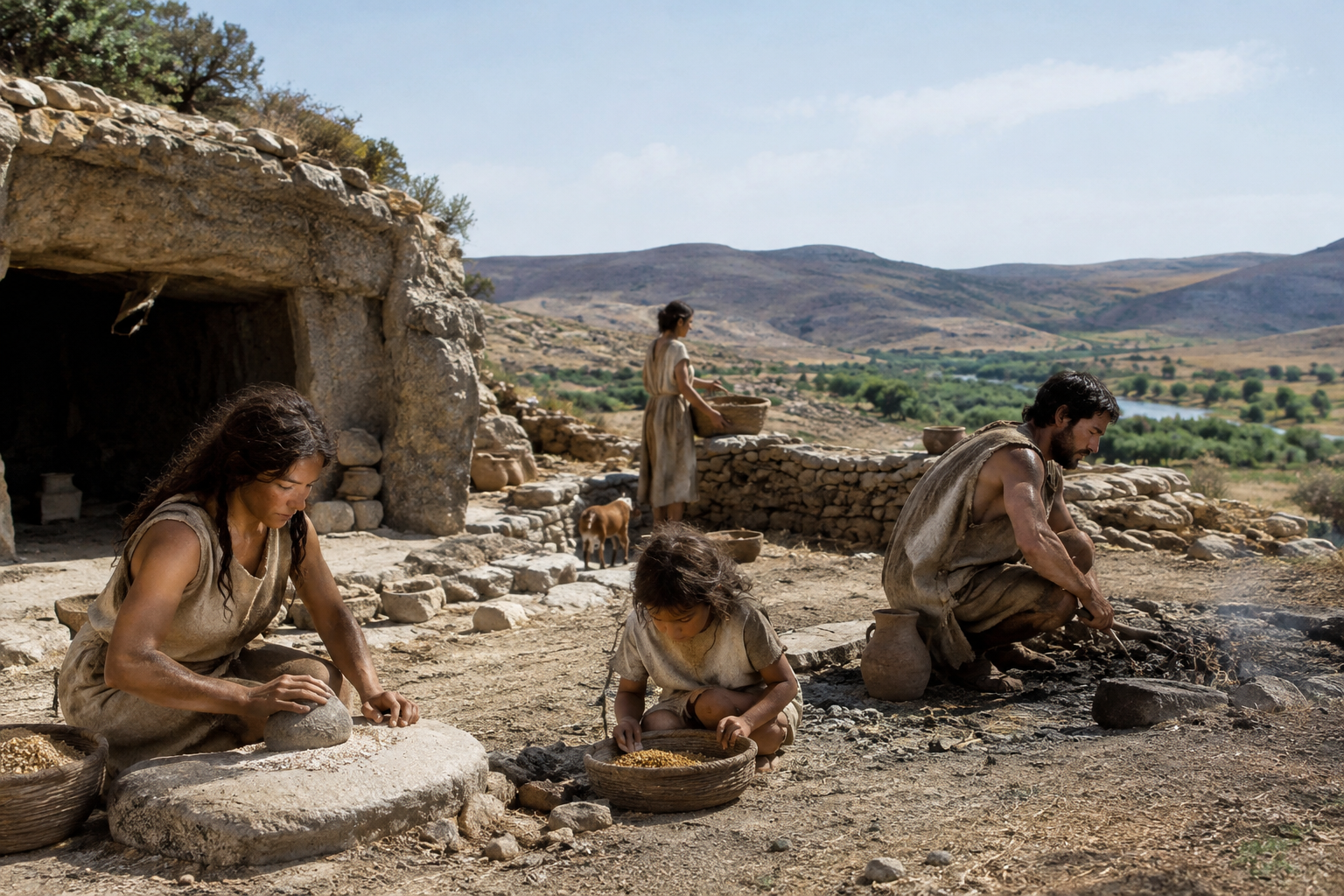
At Kaf Taht el-Ghar, in northern Morocco, one Early Neolithic man dated to around 5250 BC has become a particularly striking witness to the deep history of Y-DNA haplogroup a. He appears in the record simply as ktg001, which sounds rather dry until you pause over what it means: a paternal line identified in one of the earliest farming contexts in the western Maghreb, at the edge of the Mediterranean and close to the Strait of Gibraltar.
That is what makes this find so interesting. Haplogroup a is an extremely old Y-chromosome branch in the wider human family tree, and Y-DNA tracks only one narrow line of descent, from father to son, not a person's whole ancestry. But when a lineage this old turns up in a well-dated Neolithic North African context, it forces us to think carefully about continuity, mixture, and local histories that do not fit tidy one-direction migration stories.
Kaf Taht el-Ghar is part of the Early Neolithic world of northwestern Africa, a period when farming, herding, pottery, and new settlement practices were taking shape around the western Mediterranean. Northern Morocco matters here because it was not isolated. It sat between African inland networks, Mediterranean seaways, and the Iberian-facing coast, making it a crucial region for understanding how Neolithic lifeways spread and changed.
The sample ktg001 comes from this frontier zone. Even from the limited bare facts alone, the combination is noteworthy: an Early Neolithic Moroccan individual, securely placed around 5250 BC, associated with haplogroup a. That does not mean every man at the site belonged to the same paternal line, nor that one burial can stand in for all of Neolithic Morocco. It does mean that among the men present in this early farming setting, at least one carried a very old paternal branch rooted deep in African population history.
A broader ancient DNA study of North Africa published in Nature has helped sharpen exactly this kind of question by examining prehistoric population shifts across the region. The larger significance is not simply that a rare or ancient lineage existed, but that the Neolithic in the Maghreb was biologically and historically more complex than any simple replacement model would suggest.
North Africa's Genetic History
It is tempting, when discussing a haplogroup with such deep roots, to drift into enormous claims about "origins of humanity" and leave archaeology behind. Better not to. For family history and ancient DNA alike, the real value lies in context. A Y-chromosome label becomes historically meaningful only when attached to a date, a place, and an archaeological setting.
In this case, haplogroup a appears not in a vague prehistoric cloud but in an Early Neolithic community in Morocco. That matters because the North African Neolithic was shaped by both local continuity and outside contacts. Material culture, subsistence, and genes did not all move in lockstep. A paternal lineage as old as a appearing in this context may reflect local male ancestry persisting through cultural change, or a more complicated web of regional interactions in which older African lineages remained part of early farming populations.
What we should not do is overstate the resolution. The article haplogroup here is simply a, and without a securely stated downstream subclade there is no justification for inventing one. Nor should we assume that this paternal branch tells us the language, identity, or precise migration route of ktg001. Ancient DNA is powerful, but it is not a substitute for the rest of archaeology.
There is a habit in older storytelling to treat prehistoric Morocco as a receiving zone, a place where influences arrived from elsewhere and settled onto a passive landscape. The archaeology has been chipping away at that view for years. Sites in the western Maghreb show communities making active choices about pottery, food production, exchange, and settlement, and the genetics increasingly fit that picture of regional agency rather than mere absorption.
The importance of ktg001 lies partly in that correction. A man carrying haplogroup a in Early Neolithic Kaf Taht el-Ghar reminds us that the spread of farming into North Africa did not simply erase earlier human histories. The Neolithic here was a meeting ground. Some ancestry components likely arrived through Mediterranean contacts, while others carried deeper local roots. Paternal lineages could persist, disappear, or be reshuffled quite independently of pottery styles or domestic animals.
That makes northern Morocco especially valuable for comparison with Iberia and the central Mediterranean. Across the strait, archaeologists have long studied maritime links, but the genetic story is not one of mirror-image populations. The western Mediterranean connected people, certainly, yet it also preserved strong local signatures.
Prehistoric North African Ancestry
With only one named ancient sample here, it is worth being honest about scale. ktg001 is not a dynasty, not a tribe, and not a population in himself. He is one excavated individual whose paternal line opens a window onto a much broader problem: how early farming communities in North Africa formed, and how much of their ancestry came from local populations already living there.
That is where a single burial can still be historically useful. In archaeogenetics, the most valuable samples are not always the grandest graves or the biggest cemeteries. Sometimes the importance lies in anchoring a lineage to a particular region and period. Here, haplogroup a is not floating free in an abstract phylogenetic tree. It is fixed, however modestly, in Early Neolithic Morocco.
For readers exploring their own Y-DNA, this is a useful reminder that old African branches are not marginal footnotes to world history. They belong inside the main narrative. North Africa was a zone of movement, adaptation, and continuity over very long spans, and paternal lines like a help show just how deep some of those continuities may run.
The setting of Kaf Taht el-Ghar also matters because northern Morocco sits in a historical corridor that later periods would use repeatedly: Phoenician traders, Roman administrators, Islamic polities, and medieval cross-strait networks all moved through a landscape that was already ancient. By 5250 BC, this was not yet a world of states or texts, but it was already a connected one.
That is why Early Neolithic Morocco deserves to be read on its own terms rather than as a mere prelude to Europe or the Near East. The paternal lineage in ktg001 speaks to a human history grounded in Africa, while the archaeological setting belongs to a Neolithic world linked across the Mediterranean. Those two facts are not contradictory. They are precisely the point.
Later Western Mediterranean DNA
If your paternal line falls within haplogroup a, the most responsible lesson from ktg001 is not a neat claim of descent from one Neolithic Moroccan man. It is something both smaller and more interesting: this lineage was present in prehistoric North Africa within an Early Neolithic community, showing that very old African paternal branches remained part of real archaeological populations during major cultural change. In other words, haplogroup a belongs to the lived history of the Neolithic Maghreb, not just to the remote opening chapters of the human family tree.






Comments