Haplogroup R1b1a1b1a1a3a

– 5 min read


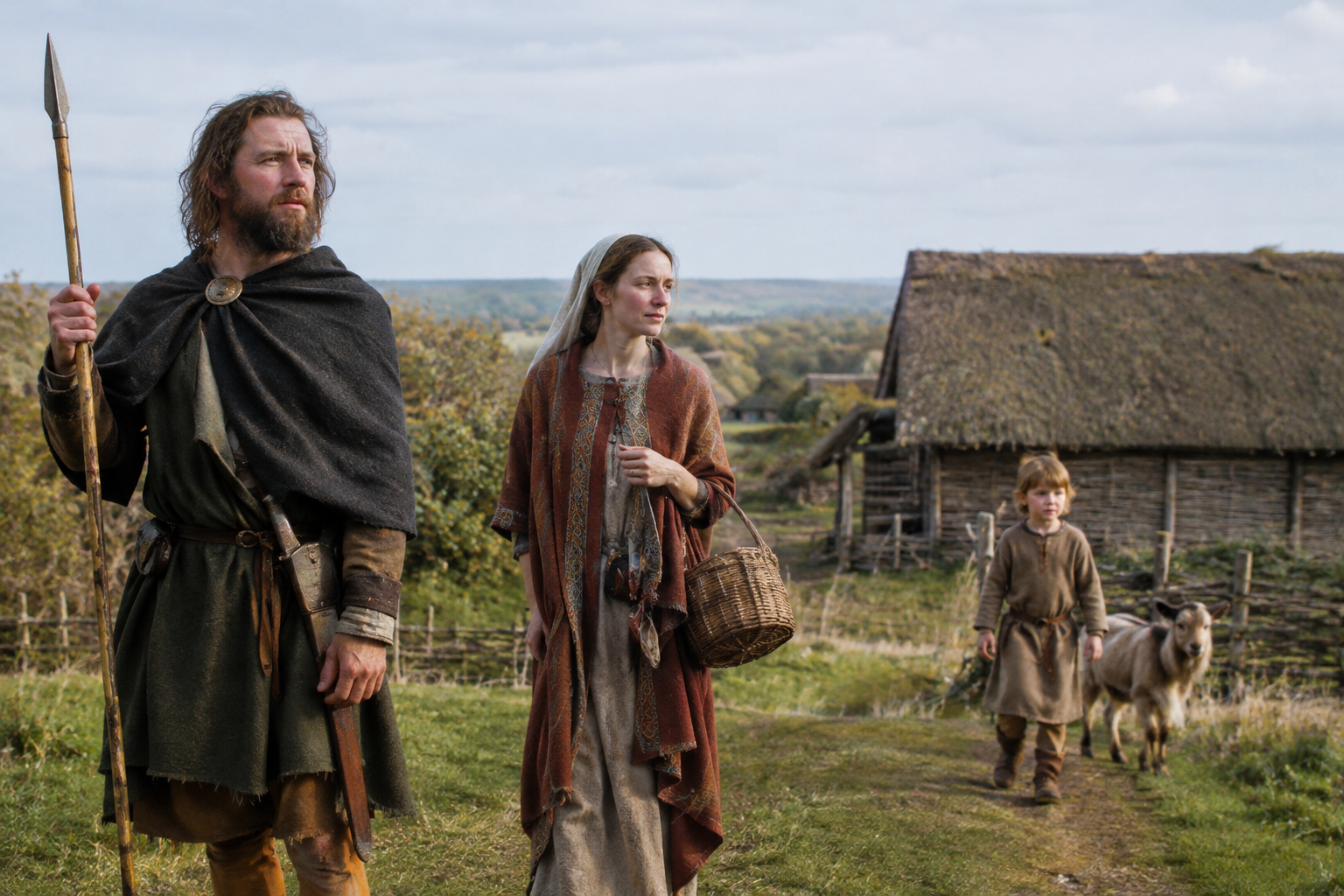
At Hatherdene Close in Cambridgeshire, an early Anglo-Saxon burial dated to around AD 500 produced one of the more useful little clues in the long history of Y-DNA haplogroup R1b1a1b1a1a3a. The individual known as HAD017 does not give us a legend, a dynasty, or a named man from the chronicles. What he gives us instead is something archaeologists value just as much: a securely placed person in a real early medieval community, living in England at the moment when post-Roman Britain was being remade.
A second sample, CE050, from Worth Matravers in Dorset and dated to around AD 600, shows the same paternal branch turning up again in southern England a century later. That is the real interest here. Not a single glamorous burial, but a pattern: this lineage appears in the archaeology of early medieval England across different regions and in two rather different historical settings. Y-DNA traces one direct paternal line only, not a person's whole ancestry, but even one line can tell us where certain male lineages were present, and when.
R1b1a1b1a1a3a is a very specific sub-branch within the much larger R1b family of Y-chromosome lineages, one of the major paternal groupings in western Europe. That larger parent branch has a deep and complicated prehistoric history, but it would be careless to paste that entire story directly onto this narrower subclade. The evidence in hand for this article is much more focused: it places this branch, or an assignment associated with it, in early medieval southern and eastern England.
That matters because the fifth to seventh centuries in Britain were not a simple tale of replacement. They were a period of regional variation, migration, intermarriage, survival of local communities, and the gradual emergence of new political and cultural identities. A lineage found in that setting is not automatically "Anglo-Saxon" in any pure or exclusive sense; rather, it belonged to men living inside that changing world.
An ancient DNA study of early medieval England, linked to the Hatherdene Close material, examined precisely this broad historical problem: how migration and local ancestry combined in the making of the early English population. The wider context can be explored through research on the Anglo-Saxon migration and the formation of the early English gene pool.
HAD017 comes from Cambridgeshire, one of the key regions for understanding early Anglo-Saxon England. Eastern England is where archaeology, place-names, burial customs, and now genetics all intersect most intensely in debates about migration after the end of Roman rule. By around AD 500, communities in this zone were living through a genuine reordering of society, with new burial grounds and new material culture appearing alongside signs of continuity from the late Roman past.
That is the useful setting for this haplogroup. Rather than treating R1b1a1b1a1a3a as a floating label, HAD017 anchors it in one of the most historically consequential landscapes in Britain. A man carrying this paternal line was part of an early medieval community in the Cambridgeshire region during the first generations of Anglo-Saxon settlement and consolidation.
What we should not do is leap from that fact to an overconfident ethnic badge. Y-DNA cannot tell us which language this man spoke, what legal status he held, or whether his family had arrived recently or already had roots in Britain. But it does show that this paternal branch was present among people participating in that early Anglo-Saxon world.
The Dorset sample CE050, dated to around AD 600, is just as interesting for being different. Worth Matravers sits in the far south-west of the zone usually associated with the densest early Anglo-Saxon settlement. Dorset, especially in the post-Roman centuries, was a frontier of sorts: not a neat border on a map, but a region where older Romano-British populations, incoming groups, and emerging kingdoms interacted in messy and highly local ways.
So CE050 broadens the story. This haplogroup was not confined to one eastern cemetery or one narrow migration pulse. By the seventh century it appears in Dorset as well, in a landscape where cultural identities were being negotiated rather than mechanically imposed. That makes R1b1a1b1a1a3a look less like a one-site curiosity and more like part of the paternal diversity of early medieval England.
A broader genetic study of Roman and early medieval Britain has been especially important for showing how uneven these transitions were across the island, with some areas showing stronger continental input and others more continuity or mixture. For that wider frame, see this ancient DNA research on Roman and early medieval Britain.
Ancient DNA articles often tempt us into hero worship of the single dramatic burial. But for a haplogroup article, repetition is often more revealing than spectacle. HAD017 and CE050 are separated by roughly a century and by a considerable stretch of southern England. Together, they suggest that this paternal line had some staying power during the centuries when Roman Britain gave way to early medieval England.
That does not mean there was one uninterrupted elite family moving from Cambridgeshire to Dorset, nor that every man with this lineage belonged to one people in the modern sense. It means something both smaller and more solid: the branch was present in more than one community during the formative centuries of English history.
This is exactly where ancient DNA is most helpful. It can test whether lineages were fleeting arrivals, deeply rooted survivors, or part of broader mixed populations. In this case, the evidence points to a branch that was at home in the patchwork society of fifth- to seventh-century Britain.
There is a lingering habit, in popular history, to imagine post-Roman Britain as a clean handover from "Romans" to "Saxons". The archaeology has long resisted that simplicity, and genetics has made it still harder to maintain. Cemeteries, settlement evidence, and now genomes show a range of outcomes: some communities with substantial continental ancestry, some with strong local continuity, and many with mixtures that do not fit tidy tribal narratives.
R1b1a1b1a1a3a belongs in that untidy but far more interesting picture. A lineage found in Cambridgeshire around AD 500 and Dorset around AD 600 reminds us that paternal ancestry did not always travel in lockstep with political labels. Men bearing related Y-lineages could be absorbed into very different local societies, and those societies themselves were changing rapidly.
Roman to early medieval Britain
There is also a larger British angle here. R1b lineages in general are deeply associated with western Europe over the long term, but the early medieval evidence shows that specific branches kept circulating through new historical settings rather than belonging to one frozen "ancient people". The men represented by HAD017 and CE050 lived after the Roman administration had collapsed, but before England had fully cohered as a kingdom-based Christian realm. Their paternal line sat inside that transition.
If your own Y-DNA falls under R1b1a1b1a1a3a, these ancient finds make one careful point rather well: this direct paternal branch is attested in early medieval England, including both an early Anglo-Saxon context in Cambridgeshire and a post-Roman context in Dorset. That does not hand you a named ancestor or a guaranteed cultural identity. It does, however, place your paternal line within the real human landscape of Britain during one of its most transformative centuries.
Diversity in 7th-century England
And perhaps that is the best kind of evidence: modest, local, and stubbornly real. Not mythic founders, but actual men in actual places - one in Cambridgeshire around AD 500, another in Dorset around AD 600 - showing that this lineage was part of the making of early medieval England.






Comments