Haplogroup R1b1a1b1a1a2c1a5a2a2a

– 8 min read


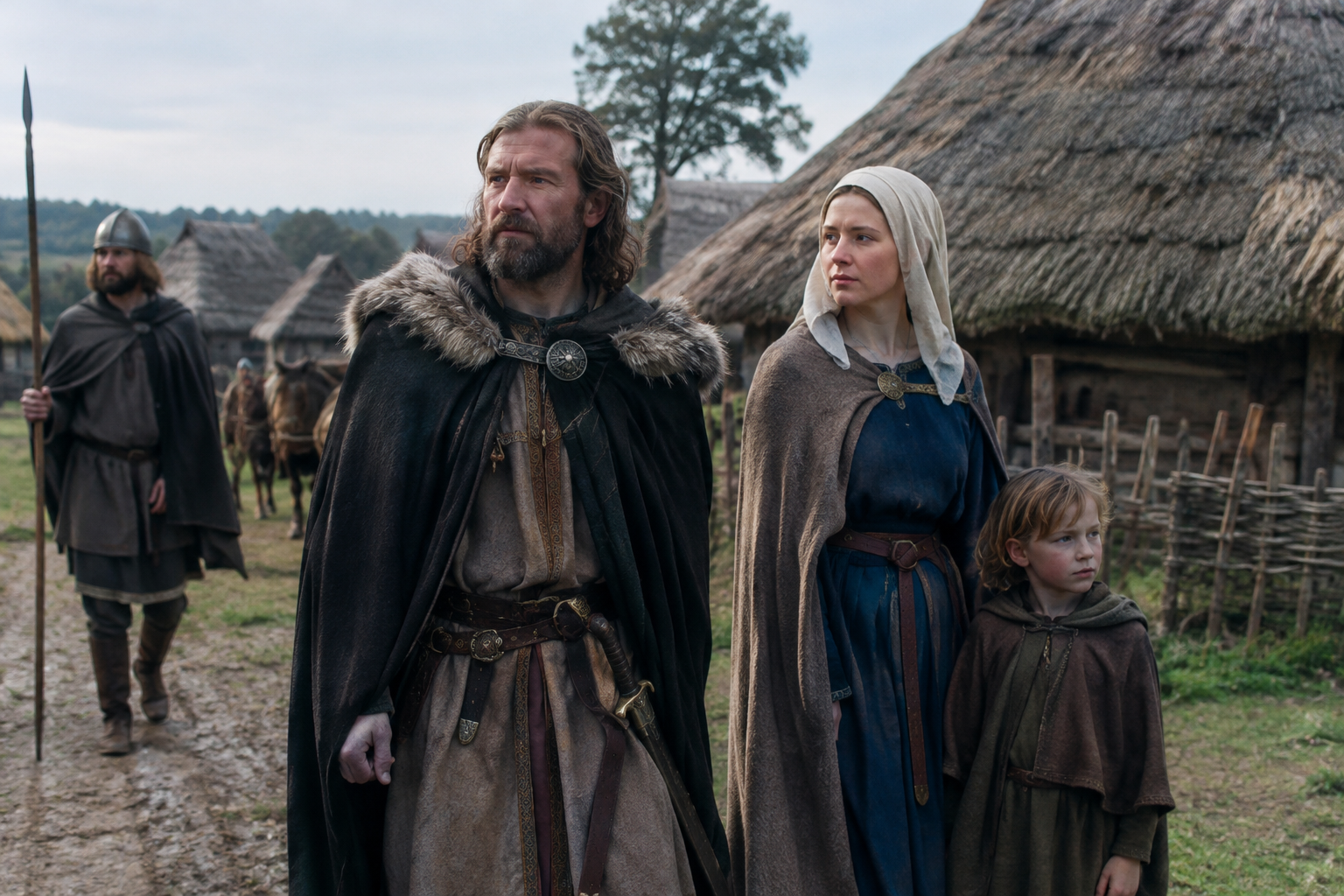
Some Y-DNA lineages are famous because they are broad and ancient. Others are interesting precisely because they are so narrow, so specific, and so stubbornly human in what they reveal. Haplogroup R1b1a1b1a1a2c1a5a2a2a belongs to that second category. It sits deep within the great R1b family tree, one of the major paternal lineages in western Eurasia, but this particular branch is not a stand-in for all R1b men, nor for all Celts, Franks, or Highland clans. It is a much smaller twig on a very large tree.
That is exactly why it matters. Y-DNA haplogroups trace one direct paternal line only: father to father to father across centuries. They do not describe a person's whole ancestry, culture, language, or identity. But when an unusually specific branch turns up in ancient DNA, it gives us a rare sort of evidence: not a grand slogan about peoples, but a glimpse of male-line continuity and movement through real landscapes, from early medieval burial grounds to later historical regions where castles, clans, and memory still cling to the shoreline.
The broad parent haplogroup R1b has a long and complicated history across Eurasia and later became especially prominent in many parts of western Europe. Within that vast family, however, every downstream branch has its own history, and the narrower the branch, the more careful we need to be. It would be wrong to pour the entire prehistory of R1b directly into R1b1a1b1a1a2c1a5a2a2a as if nothing changed along the way.
What can be said responsibly is that this lineage belongs to a paternal framework that became deeply established in western and central Europe over time. Ancient DNA has shown again and again that paternal lines within R1b appear in very different settings: Bronze Age expansions, Iron Age communities, Roman frontier zones, and early medieval populations. The important lesson is not that one branch equals one people, but that male-line ancestry can persist while languages, kingdoms, loyalties, and burial customs change around it.
If you want the wider archaeological background to the western European world in which many R1b branches later flourished, the Rhine-Meuse region is one of the key corridors to watch.
Explore the Rhine-Meuse Deep Past
The most concrete anchor supplied for this haplogroup is an ancient individual from the early medieval world: Mln9, described as Merovingian Period Frankish, from Moemlingen, Germany, dated to 650 AD. Even a single sample, properly handled, can be illuminating. It places this paternal line in the heart of the post-Roman Frankish world, at a time when the old Roman order had fractured but not vanished, and new political identities were taking shape across western and central Europe.
Moemlingen lay within a region shaped by both continuity and upheaval. By 650 AD, the Merovingian kingdoms ruled much of former Roman Gaul and influenced adjoining territories east of the Rhine. Frankish identity was not genetically uniform, and ancient DNA has increasingly shown that communities of this period were often more mixed than older nationalist histories liked to imagine. A Y-chromosome lineage found in such a burial should therefore be read as evidence of one paternal thread within that society, not a genetic definition of "the Franks."
Still, Mln9 matters. It shows that a branch on this narrow paternal line was present in early medieval Germany within a Frankish setting. That alone gives the haplogroup historical texture. It is no longer just a string of letters and numbers on a testing page. It is attached to a man who lived in the Merovingian world, in a landscape of churches, farms, local elites, and shifting loyalties inherited from both Germania and Rome.
Readers interested in how DNA is changing our picture of frontier populations in exactly this period should also look at studies of blending on the late Roman and early medieval German frontier.
Read About the German Frontier World
How, then, do we connect an early medieval Frankish sample from Germany to later historical worlds further northwest? Carefully, and without pretending to prove more than the evidence allows.
One of the most useful things about Y-DNA is that it highlights how paternal lines can travel through ordinary history. Men moved in war bands, trading networks, feudal retinues, colonising ventures, church lands, and marriage alliances. Over generations, a paternal branch present in one early medieval region may appear centuries later far away, not because we can trace every father and son, but because Europe was never static. The North Sea zone, the Channel, and the Irish Sea were not barriers so much as busy highways.
That is why a branch found in Merovingian Germany can sit quite comfortably in a wider story that later includes Britain and Scotland. Not as proof of direct descent from Mln9, and not as evidence that one clan "came from the Franks" in any simplistic sense, but as part of the broader map of western European paternal continuity and mobility.
For readers who want to see how ancient DNA is reshaping the early medieval British picture more generally, especially after Rome, there is a useful companion piece on post-Roman Britain.
Explore Post-Roman Britain Through DNA
That longer arc, from documented early medieval DNA to later regional traditions, is also where surname groups and clans begin to enter the picture. They do not give us proof of a single uninterrupted paternal descent from an ancient burial, but they do show how particular lineages became embedded in named communities, local power structures, and remembered landscapes.
The principal later association supplied here is Clan Darroch. That link should be handled in the right way: as a reported historical and genealogical association with this haplogroup, not as a claim that every man of the name Darroch carried the same Y-DNA line, nor that all branches of the clan shared one recent paternal ancestor that can be demonstrated from the evidence given here.
Even so, Clan Darroch is an intriguing example of how a narrow Y-DNA lineage can acquire a recognisable place in later history. In the Scottish context, clans were not merely family trees written large. They were social and territorial groupings, shaped by kinship, fosterage, allegiance, and service, often in regions where maritime movement mattered as much as inland lordship. To find a haplogroup associated with a clan like Darroch is therefore to enter a world very different from Merovingian grave fields, but not unrelated to them in the broader sense of male-line continuity across changing political landscapes.
What makes this especially interesting is the west-coast setting implied by the supplied material. The historical world around Clan Darroch is one of island connections, sea routes, and overlap with greater powers in the Hebrides. This was not a remote fringe in the modern sense. It was part of a busy Atlantic zone where Gaelic lordship, Norse influence, and later Scottish crown intervention all left their mark. In that environment, paternal lineages could endure within communities whose recorded history was bound up with larger island dynasties and shifting regional loyalties.
So while the genetic story must remain cautious, the historical setting is vivid enough. The haplogroup's significance here lies not in any inflated claim to noble blood, but in the possibility that one small paternal branch later found expression in a clan tradition rooted in the Hebridean world.
The strongest place-name attached to this later historical setting is Dunyvaig Castle on Islay. According to the supplied information, it began as a sea stronghold of the Lords of the Isles and later became a key power base of Clan Donald in the Hebrides. That alone tells us a good deal about the sort of landscape in which associated families and clans operated. This was not a quiet manor house inland, but a fortress positioned in a maritime world where command of channels, harbours, and island routes was politically decisive.
Dunyvaig is especially useful because it anchors the clan history in a real and contested place. The castle was fought over many times in the 16th and 17th centuries before government forces finally took it and left it to fall into ruin. That pattern is entirely characteristic of the western seaboard in the age when the Scottish crown sought to curb the autonomy of major island lordships. A stronghold such as this was not merely a residence. It was part administrative centre, part military outpost, and part symbol of who held authority in the Hebrides.
For a clan association such as that of Darroch, Dunyvaig offers something tangible even when genetics cannot prove a direct link to any one historical occupant. Castles do not carry haplogroups, of course, and they do not settle questions of descent. But they help locate a paternal lineage within the lived geography of later history. In this case, the ruined stronghold on Islay evokes the same sea-facing world of shifting allegiance, maritime power, and clan memory that frames the historical association supplied for this haplogroup.
The supplied noble connection brings us far from inland Germany to the south coast of Islay, where Dunyvaig Castle stood as one of the great strongholds of the Lords of the Isles. This is associated here with Clan Darroch, but the castle's recorded history in the supplied material is bound especially to Clan Donald and the maritime politics of the Hebrides.
Dunyvaig was not simply a pile of defensive masonry. It was a statement about control of the sea. Probably first fortified in the late Middle Ages, it became by the 15th and 16th centuries a key base for the MacDonalds, who used it to dominate routes through the western seas. This was a kingdom measured not just in fields and rents, but in ships, anchorages, and movement between islands. In such a setting, power depended as much on command of water as on command of walls.
The castle was fought over repeatedly as the Scottish crown tried to break the power of the island chiefs. In the early 17th century it was seized after bitter struggles involving the MacDonalds and Campbells, after which its importance declined. Today, as the supplied description rightly suggests, its ruined walls still look over the water and preserve the memory of a fierce maritime polity in which Islay sat near the centre of events.
What does this have to do with the haplogroup? Not proof of lineage, certainly. A historical association between a clan and a Y-DNA haplogroup does not mean every bearer of the surname shared the same paternal line, and a castle never proves genetics. But places like Dunyvaig matter because they root DNA history in real regional history. They remind us that paternal lines survived not in the abstract, but among communities shaped by lordship, sea travel, conflict, and local memory.
If you would like to follow the clan side of this story more directly, MyTrueAncestry has a related piece on Clan Darroch itself.
The attraction of a highly specific haplogroup such as R1b1a1b1a1a2c1a5a2a2a is obvious. It feels close to genealogy. It feels as though the past is narrowing in, becoming personal. Sometimes that instinct is useful. Ancient DNA samples like Mln9 show that branches of a paternal line were already present in recognisable historical societies, not just in some misty prehistoric nowhere.
But the limits matter just as much. Sharing a haplogroup with an ancient individual does not prove direct descent from him. Sharing a broad paternal lineage with a historical clan does not prove membership in that clan, still less noble descent. And a later Scottish association does not erase the possibility of earlier continental branches, just as an early medieval German sample does not define the full later history of the lineage.
What Y-DNA does especially well is give us continuity without oversimplification. A branch can pass through many worlds: prehistoric Europe, post-Roman kingdoms, medieval lordships, and island strongholds. Written records tell us about names, titles, and castles. Ancient DNA tells us that beneath those shifting labels, some paternal lines endured, divided, travelled, and survived.
That is the real fascination here. R1b1a1b1a1a2c1a5a2a2a is not a shortcut to identity. It is a narrow beam of evidence, but a vivid one: a Merovingian man in Moemlingen, a western European paternal framework, and later historical landscapes such as Islay and Dunyvaig where family memory and regional power still hang in the air.
If this haplogroup story has caught your interest, MyTrueAncestry lets you explore how your DNA may compare with ancient individuals, archaeological cultures, and historical populations. Those matches can offer remarkable clues about the long paths behind your ancestry, even when they do not prove direct descent from a particular ancient person or noble family.
Upload your DNA to see whether your results connect with ancient samples like Mln9, with medieval populations, or with the wider historical worlds that shaped Europe from the Merovingians to the Lords of the Isles.

Comments