Haplogroup R1b1a1b1a1a2c1a4c1a

– 5 min read


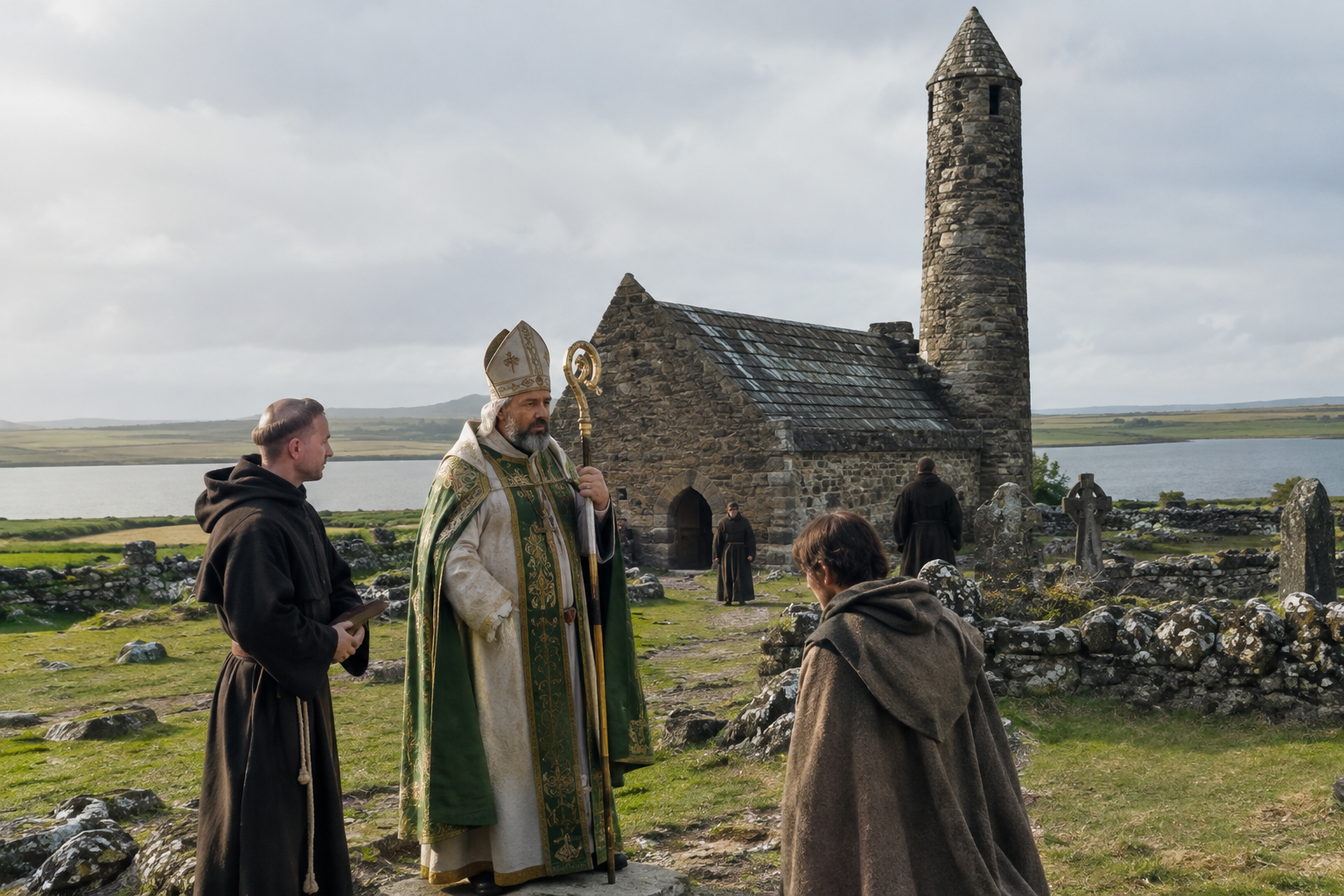
Some Y-chromosome lineages arrive in history with trumpets. Others turn up more quietly: in a medieval burial, in a family tradition, in the stubborn survival of a paternal branch across centuries of invasion, conversion, and social change. Haplogroup R1b1a1b1a1a2c1a4c1a belongs to that second category. It is a very specific branch within the vast and important R1b family, one of the major Y-DNA lineages in western Europe, but a branch so narrow that it reminds us at once of the power and the limits of genetic storytelling.
That matters. Y-DNA traces one direct paternal line only: father to son to son across time. It does not describe a person's whole ancestry, culture, language, or identity. Still, when a rare or highly specific branch appears in ancient DNA and then surfaces in later historical settings, it offers something precious: a glimpse of continuity in the male line, not proof of noble descent, but a way of placing family history into a much larger human past.
The lineage R1b1a1b1a1a2c1a4c1a sits deep within the wider haplogroup R1b tree. Broadly speaking, R1b is one of the best-known paternal lineages in Atlantic Europe, especially in places such as Britain and Ireland, and it has long been discussed in connection with major prehistoric and later population shifts. But one should be careful here. The full history of broad R1b cannot simply be dumped onto a very narrow downstream branch as if nothing changed for thousands of years. Specific subclades often had much more local, regional, or historically recent stories.
What we can say responsibly is that this branch belongs to a paternal landscape strongly associated with western Europe, and especially with the long history of male-line continuity and reshaping in the British Isles. That includes prehistoric migrations, later Iron Age developments, Roman-era mobility, early medieval settlement, and the formation of regional dynasties and lordships. The fascination of a branch like this lies not in grand certainty, but in how it may connect those layers.
Explore Celtic Origins in Ancient DNA
The most tangible anchor supplied for this haplogroup is an ancient individual from Ireland: KIL034, from Medieval Ireland Kilteasheen Roscommon Bishops Seat, dated 650 AD. That is already enough to make the story interesting. Seventh-century Ireland was a world of monasteries, local kings, ecclesiastical estates, learned dynasties, and deeply rooted kin groups. Roscommon, in the Irish midlands and west, sat within a political landscape where power was negotiated not only by swords but by saints, churches, landholding, and lineage memory.
The place name matters too. A bishop's seat is not merely a dot on the map. It signals an early Christian environment where burial, status, and regional authority intersected. An individual like KIL034 therefore belongs to a world that was neither prehistoric nor fully feudal, but one in which old kin structures were adapting to a Christian order. If this sample is associated with the haplogroup under discussion or with a closely relevant paternal branch, it suggests that this lineage was present in Ireland by the early medieval period, embedded in local society rather than arriving as some late aristocratic novelty.
That does not prove that any later family, noble or otherwise, descends from KIL034. Genetics is not a fairy tale with a neat ending. But it does show that the paternal line existed in a real community, in a real historical setting, and in a landscape where lineages and territory were often closely entwined.
Read About Irish Kinship and Ancient DNA
How might a lineage like this fit into the wider history of Britain and Ireland? Cautiously, one can place it within the long male-line history of the western seaways. Ireland, western Britain, and the North Sea world were never sealed compartments. People moved through marriage, fosterage, church networks, raiding, trade, war, and colonisation. Some paternal lines remained locally concentrated for centuries; others spread into new regions while preserving only the faintest trace of their original movement.
For branches within R1b, one possible historical frame includes the later Bronze Age and Iron Age expansion of paternal lineages that became prominent in Atlantic Europe. Another includes the persistence of regional male lines through the transition from Roman Britain to post-Roman kingdoms and into the medieval period. Yet these are frames, not verdicts. A narrow branch may have formed long after the larger movements usually associated with R1b, and its distinctive local distribution may reflect medieval rather than prehistoric history.
This is where ancient DNA is so valuable. Written genealogy reaches only so far, and usually only for the socially prominent. Ancient burials let us see paternal lineages among people who never entered chronicles at all. They also remind us that what later became "English," "Irish," or "British" aristocratic landscapes rested on much older biological and social foundations.
Explore Roman and Early Medieval Britain
That brings us, by a leap of centuries, to the House of Townshend and Raynham Hall in Norfolk. The hall, built in the early 17th century for the Townshend family, became one of the great houses of Georgian England. It is associated with Charles Townshend, with aristocratic politics, and with that very English combination of property, parliament, and family continuity. It is also famous for the legend of the Brown Lady, said to be the ghost of Lady Dorothy Walpole, a haunting that has done as much as brickwork to preserve Raynham in public memory.
But from a historical point of view, the important thing is not the ghost. It is the house as a statement of permanence. Raynham Hall was not a royal palace. It was a family seat, and that tells us a great deal about how paternal identity functioned in early modern England. Houses like this were engines of memory. They turned land ownership into dynasty, and dynasty into architecture.
It would be irresponsible to claim that the Townshends are genetically proven to belong to haplogroup R1b1a1b1a1a2c1a4c1a on the basis of the information supplied here alone. Nor can one draw a direct line from KIL034 in Roscommon to the masters of Raynham Hall. What one can say is that both belong to the same broad story of paternal continuity in the islands: one visible in the soil of an early medieval burial ground, the other in the documents, estates, and masonry of the post-medieval elite.
Norfolk itself is an apt setting for this. Eastern England has seen layer upon layer of settlement and resettlement, from prehistoric communities to Roman administration, Anglo-Saxon kingdoms, Scandinavian influence, Norman lordship, and parliamentary aristocracy. A Y-DNA branch found in the British Isles may have moved through many such worlds without ever leaving a surname, a coat of arms, or a castle behind.
Discover the Noble House of Townshend
So what does haplogroup R1b1a1b1a1a2c1a4c1a really tell us? First, it places a direct paternal line inside a much older European framework, one whose broad roots lie within the western R1b world. Second, with the presence of KIL034 in Medieval Ireland Kilteasheen Roscommon Bishops Seat at 650 AD, it gains an archaeological foothold in early medieval Ireland. Third, it offers historical context for understanding how paternal lineages can persist across enormous changes in religion, language, state formation, and class structure.
What it does not tell us is that everyone with this haplogroup shares a recent family relationship, or that they belong to a particular ethnic group, kingdom, or noble house in any simple sense. Shared haplogroups can connect men separated by many centuries. Noble association is not the same thing as proof. A hall, a coat of arms, or a surname may preserve family tradition, but only careful genetic evidence can test specific paternal claims.
And that, really, is the pleasure of archaeogenetics. It complicates the old stories without ruining them. The medieval burial in Roscommon and the stately house in Norfolk do not collapse into one easy tale. Instead, they show us two ends of the same long historical problem: how male lines endure, branch, disappear, and sometimes reappear in the record.
If your own Y-DNA belongs to a branch like R1b1a1b1a1a2c1a4c1a, MyTrueAncestry can help place that paternal line beside ancient individuals, archaeological cultures, and historical regions. Those matches do not automatically prove direct descent from a specific ancient person or noble family, but they can offer a remarkably vivid sense of where your deeper ancestry may fit into the human past.






Comments