Haplogroup R1b1a1b1a1a2c1a4b2c1a1a

– 6 min read


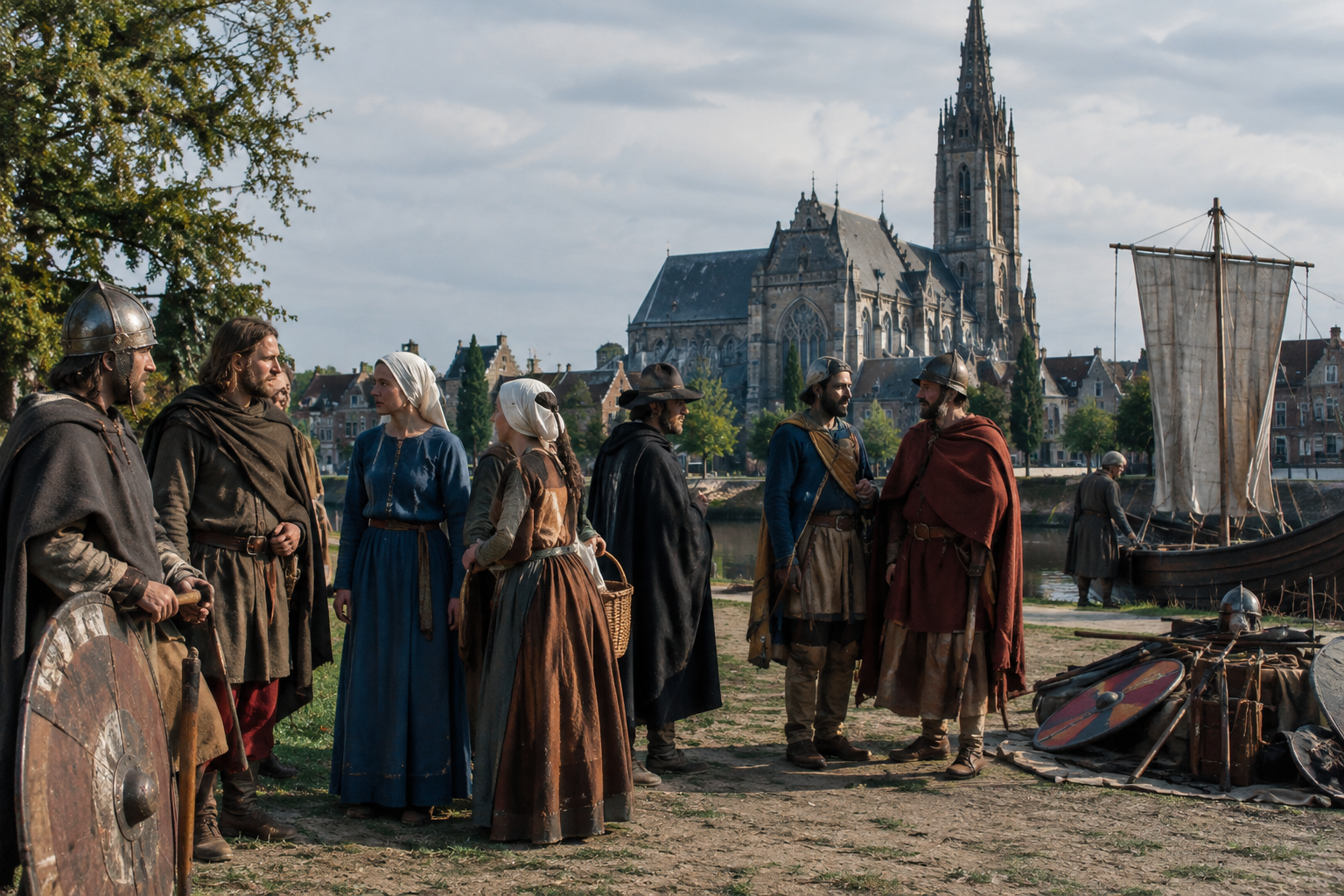
Some Y-chromosome lineages are so specific that they look, at first glance, almost impossible to say anything sensible about. R1b1a1b1a1a2c1a4b2c1a1a is one of those. It is a very narrow twig on a very large paternal tree, and that matters. The narrower the branch, the more careful we have to be. We are not dealing here with "the history of all R1b men," nor with a ready-made ethnic label, but with one small surviving line within a much older European paternal story.
That is also what makes it interesting. Y-DNA haplogroups trace a direct paternal line: father to son, across generations, through the Y chromosome. They do not describe a person's whole ancestry, culture, language, or identity. But when ancient DNA turns up similar paternal branches in archaeological burials across centuries, it gives us something precious: not a fairy tale of pure descent, but a map of where one line of male ancestry appears in the historical record, and where it may have persisted, shifted, or reappeared.
This haplogroup belongs within the wider R1b family, one of the major Y-chromosome groupings found in much of western Europe today. That broad parent lineage has deep prehistoric importance, but we should not lazily pour that entire history into this much narrower subclade. What can be said responsibly is that a branch this specific is best understood through context: where related paternal lines show up, what archaeological cultures they appear in, and how later historical landscapes overlap with those older distributions.
The supplied ancient samples point us repeatedly toward northwestern Europe: Bronze Age Germany, Iron Age eastern Britain, Viking Age Sweden, and later Belgium. That does not prove a single neat migration path, nor does it mean every one of these men belonged to the exact same terminal branch as a modern tester. It does suggest, however, that the paternal world around this lineage was active in the North Sea and adjacent continental zones for a very long time.
For readers interested in the bigger prehistoric backdrop behind northwestern European paternal lines, one especially useful companion piece is this look at the Lower Rhine and Bell Beaker expansion:
Explore Bell Beaker changes in the Rhine-Meuse
One of the earliest anchors in this set is WEZ59, from the Bronze Age Germany Tollense Valley Battlefield Mecklenburg-Vorpommern, dated to 1250 BC. Tollense is one of the great shocks of European archaeology: a battlefield on a scale that forces us to take Late Bronze Age conflict far more seriously than older textbooks once did. A paternal lineage connected with this world was not sitting still in some timeless village. It belonged to men living in societies capable of organizing violence, alliances, and movement across considerable distances.
Then the trail jumps west to Iron Age Yorkshire, and here the evidence becomes especially evocative. At Wetwang Slack in East Yorkshire, several individuals from around 225 BC appear in the record: I36850, I36846, I36825, I31007, I36894, I36898, and I39730. Some are identified as Celtic Parisi Iron Age England East Yorkshire Wetwang Slack, with I36846 specifically noted as Arras Culture.
That cluster matters. Wetwang Slack belongs to the celebrated Arras culture landscape of Iron Age East Yorkshire, famous for its burials and often drawn into discussions of links across the North Sea world. We should be cautious: shared haplogroup background is not proof that all these men were close paternal kin, still less that they represent a single "tribal signature." But a repeated paternal appearance in one Iron Age cemetery zone does suggest continuity of certain male lines within that regional society.
If you want to push further into the relationship between ancient genetics and Iron Age Britain, this article makes an excellent companion read:
Discover Iron Age Britain through ancient DNA
Another striking sample is VK349 from Early Viking Age Oland Sweden, dated to 829 AD. Oland sits in a Baltic setting, but not in isolation. Viking Age Scandinavia was tied to the North Sea, the eastern Baltic, the river routes of eastern Europe, and the trading circuits of the wider medieval world. A paternal lineage appearing here alongside earlier evidence from Britain and continental Europe reminds us that male lines could persist through very different social orders: Bronze Age warrior networks, Iron Age communities, and Viking Age maritime societies.
It is tempting to turn that into a story of one uninterrupted clan on the move from Germany to Yorkshire to Oland. Tempting, but much too tidy. Ancient DNA rarely gives us tidy. What it gives us is a pattern of presence. Men carrying related paternal branches were part of several interconnected northern European worlds, and the sea between them was less a barrier than a road.
For more on how these northern connections developed over time, this broader piece is well worth reading:
Explore North Sea migrations to Britain
The later evidence comes from Belgium, at St. Rombouts. Here we have STR105d from Late Medieval Belgium St. Rombouts Year:1677 AD, and three early modern individuals from 1800 AD: STR105b, STR105c, and STR105f. This is a very different setting from battlefield bones and Iron Age burials. We are now in the world of church burial, urban memory, and the increasingly documented populations of early modern Europe.
What is especially useful about these Belgian samples is not romance but chronology. They show that related paternal signatures associated with this haplogroup's broader neighborhood are still visible in the Low Countries in the medieval and early modern periods. In other words, this is not only a prehistoric or Iron Age story. It is also a story about long-term regional persistence in northwestern Europe.
That makes geographical sense. The Low Countries, eastern England, the North Sea coast, and parts of Scandinavia were linked for centuries by commerce, warfare, migration, and dynastic entanglement. None of this proves direct descent from one named ancient individual to another. But it does show how Y-DNA can illuminate continuity in places where written genealogy alone cannot reach very far back.
Readers interested in the Belgian side of this later medieval picture may enjoy this related study of urban genetic history:
Read about medieval genetics in the Low Countries
That brings us, rather pleasingly, to Scotland and Saltoun Hall in East Lothian, associated here with Clan Fletcher, older de Moravia roots, and later the Frasers of Philorth, who gained the estate in the late 17th century. The present house was largely rebuilt around 1800 for Alexander Fraser by William Burn in a grand Scots baronial style, while still preserving the memory of earlier tower-house traditions.
This is exactly the sort of place where genetics and history meet without becoming the same thing. Saltoun Hall does not prove a haplogroup. Stone walls do not yield a clan's Y-chromosome by architectural intuition. But estates like this preserve the social world in which paternal descent mattered enormously: inheritance, naming, land transfer, prestige, and the careful staging of antiquity. The house itself became part residence, part argument about ancestry.
The de Moravia and Fraser associations also place Saltoun Hall within the long politics of Scottish landed society, where families reworked older claims through marriage, purchase, and inheritance. By the 19th century, rebuilding in Scots baronial style was often a deliberate reinvention of the medieval past. One might say, with some sympathy and some suspicion, that the building was doing genealogy in stone.
That is why a haplogroup article can end up in a country house. Y-DNA studies the strict paternal line; noble history often prized exactly that line, though real family histories were always messier than heraldry admitted. A lineage such as R1b1a1b1a1a2c1a4b2c1a1a may help place a modern tester in the wider paternal history of northwestern Europe, but it cannot by itself certify descent from the Frasers, the de Moravia line, or every man ever attached to Clan Fletcher.
For readers who want to explore the clan world around this estate more directly, this companion article is the natural next step:
Discover the history of Clan Fletcher
So what does this very specific Y-DNA branch reveal? First, that even a narrow paternal lineage can be set within a serious historical frame when ancient DNA is available. Second, that the relevant frame here points toward northwestern Europe across a long span: Bronze Age conflict, Iron Age Britain, Viking Age Scandinavia, and medieval to early modern Belgium. Third, that later noble landscapes such as East Lothian help us understand how paternal descent remained socially meaningful long after the prehistoric world had disappeared.
And what can it not tell you? It cannot tell you your whole ancestry. It cannot assign you a culture, language, or nationality. It cannot prove that an Iron Age man from Wetwang Slack or a burial from St. Rombouts is your direct genealogical ancestor. Still less can it prove that sharing a broad haplogroup with a noble house makes you part of that family. What it can do is something subtler and, in its way, more interesting: place your direct paternal line inside a documented human past.
If your own DNA belongs somewhere in this northern European story, MyTrueAncestry can help you explore how your results compare with ancient individuals and historical populations. Those matches do not automatically prove direct descent or noble affiliation, but they can open a remarkable window onto the deep background of your ancestry.






Comments