Haplogroup R1b1a1b1a1a2c1a3c

– 6 min read


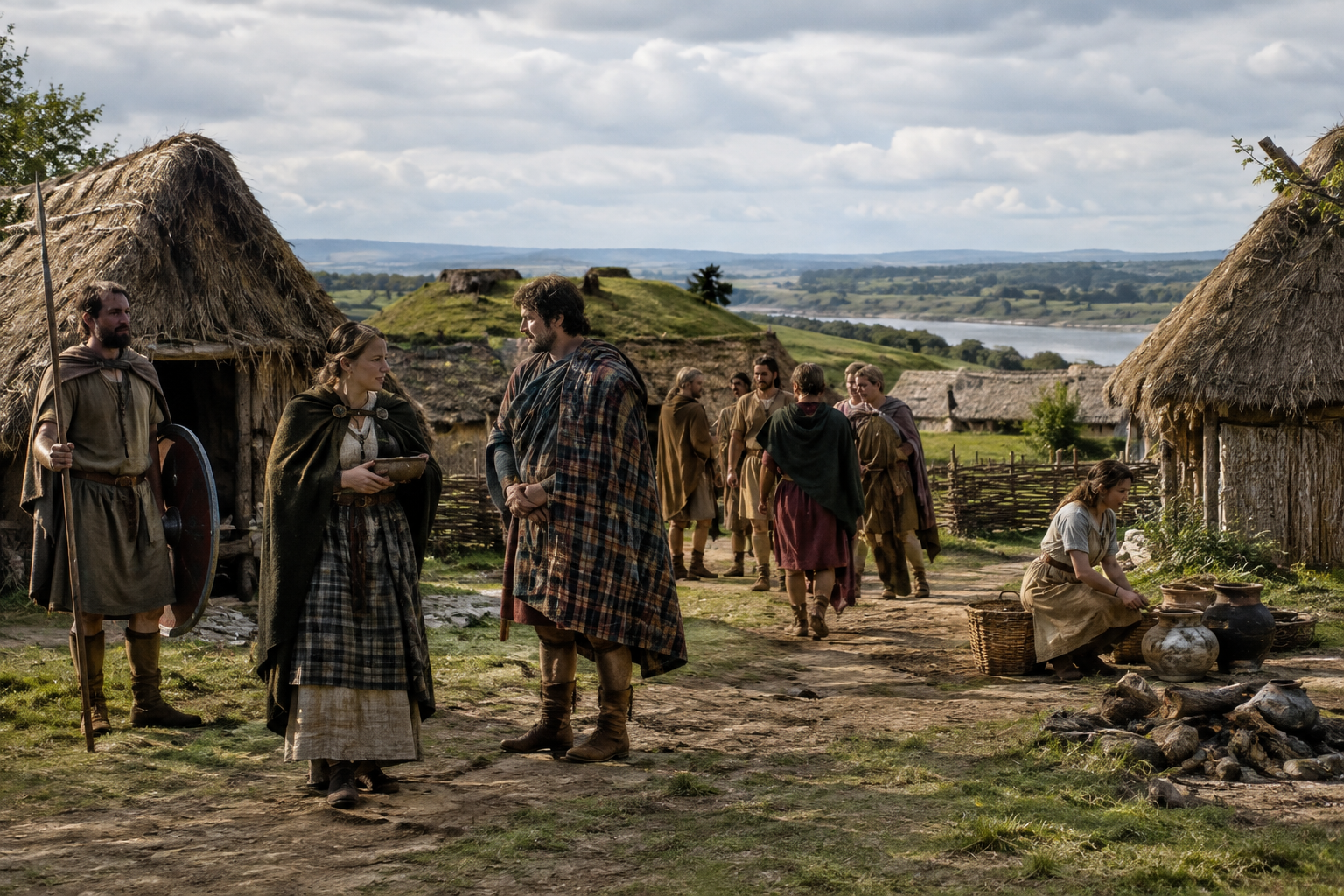
Some Y-chromosome lineages announce themselves with grand imperial labels. Others emerge in a more intriguing way: scattered through barrows, cave burials, hillfort cemeteries, Roman towns, and medieval estates, until a pattern begins to appear. Haplogroup R1b1a1b1a1a2c1a3c belongs to that second category. It sits inside the wider R1b family, one of the major paternal lineages of western Europe, but this very specific branch is not the same thing as the whole of R1b. That distinction matters, because the closer we zoom in on the Y-chromosome tree, the more careful we have to be about what the evidence can really tell us.
Y-DNA traces one narrow line of descent: father to son, to son, to son. It does not describe all of a person's ancestry, culture, language, or identity. But when ancient DNA samples carrying related paternal signatures begin turning up across Bronze Age Britain, Iron Age Yorkshire, Roman Dalmatia, post-Roman Dorset, and early medieval Belgium, they give us something wonderfully concrete: not a legend of origins, but a trail of male-line continuity and movement across centuries.
The broad parent haplogroup R1b is deeply important in European archaeogenetics, especially in discussions of later prehistoric population change. But it would be wrong to simply pour the entire history of R1b into the much narrower vessel of R1b1a1b1a1a2c1a3c. What we can say more responsibly is that this branch appears in a set of ancient individuals strongly concentrated in Britain, with additional appearances in parts of continental Europe and the Adriatic world. That distribution suggests a paternal lineage with deep roots in western Europe and a long history of persistence through major cultural changes.
The ancient samples here hint at a lineage present in Britain by the Bronze Age and still visible there in the Iron Age and beyond. They also show that the line was not confined to one tribe or one kingdom. Instead, it appears among communities often labeled by archaeologists as Bell Beaker, Bronze Age Britons, Arras culture groups in East Yorkshire, Durotriges in Dorset, and later populations living under Roman or post-Roman conditions. That is one of the most interesting lessons of ancient DNA: paternal lines can outlast political labels by a very long way.
Explore Celtic Origins in Ancient DNA
The older archaeological horizon in this dataset is striking. Sample I4950, from Bell Beaker Wiltshire Upavon England dated to 2300 BC, places a related paternal line in southern Britain at a moment that has become central to discussions of population change in later prehistory. Nearby in time are I2417 from Bronze Age Amesbury Down Wiltshire England Year:2300 BC, I5377 from Early Bronze Age England Thames Year:1800 BC, and dfb002 from Bronze Age England Dorset Cranborne Chase Down Farm Pond Barrow Year:1900 BC. These are not all the same social world, but together they suggest that this paternal background was established in multiple regions of Britain early on.
It was not only an English story. I5473 from Bronze Age Boatbridge Quarry South Lanarkshire Scotland Year:2250 BC, KD061 from Bronze Age Orkney Westray Links of Noltland Year:1498 BC, and I2859 from Scotland Late Bronze Age Year:900 BC show the lineage or its close paternal neighborhood in Scotland too. Add Rathlin2B from Ireland Copper Age Year:1880 BC, and suddenly the map broadens across the Irish Sea. That does not prove one unified "people" in any modern sense. What it does show is that related male lines were present across much of Atlantic Britain and Ireland long before medieval surnames or clans existed.
There are also continental hints. GMO015 from Bronze Age Calabria Cosenza Grotta della Monaca Sant Agata di Esaro Year:1300 BC reminds us that branches within this paternal world were not restricted to the islands. A lineage connected to the same deeper tree could turn up in southern Italy, just as other related lines appear later in Croatia, Austria, Portugal, Belgium, and Germany.
Read About Bell Beaker Turnover
If the Bronze Age evidence gives us depth, the Iron Age evidence gives us density. Few things are more persuasive than repeated finds from one region, and East Yorkshire delivers exactly that. The Parisi and Arras culture burials around Wetwang Slack, Pocklington, Melton, and Burton Fleming form a remarkable cluster.
Among them are I36889, I36880, I36885, I36974, I37335, I37336, I37342, and I37344, all from Celtic Parisi Iron Age England East Yorkshire Wetwang Slack Burial Year:225 BC. Then there are additional Wetwang Slack individuals such as I36819, I36827, I36791, I36805, I36765, I31019, I31515, I31516, I31008, I37175, I30989, I30992, I30970, I36912, I36916, I36918, I36902, I37130, I37134, I30911, and I30903. Even allowing for the caution that related branches are not always identical branches, this concentration is hard to ignore.
The site also includes socially notable burials, such as I36995, the Elite Celtic Parisi Chariot Burial Iron Age England East Yorkshire Wetwang Slack Year:225 BC, and I36972, a Primary Barrow Burial. These matter because they show the paternal lineage appearing not just in one ordinary grave, but across a broader social field. It was evidently part of the male population of Iron Age East Yorkshire, not a one-off anomaly.
Other Yorkshire and southern British samples reinforce the pattern: I14100 from Celtic Briton Pocklington Yorkshire England Year:320 BC, I14102, I14104, I21644, I21978, I5509, I13753, and I13760. Outside Yorkshire, I11991 from Iron Age Worlebury Somerset England Year:150 BC, I21309 from Iron Age Hillfort Battlesbury Bowl England Year:57 BC, and HI2 from Celt Hinxton Iron Age Year:45 BC suggest a wider British distribution.
Discover Iron Age Britain Through DNA
Then Rome enters the picture, and with Rome comes movement. In Dorset, a notable run of samples from Celtic Durotriges England Duropolis Winterborne Kingston Year:125 AD includes WBK12, WBK20, WBK29, WBK41, WBK05, WBK30, WBK43, WBK06, WBK08, WBK18, and WBK191. This is important because it suggests continuity of related paternal lines in a Romano-British setting rather than their disappearance after conquest.
Elsewhere the picture becomes more mobile and more Roman. I26776 from Imperial Roman Era Zadar Croatia Year:200 AD, R10656 from Late Roman Era Klosterneuburg Lower Austria Year:407 AD, and R10488 from Late Roman Conimbriga Portugal Year:330 AD place related paternal ancestry in very different corners of the Roman world. That does not mean one tidy migration route. It means that by late antiquity, branches within this lineage were distributed across western and central Europe, and some were clearly caught up in the circulation of people that empire enabled.
The line does not vanish with Rome either. I11580 from Post Roman Era Worth Matravers Dorset England Year:600 AD, IND013 from Merovingian Grave North Rhine-Westphalia Germany Alt-Inden Year:600 AD, ST2025 from Early Medieval Belgium Sint-Truiden Groenmarkt Year:900 AD, and ST1308 from Medieval Belgium Outsider Sint-Truiden Onze-Lieve-Vrouwekerk Year:900 AD show that related paternal branches remained part of the population mosaic of post-Roman Europe.
Explore Roman and Early Medieval Britain
How, then, do we move from prehistoric and ancient burials to a later historical family such as Clan Houston? Carefully. The supplied historical association does not prove that every Houston male carried R1b1a1b1a1a2c1a3c, nor does it allow us to identify a direct genealogical line from any ancient sample to the family. But it does offer a fine example of how paternal ancestry, local history, and medieval landholding can sit in the same landscape.
Houston House in Renfrewshire is tied to the old Barony of Houston, whose name comes from Hugo de Paduinan, a Norman knight granted lands there in the 12th century. Over time the estate became the seat of the Houstons of that Ilk. The present house is largely a 17th-century laird's residence, later altered and enlarged in the 18th and 19th centuries. That layered architecture is rather like the genetic story itself: not a single moment frozen in stone, but an accumulation of inheritances, rebuildings, and changing identities.
There is an added historical irony here. The Houstons emerge in written history through a Norman grant, yet the ancient DNA trail for this haplogroup points repeatedly to much older male-line presences in Britain and Scotland. Medieval families often stood on landscapes already inhabited for thousands of years. Castles and houses preserve the memory of tenure; ancient DNA reminds us of the much deeper human background beneath it.
So Houston House should not be treated as proof of a specific Y-line. It is better understood as a later chapter in a region where paternal lineages of this wider type had already been present for a very long time. Genetics and documents are doing different jobs here, and both are useful precisely because they are not the same thing.
R1b1a1b1a1a2c1a3c is historically interesting not because it can be used to assign a single identity, but because it resists that temptation. Its evidence spans Bell Beaker-era Wiltshire, Bronze Age Scotland and Ireland, dense Iron Age clusters in East Yorkshire, Romano-British Dorset, Roman Croatia and Portugal, and early medieval northwest Europe. That spread suggests durability, regional continuity, and occasional mobility rather than one simple migration slogan.
For MyTrueAncestry users, that is the real fascination. A Y-DNA haplogroup can connect your direct paternal line to broad historical processes, but not reduce your ancestry to one tribe, one castle, or one surname. Ancient DNA gives context, not a fairy tale. And often the context is better than the fairy tale.
If you want to see whether your own DNA shows connections to ancient individuals like I4950, KD061, I36995, or the Durotriges men of Winterborne Kingston, MyTrueAncestry lets you explore those comparisons for yourself. Such matches can offer powerful clues about deep ancestry and historical populations, even when they do not prove direct descent from a named ancient person or noble house.






Comments