Haplogroup R1b1a1b1a1a2c1a3a2a1a1

– 6 min read


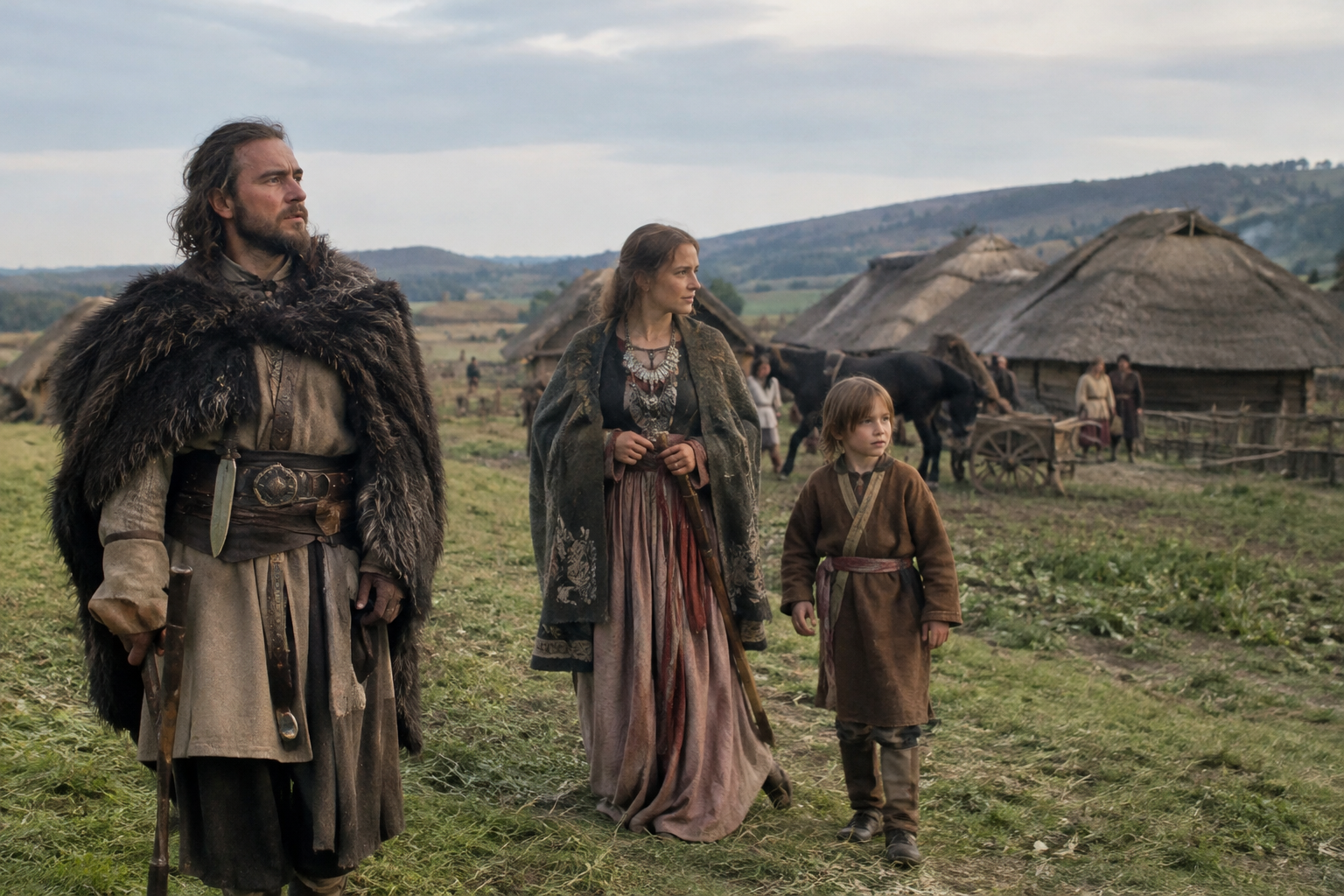
Some Y-chromosome lineages are easy to place in a familiar historical frame. Others are more like a thread glimpsed only briefly in the surviving cloth. The haplogroup R1b1a1b1a1a2c1a3a2a1a1 belongs to that second category: a very narrow paternal branch inside the vast and historically important family of R1b, one of the major Y-DNA lineages of western Eurasia.
That matters because Y-DNA can do something rather special. It follows the direct paternal line only: father to son, back through generations. It does not describe a person's full ancestry, culture, language, or identity. But in the right archaeological setting, it can illuminate how particular male lines moved through landscapes, survived political upheaval, and sometimes reappear centuries later in places that written history would never have connected on its own.
The long label R1b1a1b1a1a2c1a3a2a1a1 tells us at once that we are dealing with a highly downstream subclade. In plain English, this is not "R1b in general" but one very specific twig on that much broader tree. The wider R1b family has deep importance in European population history, and many of its branches are associated in broad terms with prehistoric and later movements across western Eurasia. But good historical method requires restraint: we should not simply pour the entire history of R1b into this one small sub-branch and pretend the job is done.
What we can say responsibly is that such specific Y-DNA branches are the result of long sequences of paternal descent, branching and re-branching over time. By the early medieval period, some of those branches were clearly present in regions shaped by migration, military service, local continuity, intermarriage, and political change. That is where ancient DNA becomes invaluable. It moves us away from sweeping myths of "peoples" and toward actual men buried in actual cemeteries.
For readers interested in the bigger methodological picture, MyTrueAncestry has a useful introduction to how this field works in practice.
Our clearest anchor here is RKF217, from Migration Period Hungary Rakoczifalva, dated to 650 AD. That is already enough to make the find intriguing. Seventh-century Hungary was not a quiet corner of Europe. It lay in the Carpathian Basin, one of the great meeting grounds of the continent, where empires, mobile warrior groups, farming communities, and local survivors of earlier political orders repeatedly overlapped.
Rakoczifalva belongs to that unsettled post-Roman and early medieval world in which old provincial structures had long since fractured and new powers were consolidating themselves. A Y-line discovered in this setting is not merely a genetic code. It is evidence that one paternal branch of this wider R1b family was present in a region famous for movement, mixture, and shifting frontiers.
That does not allow us to assign RKF217 a neat ethnic badge. Ancient DNA is often most interesting precisely when it frustrates those old labels. A man buried in 650 AD Hungary might have belonged to a local community with roots drawn from several historical streams. What the Y-line reveals is one direct paternal inheritance; what the burial context reveals is life in a crossroads society.
This is why comparisons across the Carpathian Basin are so useful. If you want to follow the wider setting of early medieval Hungary and the populations who lived there after Rome, this related article offers a valuable next step.
One of the most striking things about Y-DNA is its indifference to our usual historical periodization. Archaeologists divide time into Roman, Migration Period, Carolingian, feudal, Capetian, and so on. Paternal lineages do not care. They continue through changing languages, loyalties, and ruling houses. The same underlying branch may pass from a man in a seventh-century burial ground to descendants living centuries later under very different political banners.
That is why a sample like RKF217 matters even when it does not connect directly to a named dynasty. It helps map the distribution of paternal lines across Europe before the fuller documentary record of the high Middle Ages. In other words, it gives us context for the later historical world of lords, castles, and noble houses. Not proof of descent, certainly. But context of a very rare and useful kind.
It also reminds us that medieval Europe was built on older biological and social continuities. Castles seem permanent; lineages often seem eternal because charters say so. In reality, both were products of long prior histories. The men who held frontier fortresses in France or England were separated from a burial like RKF217 by centuries, but not by an absolute break in human inheritance.
For a wider view of how paternal and other ancestries shifted in this broader region, readers may also enjoy this article on the Hungarian conquest and its archaeological genetics.
The supplied noble connection brings us west, into the world of the House de Lacy and Chateau de Lassay in Lassay-les-Chateaux in Mayenne. Here the historical texture changes completely. We are no longer in a Migration Period cemetery but in the feudal landscape of the border between Maine and Normandy, a region where control depended on fortification, local authority, and the management of conflict.
A castle stood there by the 11th century, already marking the site as a strategic point. It guarded a frontier, and frontiers have a habit of concentrating the themes that historians relish: rivalry, allegiance, military pressure, and the need to make power visible in stone. The fortress was later damaged in the Hundred Years War, itself a reminder that aristocratic seats were not just homes but exposed instruments of politics.
The present stronghold was rebuilt in the 15th century by Jean de Vendome. Its round towers, curtain walls, and gatehouse make it one of the best-preserved late medieval castles in France. That matters because such architecture preserves more than masonry. It preserves the memory of how noble authority was staged and defended in a contested countryside.
Later, the castle passed through noble families and became more residential than military, though it kept its defensive appearance. That afterlife is almost as interesting as its martial beginnings. Many aristocratic houses survived precisely by adapting, turning fortresses into seats of memory as much as instruments of war.
We should be very careful here. A historical association between the House de Lacy and a haplogroup article does not prove that every de Lacy male belonged to this exact Y-DNA branch, nor that an ancient man from Hungary was an ancestor of that family. What it does offer is a way to think about continuity on different scales: ancient paternal lines on one hand, and medieval institutions of lineage and inheritance on the other.
If you want to read more specifically about this noble house within the MyTrueAncestry community, there is an obvious companion piece.
So what does haplogroup R1b1a1b1a1a2c1a3a2a1a1 reveal? Not a fairy tale of one unbroken noble bloodline marching from antiquity into a French castle. History is more interesting, and more untidy, than that. What it reveals is the value of combining different kinds of evidence.
Ancient DNA gives us fixed points: a man such as RKF217, buried in 650 AD at Rakoczifalva, carrying one branch of a paternal lineage. Medieval history gives us named houses, fortified landscapes, and surviving structures such as Chateau de Lassay. Put together, they show how the study of ancestry works best when genetics, archaeology, and written history are allowed to correct one another.
Genes alone do not tell us who spoke which language, swore fealty to which lord, or built which tower. But they can reveal that paternal lines persisted through upheaval, appeared in unexpected regions, and formed part of the human background from which later medieval societies emerged. Equally, castles and genealogies do not provide DNA proof, but they preserve the social worlds in which lineages were remembered, claimed, and sometimes reinvented.
That is really the fascination of a specific subclade like this one. It is small enough to feel personal, yet old enough to open onto the grander history of Europe: post-Roman mobility, frontier regions, noble memory, and the sheer stubborn continuity of fathers and sons across centuries of change.
If your own DNA includes a Y-DNA line like this, MyTrueAncestry can help place it beside ancient individuals, archaeological cultures, and historical populations. Those comparisons do not by themselves prove direct descent from any one ancient person or noble family, but they can offer a remarkable new angle on the deep history behind your paternal line.






Comments