Haplogroup R1b1a1b1a1a2c1a2b2b1a

– 6 min read


Some Y-chromosome lineages arrive in history wearing grand labels. Others appear almost sideways, through the remains of one man, one burial ground, one island chapel, one violent episode caught by archaeology. Haplogroup R1b1a1b1a1a2c1a2b2b1a belongs to that second sort of story. It is an extremely specific paternal branch, deep within the vast and much-studied R1b family, and that very specificity is part of what makes it interesting: it reminds us that the broad maps of European male-line ancestry eventually narrow into small, human-scale histories.
That is worth stressing at the outset. A Y-DNA haplogroup traces one direct paternal line only: father to father to father. It does not describe a person's whole ancestry, nor does it by itself prove belonging to a nation, clan, language group, or noble house. But when a branch like this turns up in ancient DNA and in the historical geography of the North Atlantic world, it gives us a sharp tool for asking better questions about movement, continuity, and memory.
This haplogroup is a downstream branch within R1b, one of the major Y-chromosome lineages in western Eurasia and especially well known in Europe. That broad parent lineage has a long and complex history involving multiple expansions and many sub-branches, and it would be careless to assign the whole history of R1b directly to so narrow a subclade as R1b1a1b1a1a2c1a2b2b1a. Still, the wider family context matters. Much of the discussion around R1b in European prehistory touches on Bronze Age population change, later regional differentiation, and the eventual formation of many local paternal lineages across Atlantic and northwestern Europe.
For a highly specific branch like this one, the safest historical approach is not to invent a dramatic point of origin, but to place it within that broader western European paternal framework and then follow the evidence where it actually appears: in medieval and Viking-age settings, in the British Isles, and in regions shaped by sea travel, raiding, settlement, and later clan traditions.
That matters especially in the North Atlantic zone, where paternal lines did not stay neatly inside modern borders. The sea between Scandinavia, northern Britain, Ireland, and the Hebrides was not a barrier in the early medieval period. It was a road.
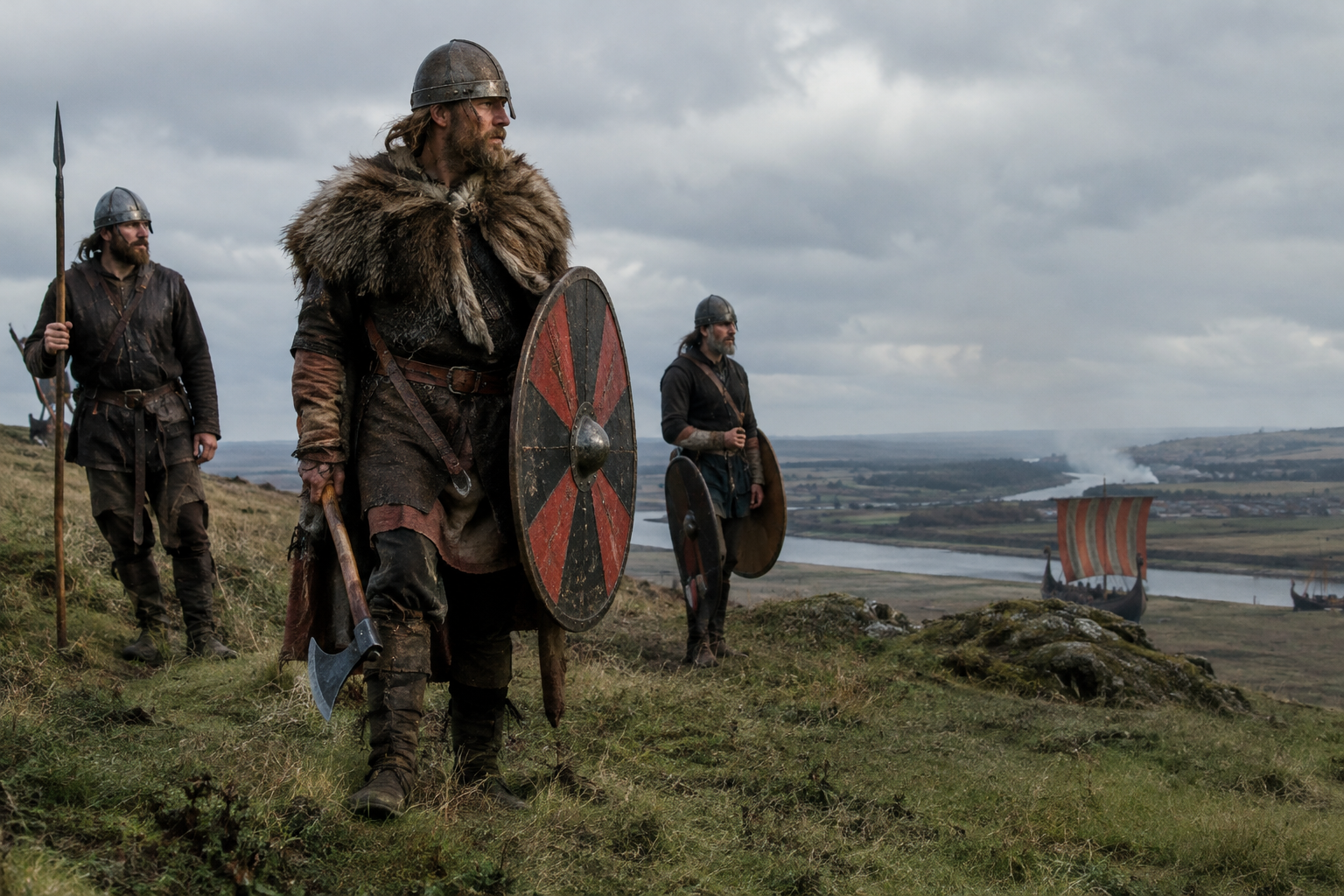
The most vivid anchor in the supplied evidence is VK263, identified as Viking Invader Ridgeway Hill England Year:998 AD. That label alone is arresting. Ridgeway Hill in England is associated with one of the starkest archaeological signatures of the Viking Age: the remains of men killed and buried in a context linked to conflict. Even stripped to the essentials, VK263 places this paternal lineage in a world of military movement, maritime mobility, and unstable loyalties at the end of the first millennium.
What can we responsibly say from that? Not that VK263 was the ancestor of anyone named later in written records. Not that every carrier of this haplogroup was Viking, Scandinavian, or an invader. But we can say that this branch, or one extremely close to it, was present in a man connected to the Viking-age conflict zone of England around 998 AD. That is already historically significant.
Late 10th-century England was not simply "English versus Viking." It was a dense contact zone. Raiding fleets, mercenaries, settlers, traders, enslaved people, and families moved across the North Sea and Irish Sea worlds. A Y-line found in such a burial context may reflect recent arrival, longer-term settlement, or earlier generations of mobility. Ancient DNA is powerful precisely because it complicates the old story.
In other words, VK263 is not merely a datapoint in a database. He is evidence that one paternal branch now catalogued as R1b1a1b1a1a2c1a2b2b1a belonged to a man caught in the hard politics of Viking-age England.
The supplied noble-family context takes us north and west, to Clan Nicolson and to Eilean Chaluim Chille in Loch Erisort on Lewis. This is one of those places where the landscape itself seems to remember more than the written record does. The island's name, meaning the island of Saint Columba, places it within the orbit of early Christian devotion in the Hebrides. At its center are the remains of a small medieval chapel and an old burial ground. This was, by the description supplied, less a place of ordinary residence than a place of sanctity, memory, and the dead.
That setting is a useful counterpart to VK263. At Ridgeway Hill we glimpse male-line history in violence. At Eilean Chaluim Chille we glimpse it in burial, continuity, and sacred geography. Between the two lies much of medieval northern history: the conversion of old maritime worlds, the persistence of family territories, and the gradual knitting together of Norse, Gaelic, and local Hebridean traditions.
The Nicolsons are historically associated with a region where identities were never simple. Lewis and the wider Hebrides were shaped by Gaelic-speaking communities, Scandinavian settlement, lordship networks, and ecclesiastical influence. A clan name in such a setting is part of a historical story, not a genetic proof. It would be wrong to claim that the entire clan, or every Nicolson male line, carried this exact haplogroup. But it is entirely reasonable to see the clan's historical homeland as part of the same North Atlantic arena in which lineages like this one could endure, divide, and reappear in different contexts.
And the island itself matters. Eilean Chaluim Chille is not a castle in the conventional sense of towers and curtain walls. Yet it functions as an ancestral stronghold of memory. Sacred islands and burial grounds often preserve a deeper continuity than fortresses do. Generations brought their dead there across the water. That repeated act says something profound about belonging: not merely who ruled, but where families believed they ought to rest.
It is tempting to draw a bright line from a Viking-age man in England to a later Hebridean clan landscape. History, however, is seldom so obliging. Shared or nearby Y-DNA branches can signal broad paternal kinship deep in time, but they do not by themselves identify a documented family tree. Ancient DNA and genealogy work on different scales. One deals in mutations and branching lines; the other in names, charters, marriages, and remembered ancestors.
What they can do together is illuminate the background. A lineage found in a Viking invader context in 998 AD and associated in modern or later historical frameworks with a Hebridean clan region fits a larger pattern of North Atlantic connectivity. England, Lewis, the Hebrides, and the Scandinavian world were joined by ships long before they were neatly sorted by historians into national boxes. Men moved for war, trade, marriage, exile, fosterage, and faith. Some lines vanished. Others persisted.
Eilean Chaluim Chille adds another dimension to that persistence. The spread of Columban Christianity through the Hebrides did not erase older local worlds overnight; it reorganized them. Burial places became anchors of community memory. If we want to understand how paternal lines survive, we should look not only at battlefields and mass graves, but also at chapels, islands, and cemeteries where communities kept returning.
That is one of the quiet lessons of this haplogroup. Its history is not just about origins. It is about survival through changing worlds: prehistoric branching inside R1b, medieval movement around the North Sea, and later remembrance in places tied to clan identity and sacred burial.
Explore Northern Scotland Kinship
R1b1a1b1a1a2c1a2b2b1a is historically interesting not because it offers a simplistic label, but because it refuses one. It sits within a major western Eurasian haplogroup, yet the evidence supplied brings it into focus through specific medieval lives and landscapes: a man from the Viking-age violence of Ridgeway Hill, and a clan-linked burial island in Lewis where sanctity and ancestry meet.
For readers interested in paternal ancestry, that is exactly the point. Y-DNA can reveal continuity across centuries, but usually in fragments. A grave here. A sacred island there. A clan tradition somewhere else. The task is to assemble those fragments without pretending they say more than they do.
So this haplogroup does not prove Viking identity, Scottish identity, or Nicolson descent. It does something better. It places one paternal branch inside the real historical geography of the early medieval North Atlantic, where raiders, settlers, pilgrims, and kin-groups all moved through the same seas.
If you want to understand how archaeology, genetics, and family history come together, MyTrueAncestry is the perfect place to keep digging. Upload your DNA and explore whether your results show connections to ancient individuals, historical populations, or regions like those discussed here. Those matches do not automatically prove direct descent from a particular warrior, clan, or noble line, but they can open an extraordinary window onto the deeper history behind your ancestry.






Comments