Haplogroup R1b1a1b1a1a2c1a2b2b

– 6 min read


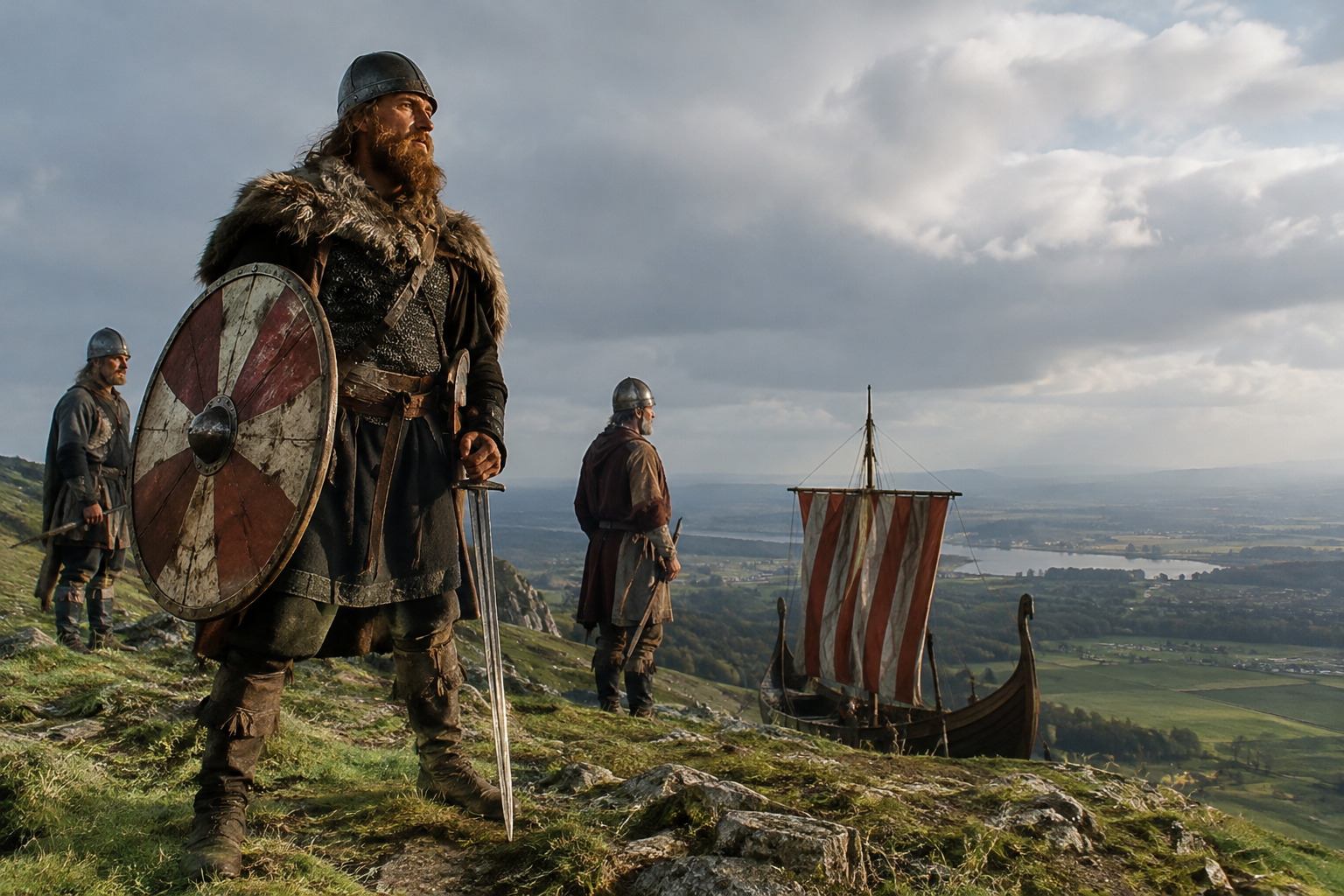
Some Y-chromosome lineages are famous because they turn up in royal tombs or in sweeping prehistoric migrations. Others are interesting for a different reason: they remind us how much of history is made not by neat labels, but by movement, violence, settlement, and reinvention. The haplogroup R1b1a1b1a1a2c1a2b2b belongs to a very large paternal family tree within haplogroup R1b, one of the major Y-DNA lineages found across western Europe today. That does not mean this very specific branch can simply be given the whole biography of R1b. Quite the reverse. The narrower the branch, the more careful we have to be.
Y-DNA traces one direct paternal line only: father to father to father, back through time. It does not represent a person's whole ancestry, culture, language, or identity. But when a branch like R1b1a1b1a1a2c1a2b2b appears in ancient DNA comparisons, and when its story is set beside medieval lordships such as the Barrett stronghold at Ballincollig near Cork, it offers something rather gripping: a way of thinking about how paternal lines can pass through very different worlds, from Viking-age raiders to Norman frontier castles and Gaelic power politics in Munster.
The first thing to say plainly is that R1b1a1b1a1a2c1a2b2b is a highly specific downstream branch of the broader R1b tree. Broadly speaking, R1b lineages became historically important in many parts of western Europe, and they are often discussed in connection with later prehistoric and Bronze Age population shifts. But it would be careless to say that every downstream branch followed exactly the same route, arrived at the same time, or belonged to the same communities.
What we can say responsibly is that this lineage belongs to a paternal family whose deeper ancestry lies within that western Eurasian and European R1b expansion story. Ancient DNA has made that larger picture much clearer over the last decade, especially by showing that paternal lineages could spread dramatically while languages, burial customs, and political identities changed around them. A Y-haplogroup is therefore not a tribal badge. It is better thought of as one surviving thread in a much larger historical fabric.
For readers interested in the longer prehistoric background to the paternal landscape of Europe, one useful companion piece is this broader look at Celtic-language origins and ancient genomes:
Explore Celtic Origins and Ancient DNA
The most vivid clue supplied here is an ancient individual from one of the grimmest archaeological discoveries in England: Viking Invader Ridgeway Hill England Year:998 AD ID:VK263. Even the label is dramatic enough without embellishment. Ridgeway Hill, in Dorset, is associated with the mass burial of men widely interpreted as Scandinavian raiders who met a violent end. Their remains have become one of the most haunting archaeological windows into the Viking world in Britain.
VK263 matters because he gives this haplogroup story a human scale. Not an abstract "migration," but a man caught in a precise historical moment near the end of the 10th century, when England, the North Sea world, and Scandinavia were tied together by trade, mercenary service, raiding, tribute, and conquest. If VK263 is genetically associated with the lineage discussed here, that does not make him an ancestor of any later family in Ireland or Britain. But it does place this paternal branch in the kind of mobile, militarized world from which many later medieval lineages emerged and dispersed.
The late 10th century was not a tidy contest of "English" against "Vikings." It was a shifting political landscape of local loyalties, overseas war bands, and rulers trying to survive. Ancient DNA is especially useful here because it can reveal paternal lines moving across political frontiers long before surnames or reliable family pedigrees appear in the record.
If you want to go further into that wider Scandinavian setting, this article provides a broader genetic backdrop to Viking-age mobility:
Once you start with a Viking-age sample in southern England, it is hard not to look westward. The Irish Sea, like the North Sea, was a zone of repeated movement. Scandinavians raided and settled in Ireland; Hiberno-Norse towns emerged; Norman families later crossed into Ireland from Britain and Wales; and old Gaelic dynasties adapted, resisted, married, allied, and fought. A paternal lineage in this setting could pass through several cultural identities without changing its Y-DNA label at all.
That is one of the most useful lessons of haplogroup history. The same direct paternal line might belong, in different centuries, to a Bronze Age herder, an Iron Age farmer, a Viking raider, a Norman settler, or a Gaelicized lord. The genetics alone cannot tell you which language he spoke or what banner he followed. But archaeology and history help narrow the world he lived in.
For Britain and nearby regions, that long view is especially important. Roman rule, post-Roman upheaval, Anglo-Saxon settlement, Viking activity, and Norman expansion all altered the political map. Yet paternal continuity and reshuffling could happen at different scales in different places. Some lines persisted locally; others arrived with newcomers and became rooted over time.
A good wider context for that changing insular landscape is this piece on Roman and early medieval Britain:
Explore Roman and Early Medieval Britain
The supplied noble connection brings us to Clan Barrett and Ballincollig Castle near Cork. Here the story becomes properly medieval: not just men on ships, but stone fortification, territorial control, and the uneasy business of holding power in Munster. Ballincollig began as a Norman stronghold, probably built in the 13th century by the Barrett family to control the route west from Cork city and to command the River Lee valley.
That single detail tells us a great deal. Castles were not only residences. They were instruments of surveillance, taxation, intimidation, and communication. A family associated with a fortress like Ballincollig stood at a pressure point between town and hinterland, river and road, conquest and accommodation.
Over the centuries the castle was fought over, repaired, altered, and drawn into the shifting balance of power between Anglo-Norman lords, Gaelic families, and the English crown. By the 16th century it had become linked with the rising MacCarthy rulers of Muskerry. That transition is classic Ireland: supposed conquerors becoming localized, old Gaelic powers reasserting themselves, and strongholds changing hands in a landscape where alliance could matter as much as descent.
There is an obvious temptation to leap from a haplogroup to a castle-owning family and declare a direct paternal continuity. We should resist it. A historical association with R1b1a1b1a1a2c1a2b2b does not prove that every Barrett male carried that exact lineage, nor that a medieval Barrett line descends from any particular ancient sample such as VK263. What it does provide is a meaningful historical setting. Both belong to a world of movement around the British and Irish seas, where paternal lines could travel, settle, and be folded into new aristocratic identities.
Readers interested in the family itself can dig further into the Barrett story here:
Ruins such as Ballincollig are powerful precisely because they outlast the paperwork. Genealogies break, surnames branch, documents vanish, and lordships collapse. But the castle remains, battered and partial, still marking where a family once tried to anchor itself in stone. In that sense, castles preserve the geography of lineage even when they cannot prove the genetics of lineage.
Ballincollig's ruined tower and walls stand as a reminder of medieval lordship in Cork, and of how unstable such power could be. For anyone exploring a paternal haplogroup, that matters. Y-DNA can suggest that a line belonged to broad historical patterns of settlement and mobility; a castle shows where, in one later chapter, some branch of that world became local, territorial, and named.
The most interesting thing about R1b1a1b1a1a2c1a2b2b is not that it gives a single neat identity, but that it does the opposite. It pulls together a very broad western European paternal background, a Viking-age individual from Ridgeway Hill in England, and a later medieval setting in Munster where Norman and Gaelic histories became entangled. That is exactly the sort of complexity ancient DNA is good at exposing.
So if this is your haplogroup, what does it mean? It means your direct paternal line belongs to a very particular branch within the wider R1b tree. It may connect you, at the level of deep paternal ancestry, with lineages that moved through major European transformations. It does not prove descent from VK263, from Clan Barrett, or from the builders of Ballincollig Castle. But it does place your paternal line in a historical arena where such comparisons become worth exploring.
That is one of the pleasures of MyTrueAncestry. Ancient samples, medieval families, and archaeological landscapes do not collapse into one another, but they can be set side by side in ways that make the past feel more human and more complicated.
Upload your DNA to MyTrueAncestry to explore whether your results show links to ancient individuals, historical populations, and the paternal lineages that moved through places like Ridgeway Hill and medieval Cork. These matches do not necessarily prove direct descent or noble-family membership, but they can offer a remarkable new perspective on your ancestry.






Comments