Haplogroup R1b1a1b1a1a2c1a2a1a1a1b1

– 6 min read


Some Y-chromosome lineages are famous because they are broad and ancient. Others are interesting precisely because they are so narrow. Haplogroup R1b1a1b1a1a2c1a2a1a1a1b1 belongs to that second category: a very specific paternal branch, far downstream within the great R1b family tree, the sort of lineage that reminds us how human history is built not only from sweeping migrations but also from countless individual father-to-son lines carried through villages, war bands, estates, and dynasties.
That is worth pausing over. Y-DNA haplogroups trace only one line of ancestry: the direct paternal line. They do not describe a person's full genetic background, let alone a whole identity. But when read carefully, especially alongside archaeology, they can illuminate long patterns of male-line continuity and movement. In the case of a highly specific branch like this one, caution matters doubly. We should not simply pour the whole prehistory of broad R1b into this narrow twig. Still, its position within the wider R1b world places it in a story deeply tied to western and northern Europe, and one of the supplied ancient samples brings us straight into that landscape.
Broadly speaking, R1b is one of the major Y-chromosome lineages of western Europe today and has been central to debates about later prehistoric migrations, especially those linked to Bronze Age expansions and the reshaping of Europe's paternal landscape. But the deeper one travels down the phylogenetic tree, the more careful one must be. A downstream lineage such as R1b1a1b1a1a2c1a2a1a1a1b1 is not a synonym for all R1b men, nor for all Celts, Vikings, Normans, or medieval nobles.
What we can say responsibly is that this branch belongs inside a paternal framework that became important across much of Europe after prehistoric population changes involving steppe-derived ancestry and later regional differentiation. Over time, branches of R1b appear in many different historical settings: Atlantic Europe, the North Sea world, parts of Scandinavia, and regions shaped by medieval mobility. That makes this haplogroup historically interesting not because it belongs to one neat people, but because it sits at the intersection of several overlapping stories: Bronze Age demographic change, Iron Age regional formation, Viking Age mobility, and medieval aristocratic settlement.
Readers interested in those bigger archaeological foundations may enjoy a wider look at how ancient DNA transformed our understanding of Europe's paternal past.
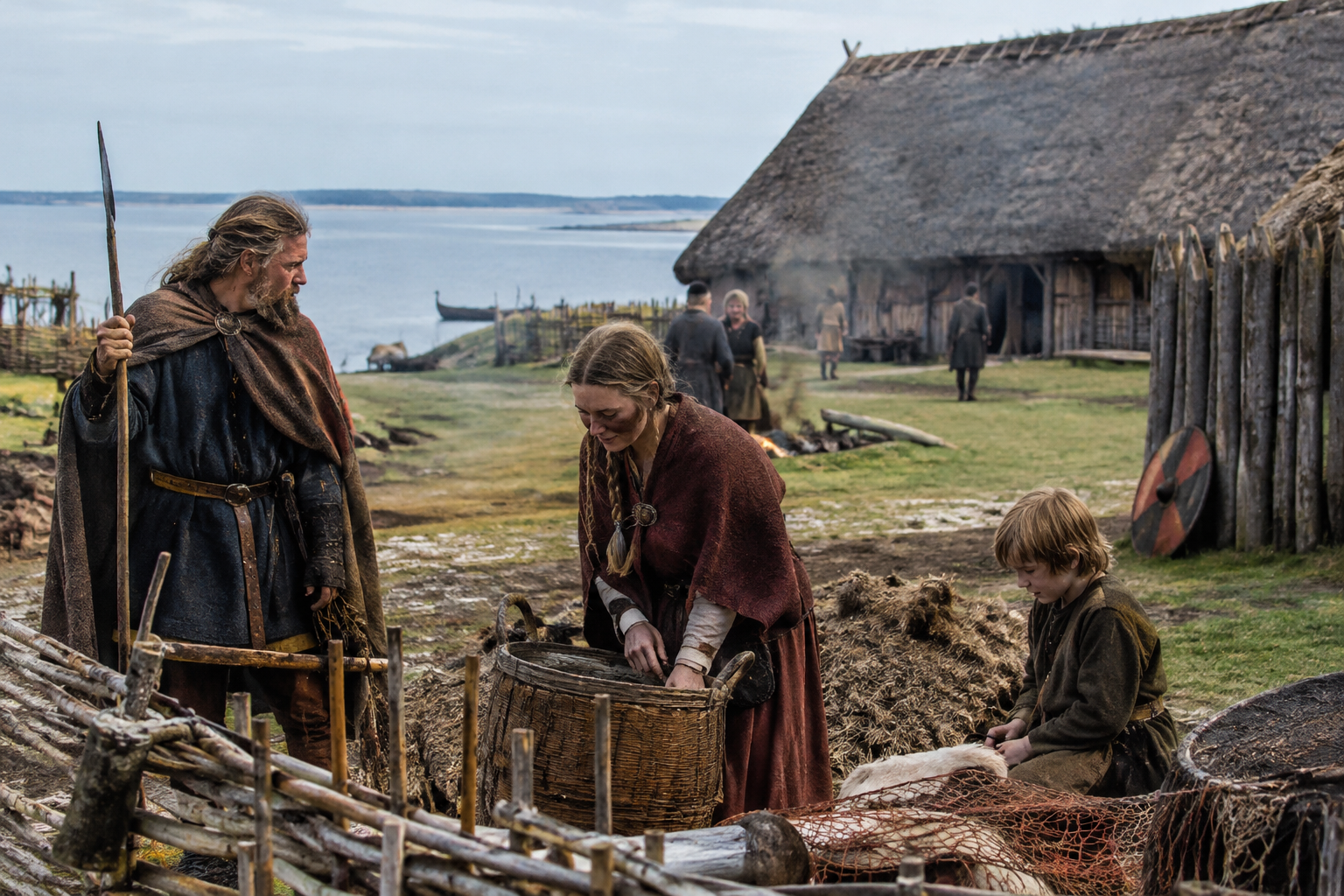
The most concrete anchor supplied here is VK287, from Viking Age Kaargarden Grav Denmark, dated to 950 AD. That date drops us into a world that is often over-romanticised: longships, raiding, kingship, conversion, trade. But as ever, the dead are more useful than the legends. A man buried in Viking Age Denmark tells us that this paternal line, or a close branch within its immediate neighborhood, was present in Scandinavia in the 10th century.
That matters because Viking Age Scandinavia was anything but isolated. Denmark in around 950 AD sat within an intensely connected maritime zone linking the Baltic, the North Sea, the British Isles, and the North Atlantic. Men moved as traders, settlers, mercenaries, retainers, and, yes, sometimes raiders. A Y-line found in Denmark at this period is therefore part of a social world that stretched well beyond modern national borders.
At the same time, one sample is not an ethnic label. VK287 is not "the Viking haplogroup," and he is certainly not proof that every later bearer of this lineage descends from a Scandinavian adventurer. Ancient DNA is better read as evidence of presence, context, and pattern. Here the pattern is that a paternal branch associated with the broader R1b family was alive in Viking Age Denmark, in a region deeply entangled with the histories of Britain and Ireland.
If you want more on that Scandinavian setting, the MyTrueAncestry community has an especially relevant article on the genetic picture of the Viking world.
Now comes the historically tantalising part. Denmark in 950 AD and County Meath in medieval Ireland are not the same place, but they belong to a connected northwestern European story. Viking movement affected Ireland profoundly, not only through raiding but through settlement, trade towns, political alliances, and changing military fashions. Meanwhile, after the Norman invasion of Ireland, new aristocratic networks from Britain and the Continent were planted across the island. These were overlapping worlds of mobility, intermarriage, lordship, and local adaptation.
That is exactly the sort of landscape in which a specific paternal lineage might appear in more than one historical setting without implying a direct, traceable genealogical line between them. Ancient DNA gives us snapshots. Written history gives us castles, grants, marriages, and lawsuits. Together they do not produce a simple family tree; they produce a better map of how lineages could persist and travel.
This broader pattern of movement around the North Sea and into Britain is explored further in another useful community article.
In County Meath, Killeen Castle offers a very different kind of evidence: not bone and burial, but stone, inheritance, and memory. Its story reaches back to about 1181, when Hugh de Lacy granted the lands to his knight Geoffrey de Cusack. Geoffrey built an early fortress there and established a family line that held the place for centuries. Already we are in the classic Anglo-Norman world of land grants and military colonisation, where new lordships were fixed onto older Irish landscapes.
In the early 1400s the property passed by marriage to the Plunket family, who became Lords of Killeen and later Earls of Fingall. They rebuilt and enlarged the castle over time, as noble families tend to do when turning conquest into residence and residence into prestige. The place then lived through the normal upheavals of Irish history: war, altered fortunes, shifting ownership. Much of what later stood there reflected a grand 19th-century Gothic revival remodelling, itself a reminder that aristocratic houses are always rewriting their own pasts.
Then came catastrophe. In 1981, a fire gutted the building and left it a ruin. In the 21st century it was restored as part of a broader estate redevelopment with a hotel, golf course, and the old demesne brought back into use. It is, in other words, a castle that has been medieval fortress, aristocratic seat, romantic relic, and modern restoration project - which is practically the biography of half the great houses of these islands.
What has this to do with haplogroups? Not proof, certainly. The existence of Killeen Castle does not establish that the Plunkets carried this exact Y-DNA branch, and a historical association should never be mistaken for confirmed genetic descent. But castles like Killeen preserve the regional and familial contexts in which paternal lines were remembered, disputed, and transmitted. They are the documentary counterpart to what ancient DNA offers archaeologically.
Readers who want the specifically family-centered side of this story should look at the community article on the clan itself.
For a lineage as specific as R1b1a1b1a1a2c1a2a1a1a1b1, the greatest value is precision, but the greatest temptation is overreach. Precision means it may help place a direct paternal line within a narrower historical pattern than a broad label like R1b ever could. Overreach is the urge to jump from a Viking Age grave in Denmark to a medieval lord in Meath and declare a tidy family saga. History is almost never that obliging.
What we can say is more interesting than a fairy tale anyway. We have a paternal branch embedded in the larger R1b history of Europe. We have an ancient individual, VK287, showing that this lineage's world included Viking Age Denmark in 950 AD. We have a medieval aristocratic landscape in Ireland, centred on Killeen Castle and the Plunkets, where paternal inheritance, lordship, and historical memory mattered enormously. Those are not identical things, but they belong to a connected historical geography of the North Sea and Irish Sea worlds.
That is the real strength of combining genetics with archaeology and history. DNA can show that a paternal line existed in a place and time where documents are silent. Castles and family records can show how lineages later became socially visible. Neither source alone is enough. Together, they let us ask better questions.
If your own results include this haplogroup or a related branch, MyTrueAncestry can help you explore where your paternal line fits into the bigger human story. Ancient DNA matches and haplogroup context may reveal striking links to archaeological individuals and historical populations, even if they do not by themselves prove direct descent from any particular ancient person or noble house.
Upload your DNA to MyTrueAncestry and see whether your ancestry connects you to ancient samples like VK287, to the wider Viking Age world, or to the medieval landscapes where families such as the Plunkets built their power in stone.






Comments