Haplogroup R1b1a1b1a1a2c1a2a1a1a1

– 6 min read


Some Y-DNA haplogroups announce themselves with a familiar historical label. This one does not. R1b1a1b1a1a2c1a2a1a1a1 is a very specific paternal branch, tucked deep inside the vast R1b tree, and that is precisely what makes it interesting. It reminds us that the history of male lineages is not really about grand, tidy categories, but about countless narrower family branches moving through real places, surviving political upheavals, and sometimes turning up in the archaeology of surprisingly distant regions.
Y-DNA traces a direct father-to-son line only. It is not the same thing as a person's full ancestry, culture, language, or identity. Still, paternal lineages can be wonderfully revealing. They help us ask where certain male lines appear in ancient burials, how they spread across regions, and how later historical landscapes - Viking Denmark, Gaelic Ulster, a ruined frontier castle - may sit within much older patterns of movement and continuity.
This haplogroup belongs to the broader R1b family, one of the major Y-chromosome groupings in western Eurasia. At the broadest level, R1b has an enormous and complicated history stretching across prehistoric and historic Europe. But caution matters here: the story of the whole R1b tree cannot simply be pasted onto one very narrow downstream branch. The more specific the lineage, the more careful we need to be.
What we can say responsibly is that a subclade as detailed as R1b1a1b1a1a2c1a2a1a1a1 points to a later refinement within a much older paternal framework. In other words, it belongs to a branch of the tree that emerged after many earlier population movements had already shaped Europe. Ancient DNA has transformed our ability to see this. Instead of speaking only in broad continental patterns, we can now catch glimpses of very specific paternal lines in named individuals, from named graves, in dated archaeological settings.
For readers interested in the deeper background to how archaeology and genetics together reconstruct such lineages, MyTrueAncestry's broader introduction to the field is well worth exploring.
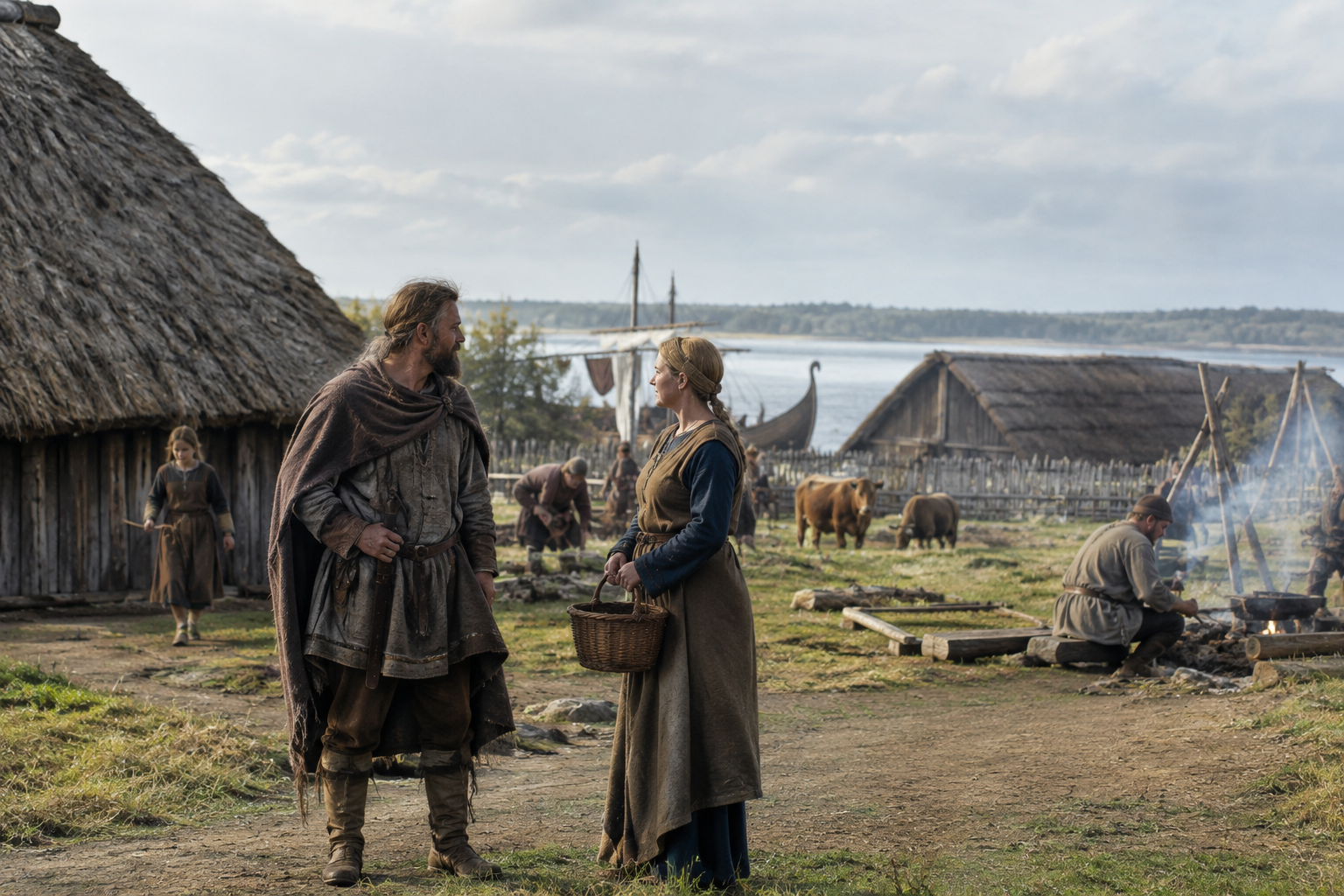
The most concrete anchor provided here is an ancient individual from Scandinavia: VK287, from Viking Age Kaargarden Grav Denmark, dated to 950 AD. Even with a single sample, there is quite a lot to think about. By 950 AD, Denmark was not some sealed ethnic box. It was part of an intensely connected North Sea world of raiding, trade, migration, settlement, intermarriage, and political ambition.
A burial from Viking Age Denmark carrying a lineage associated with this narrow branch tells us, at the very least, that this paternal line was present in that Scandinavian world. It does not prove that all bearers of the haplogroup were Vikings, still less that everyone with the haplogroup today descends from this one man. But it gives us something far more valuable than modern guesswork: a securely dated historical appearance of the lineage in a real archaeological context.
The setting matters. Around the middle of the 10th century, Danish society was changing fast. Royal power was consolidating. Christianity was advancing unevenly. Maritime connections tied Denmark to England, Ireland, the Scottish isles, the Frankish coast, and the Baltic. A paternal line found in this setting may reflect local continuity, mobility across the North Sea, or a combination of both. Viking Age burials repeatedly show that the Scandinavian world was socially and biologically mixed, not genetically uniform.
If you want a wider look at that world of movement and ancestry, there is an excellent companion piece on Viking-era population history.
Once a paternal lineage is documented in Viking Age Denmark, the next historical question is geographical rather than genealogical: where else might related branches have circulated in the medieval North Atlantic world? That question matters especially for Ireland and the western seaways, where Scandinavian, Gaelic, Hiberno-Norse, Anglo-Norman, and later English influences overlapped over centuries.
None of this means that a Danish Viking sample is the ancestor of a later Irish family. That would be far too strong a claim. But the broader historical geography is compelling. Denmark, the Irish Sea, and eastern Ulster were all part of connected medieval routes of movement. Men, ships, mercenaries, traders, clerics, settlers, and captives crossed these waters constantly. Y-DNA helps illuminate the paternal side of that traffic, though written records and archaeology still do much of the heavy lifting when we try to understand who these people were.
Readers interested in the larger story of how Scandinavian and North Sea migrations shaped Britain and Ireland may enjoy another community article that follows those long connections across time.
This brings us, carefully, to Clan Magennis and Rathfriland Castle in County Down, Northern Ireland. The site is historically rich even before one says a word about genetics. Its name comes from the Irish Rath Fraoileann, "the ringfort of Fraoileann", a reminder that this was an important place long before any early modern fortified house rose there. In other words, the castle site preserves memory of an older Gaelic stronghold underneath the later masonry and military use.
That matters because a place like Rathfriland sits at the crossroads of exactly the sort of historical layering that Y-DNA cannot explain on its own but can help frame. Here was a landscape of Gaelic lordship, then plantation, then rebellion, then renewed garrisoning, then ruin. In the early 17th century, during the Plantation of Ulster, a fortified house or castle was built there as an instrument of English control. It was attacked and burned in the 1641 rebellion, rebuilt again, and later used in the Williamite wars. Very little survives above ground now, but the site still carries the memory of repeated contest over power, land, and belonging.
The historical association with Clan Magennis is therefore regional and contextual rather than a proof-text for paternal descent. A noble family or clan may be linked to a haplogroup in tradition, project data, or regional history, but that does not mean every man of that surname shared the same Y-line, nor that the castle itself proves a genetic lineage. Medieval and early modern kin groups were political as well as biological formations.
Still, there is something rather splendid in placing a precise paternal branch beside a place like Rathfriland. One gives us the microscopic grammar of male-line inheritance; the other gives us the messy historical prose of conquest, resistance, and survival.
For readers who want to follow the family history side of this Ulster story more closely, the dedicated community feature on the clan adds valuable context.
The real value of a haplogroup like R1b1a1b1a1a2c1a2a1a1a1 is not that it hands us a ready-made identity. It does something more interesting. It lets us set a narrow paternal lineage against several different kinds of evidence: an ancient man in Viking Age Denmark, the connected North Sea world of the 10th century, and a later Gaelic lordship in Ulster whose stronghold became entangled in plantation and war.
Ancient DNA is especially good at showing that the past was not still. Paternal lines can persist for centuries, but the societies carrying them may change language, allegiance, religion, and political identity more than once. The man buried as VK287 in Denmark in 950 AD belonged to a Viking Age context. A much later Magennis lord belonged to a Gaelic and then colonial frontier context. Shared haplogroup background, even if demonstrated at some level, would not make them the same sort of historical person. It would simply mean that one thread of paternal ancestry survived through very different worlds.
That is why Y-DNA works best when paired with archaeology and history. Genetics can identify lineages and connections. Archaeology tells us how people were buried, where they lived, and what sort of material world they inhabited. Written history tells us who held power, who lost it, and how places such as Rathfriland acquired their layered meanings.
Very specific subclades often become more informative as new ancient samples appear. Today, one Viking Age Danish individual may be our clearest fixed point. Tomorrow, additional burials from Britain, Ireland, the North Sea coast, or Scandinavia may sharpen the picture. That is the excitement of archaeogenetics: not certainty where none exists, but the steady narrowing of old historical fog.
If this haplogroup appears in your own paternal results, it offers a clue to one line among many in your ancestry. It may place your direct male line within a wider story of western Eurasian and North Sea history. It may also connect you, broadly and cautiously, to populations that moved between Scandinavia, Britain, and Ireland in the medieval period. But it does not by itself prove descent from Vikings, from Clan Magennis, or from any named noble house. The fascination lies in context, not fantasy.
Upload your DNA to MyTrueAncestry to explore whether your results show similarities to ancient individuals such as VK287 or to historical populations from places like Viking Age Denmark and medieval Ireland. Those matches can offer remarkable perspectives on your past, even when they do not amount to a documented family tree or proof of noble descent.






Comments