Haplogroup R1b1a1b1a1a2c1a1f1a2

– 6 min read


There is something wonderfully humbling about a Y-DNA label as long as R1b1a1b1a1a2c1a1f1a2. It looks less like history and more like a railway timetable gone wrong. But behind that string lies a very human story: fathers and sons, migrations and settlements, war bands and farmsteads, and the slow persistence of a paternal line across centuries of upheaval.
That matters because Y-DNA haplogroups trace one very particular thread of ancestry: the direct paternal line. They do not describe a person's whole family tree, ethnicity, or complete genetic background. Still, they are remarkably useful for understanding how male lineages moved through time and space. In this case, the haplogroup sits within the broader R1b family, a major branch in western Eurasia with a long and complicated prehistoric and historic record. For a narrow downstream branch like this one, however, caution is essential. We can place it within that wider paternal landscape without pretending that every episode in the big history of R1b belongs neatly to this much more specific subclade.
The parent haplogroup R1b is deeply important in the study of European paternal ancestry. Ancient DNA has shown that different branches of R1b became widespread in parts of Europe over time, especially after major prehistoric population changes linked to Bronze Age movements. But a downstream branch such as R1b1a1b1a1a2c1a1f1a2 is not the same thing as R1b in general. It represents a much narrower twig on a very large tree, and its own history is likely to be later, more regional, and more specific than the grand sweep of R1b as a whole.
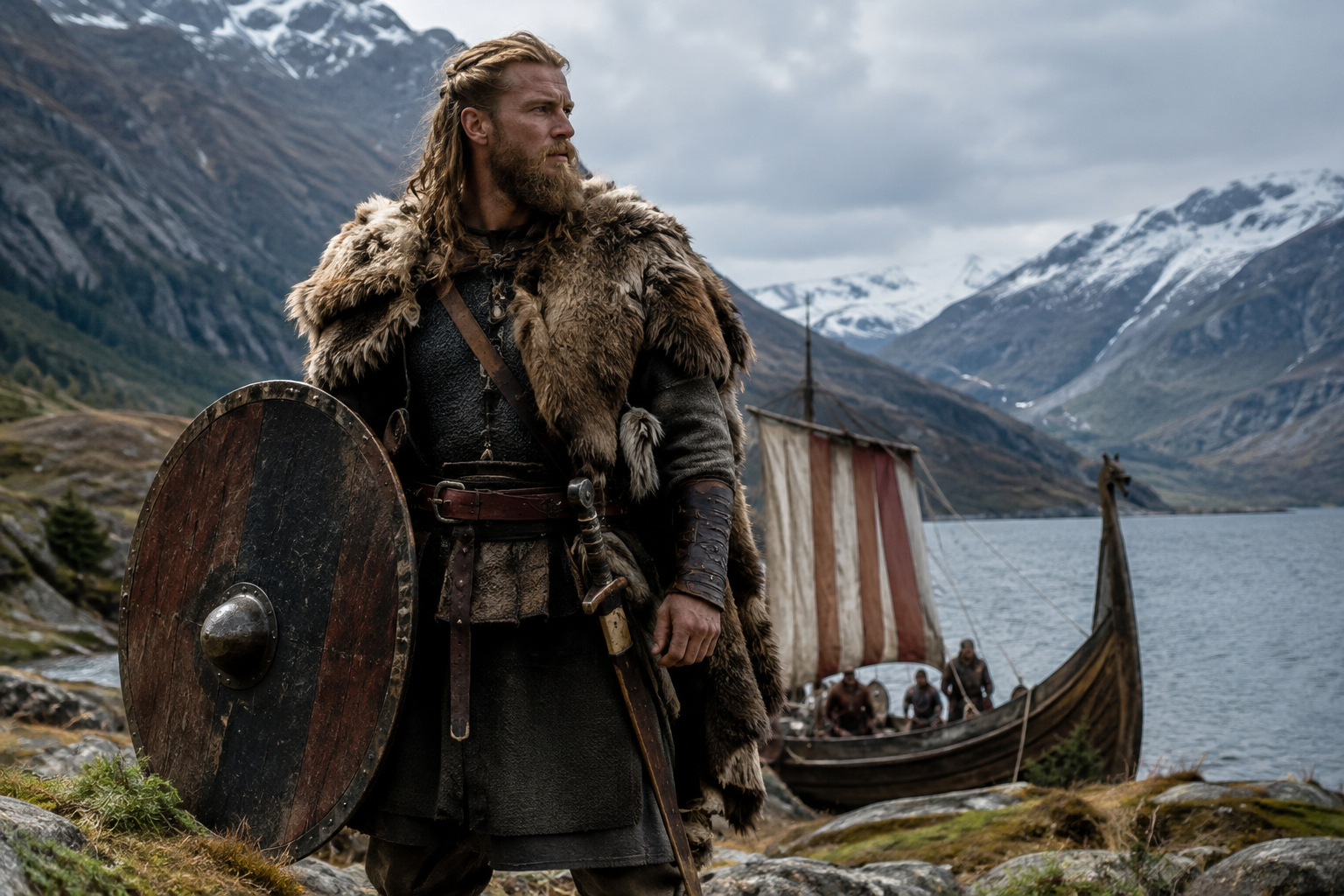
That is where archaeology becomes so useful. Rather than waving vaguely at all of prehistoric Europe, ancient DNA lets us catch this paternal line in the company it kept. In the present case, the strongest anchor we have is in Scandinavia, in the Viking Age, and that already tells us something important. By around 900 AD, this lineage, or a very closely related paternal line, was present in Norway among people living in the world of Viking Age mobility, regional lordship, and North Sea connections.
Readers interested in the deeper background to how ancient DNA transformed these kinds of questions may enjoy a broader introduction to the field itself.
The most vivid evidence here comes from VK386, identified as a Viking Age Warrior from Oppland, Norway, dated to 900 AD. Even with only a short description, the sample opens a window onto a very particular landscape. Oppland was inland Norway, not the dramatic fjord-edge of tourist posters but a region tied into the political and economic life of the Viking world. Men from such places could be farmers, local retainers, traders, raiders, or all of these at different points in life. The word "warrior" reminds us that this was an age in which status, kinship, and armed service often went together.
What does VK386 tell us? First, it shows that this paternal branch belongs securely within the historical population of Viking Age Scandinavia. Second, it reminds us that lineages travel not as abstract markers, but in real people: men buried with identities shaped by local loyalties and wider northern networks. Third, it offers context rather than proof. A shared haplogroup connection between a modern tester and VK386 would suggest some paternal relationship far back in time, but not a direct line of descent that can be named in a family tree.
Nor should we jump too quickly from one Viking Age sample to sweeping ethnic conclusions. Ancient Scandinavia was not genetically uniform, nor was "Viking" a genetic category. It was a historical world, full of movement around the North Sea and Baltic, and ancient DNA keeps showing just how mixed, local, and mobile those communities could be.
If you want a wider view of that complexity, one of the best companion reads is the MyTrueAncestry article on Viking Age genomics.
Once we place a lineage like this in Viking Age Norway, the next question practically asks itself: where might such paternal lines have gone? Here the responsible answer is twofold. Some probably stayed local, passing from father to son within Scandinavian communities. Others may have moved through the now familiar Viking Age corridors linking Norway, the British Isles, the Irish Sea, the North Atlantic islands, and beyond.
That does not mean every modern bearer of this haplogroup descends from a Viking raider, nor that every medieval Scottish or northern English family with North Sea ties shared this exact paternal branch. But geographically and historically, the North Sea is the right stage on which to think about such a lineage. It was less a barrier than a busy water-road, carrying goods, ideas, people, and paternal lines.
This is precisely why Y-DNA can be so illuminating. Written genealogy usually fades into uncertainty long before the early Middle Ages. Ancient DNA, by contrast, can sometimes show us that a paternal branch was already present in a region centuries before surnames, parish registers, or heraldic traditions. It does not replace history; it gives history a deeper floor.
For readers interested in the British end of those northern movements, this broader piece on North Sea migrations is well worth following up.
The supplied family connection brings us to Clan Arnott and to an unexpectedly revealing structure: Arnot Tower in Portobello, Edinburgh. This is not, in fact, an ancient fortress crouching defiantly over the landscape. It is a 19th century folly, built around 1825 by the lawyer and antiquarian Hugo Arnot, or for his family. It was designed to look medieval, a deliberate gesture toward Scotland's past rather than a survival from medieval warfare.
And that is exactly why it is so interesting. Arnot Tower tells us something about how families in modern Scotland imagined ancestry, region, and heritage. As Portobello changed from seaside resort to built-up suburb, the house disappeared while the tower remained: a relic not of feudal conflict but of historical taste. It was a monument to memory, to the romance of lineage, to the Victorian pleasure in turning the past into scenery.
There is a rather Mary Beard-like lesson in that. People have always been keen to dress themselves in antiquity, sometimes literally in stone. A family associated with a picturesque medievalizing tower is not thereby proven to share a specific Y-DNA line. Genetics and family tradition are different kinds of evidence. But when they are set side by side, they tell us something richer about how the past is inherited: through chromosomes, yes, but also through stories, landscapes, architecture, and acts of remembrance.
So the connection between this haplogroup and Clan Arnott should be read carefully. It is a historical association, not a demonstrated proof that every Arnott male belonged to R1b1a1b1a1a2c1a1f1a2. Still, the pairing is evocative. A Viking Age paternal lineage documented in Norway, and a later Scottish family preserving a cultivated sense of ancestral past, both belong to the same northern historical world shaped by centuries of contact across the North Sea.
For more on the family itself, the community article on Clan Arnott adds useful historical context.
R1b1a1b1a1a2c1a1f1a2 is interesting not because it lets us make loud claims, but because it lets us make careful ones. It places a direct paternal line within the wider R1b world, while ancient DNA gives us at least one firm historical sighting in VK386, a Viking Age warrior from Oppland in 900 AD. That is already substantial. It situates the lineage in medieval Scandinavia, in a region deeply connected to the making of the North Atlantic and North Sea worlds.
When we then turn to later Scottish historical memory, to Clan Arnott and the curiously theatrical Arnot Tower, we are not looking at proof of direct descent from VK386 or from any one medieval Norwegian. We are looking at a more subtle and more truthful picture: paternal lineages can endure across long spans of time, while the meanings people attach to ancestry change dramatically. One age buries a warrior; another builds a mock-medieval tower.
That is one of the pleasures of MyTrueAncestry. Ancient DNA does not flatten history into a slogan about identity. It makes it stranger, more local, more human, and often more surprising.
If your own Y-DNA or autosomal results connect you to northern Europe, Viking Age populations, or historic Scottish regions, MyTrueAncestry can help you explore those links through ancient samples and historical context. Such matches do not automatically prove direct descent from a named warrior or noble house, but they can offer a fascinating glimpse into the older populations that form part of your deeper ancestry story.






Comments