Haplogroup R1b1a1b1a1a2c1a1f1a1b1

– 6 min read


Some Y-chromosome lineages announce themselves with grand historical labels. Others arrive more quietly, hidden inside a very long string of letters and numbers such as R1b1a1b1a1a2c1a1f1a1b1. Yet that very specificity is what makes such a branch interesting. It reminds us that paternal ancestry is not a single sweeping saga called "R1b," but a branching tree of countless male lines, some ancient and widespread, others local, late-forming, and best understood through careful comparison of living DNA, archaeology, and a handful of ancient remains.
This haplogroup sits deep within the broader R1b family, one of the best-known Y-DNA groupings in western Eurasia. But it is worth saying at once that a narrow downstream branch cannot simply inherit the whole history of its much older parent. The rise of R1b in prehistoric Europe, its association in many contexts with later Bronze Age population change, and its prominence in parts of Atlantic Europe are broad background, not a license to assign every fine-scale descendant branch to every episode in that story. Y-DNA traces only one direct paternal line out of the thousands that make up a person's ancestry, and it does not by itself define ethnicity, language, clan identity, or noble descent.
The wider R1b tree matters because it gives context. Ancient DNA has shown that branches of R1b became important across large parts of Europe after prehistoric population shifts tied to the later Neolithic and Bronze Age. In general terms, that means the paternal background of many men in western Europe today was shaped by long processes involving migration, social change, and the uneven survival of some male lines over others.
For a very specific subclade such as R1b1a1b1a1a2c1a1f1a1b1, however, the historical question is narrower. We are not looking for the first appearance of R1b in Europe. We are looking instead at where this later branch seems to surface, how it may fit into regional histories around the North Atlantic, and what sort of medieval or early modern communities carried it. That takes us away from sweeping origin myths and into a more interesting sort of history: island settlement, seaways, churchyards, clan territories, and the stubborn continuity of local male lines.
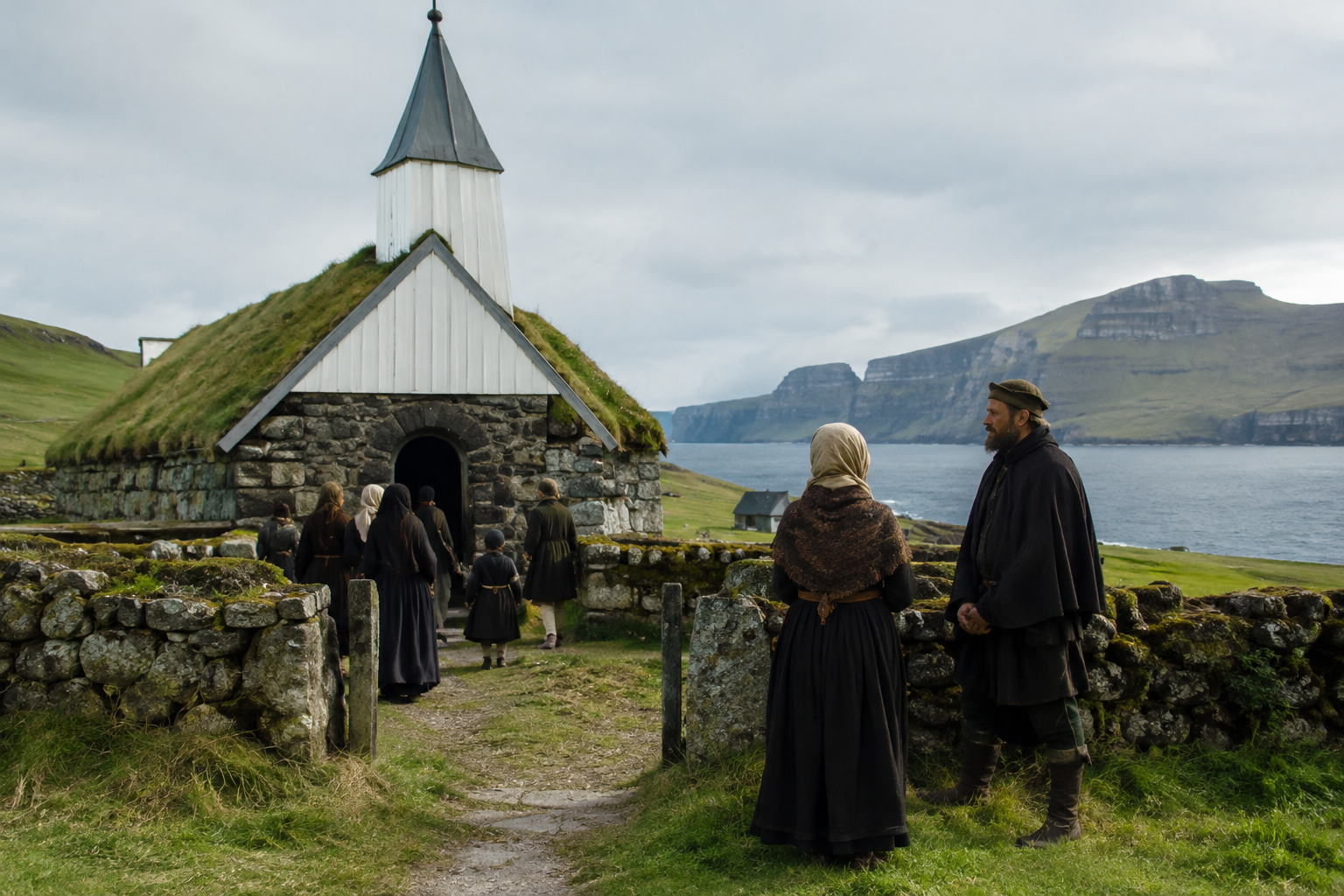
The most concrete clue supplied here is not from a Bronze Age prince or a weapon burial, but from a church site in the North Atlantic. VK242, from Medieval Age Faroe Islands Sandoy Church, dated 1600 AD, gives us a real man from a real community. The date is late by ancient DNA standards, but that hardly makes it uninteresting. On the contrary, this is precisely the sort of evidence that helps bridge the gap between settlement history and genealogical memory.
By 1600 AD the Faroe Islands had long been part of the Norse world and then its post-medieval successors. A burial at Sandoy Church belongs to a Christian landscape, to an island society shaped by seaborne connections, and to a population that had already lived for centuries at the edge of Europe. A Y-line found in such a context is not proof of Viking identity in any simple sense, nor does it tell us that one paternal branch arrived only once. But it does place this lineage in a region where Scandinavian, Insular, and North Atlantic histories met.
That matters because the Faroes were never isolated in the romantic sense. They were linked by ship to Norway, the Northern Isles, Iceland, the Hebrides, and, indirectly, to the wider British Isles. A paternal lineage present there in 1600 AD may reflect much earlier settlement streams, later movement between Atlantic islands, or the long-term persistence of one male line in a relatively small population. Ancient DNA cannot settle every detail, but it gives us an anchor that written records alone rarely provide.
If this branch appears in a Faroese churchyard, the most responsible historical setting is the North Atlantic maritime zone rather than a single modern nation. That zone included Norse settlers, Gaelic-speaking populations, mixed households, church networks, trading contacts, and later crown authority. Paternal lineages moved through it not as labels but as men: farmers, sailors, tenants, clerics, retainers, and fathers.
It is tempting to push every northern Atlantic Y-line into a single story of "the Vikings." But the archaeology and genetics of the region are more untidy, and therefore more revealing. Some paternal lines certainly spread with Norse expansion. Others may have been present in Britain and Ireland before the Viking Age and were later carried into island colonies. Still others may have expanded locally in the medieval centuries. A fine-scale haplogroup such as R1b1a1b1a1a2c1a1f1a1b1 sits inside that complexity.
The broader lesson is that ancient DNA often works best when it complicates familiar categories. It shows how regions endured while populations mixed, how Christian burial grounds preserve men from maritime societies, and how a Y-line can belong to many different historical identities across time.
If the Faroe Islands offer one island setting for this haplogroup, western Scotland offers another. The supplied family connection is Clan MacRae, linked with Eilean Donan, one of the most recognisable castles in Scotland. Here, though, the point is not to claim that all MacRaes belonged to this haplogroup, still less that a Faroese burial proves descent from any named clan. The value lies in geography and historical atmosphere: another sea-laced frontier where paternal lines could persist across centuries while power changed hands around them.
Eilean Donan stands on a small island where three sea lochs meet in the western Highlands. Tradition reaches further back still, to an early medieval church site associated with Saint Donnan. In the 13th century a fortified castle was established there, probably by the Mackenzies, lords of Kintail, in what the input aptly calls the Norwegian frontier world. That phrase matters. The western Highlands were not a sealed Gaelic interior. They were tied to a larger maritime sphere that included Norse political influence, mixed cultural zones, and constant movement by water.
Later, the castle became closely associated with the Macraes, who helped defend it through the later Middle Ages and the age of clan rivalry. That is precisely the kind of social setting in which paternal lines could acquire strong local identity without becoming genetically uniform. Clans were political and kinship groupings, but not every member necessarily shared the same direct male-line ancestor. DNA can sometimes illuminate clan history; it cannot flatten it.
The later story of Eilean Donan is equally telling. In 1719, during the Jacobite rising, Spanish troops used the castle. British warships bombarded it and blew up its magazine, leaving the building a ruin for roughly two centuries before Lieutenant Colonel John MacRae Gilstrap rebuilt it in the early 20th century in a revivalist spirit. So the castle we know now is both medieval in memory and modern in reconstruction: a monument not just to warfare, but to the persistence of Highland identity.
Not a proven family tree. That must be said plainly. A church burial on Sandoy and a later Scottish clan stronghold are not connected by any demonstrated line of descent simply because they sit in regions touched by related Y-DNA patterns. But they do illuminate the same kind of historical world: northern maritime communities, Christian institutions, local continuity, and the survival of paternal branches in places where sea routes mattered more than modern borders.
That is where ancient DNA is most useful. Written genealogy usually begins late and privileges elites. Ancient DNA can instead place ordinary or semi-visible individuals into the map of the past. A sample like VK242 tells us that one branch of this paternal line was present in the Faroe Islands by 1600 AD. The MacRae and Eilean Donan material shows how related historical regions in the North Atlantic preserved their own memories of male descent, lordship, defense, and belonging. Together they do not prove identity. They supply context.
For readers with this haplogroup, that context is the real prize. Your direct paternal line may belong to a branch whose documented story emerges not in some famous imperial capital, but in island churches, Highland sea-lochs, and the shifting frontier between Norse and Gaelic worlds. That is a very good reminder that history is often made at the edges.
R1b1a1b1a1a2c1a1f1a1b1 is a fine-scale paternal marker, and its story is best told modestly. Its deeper ancestry lies within the broad R1b expansion across parts of Europe, but its more meaningful historical setting may be much later and much more regional. The evidence supplied here points toward a North Atlantic framework, with VK242 from Sandoy Church as a valuable anchor and the MacRae world of Eilean Donan offering a vivid historical parallel from western Scotland.
That does not make every carrier Faroese, Scottish, Norse, or MacRae. It means only that this paternal branch belongs to the kind of historical landscape where those identities intersected. Ancient DNA gives us glimpses of that landscape one burial at a time.
If you want to explore how your own DNA may connect with ancient individuals, historical populations, and the deeper story behind your paternal line, MyTrueAncestry can help place your results into that wider archaeological setting. Those matches do not by themselves prove direct descent from a particular ancient person or noble family, but they can open a remarkably tangible window onto the past.






Comments