Haplogroup R1b1a1b1a1a2c1a1e1

– 8 min read


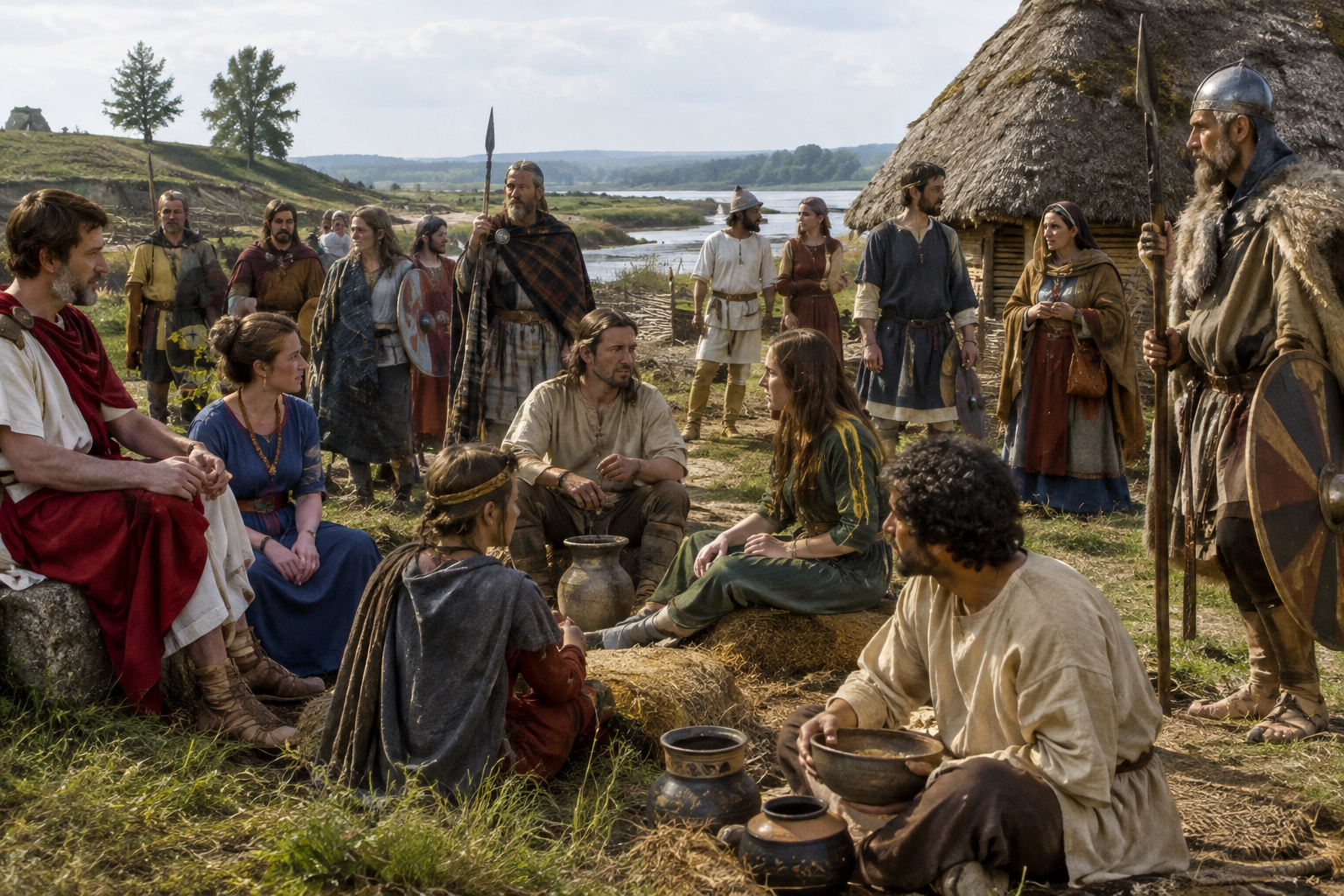
Some Y-chromosome lineages are easy to place in the grand sweep of European history. Others are more like finding a familiar family surname in a stack of documents from wildly different centuries: the same thread appears, but in settings that keep changing. Haplogroup R1b1a1b1a1a2c1a1e1 belongs to that second category. It sits deep within the wider R1b branch, one of the major paternal lineages in western Europe, yet this very specific subclade becomes most interesting when we stop treating it as an abstract code and start asking where, and with whom, it turns up.
That is where ancient DNA transforms the story. Instead of talking vaguely about "Celtic" or "British" ancestry, we can point to real excavated men from Iron Age East Yorkshire, Roman England, post-Roman Hungary, Bronze Age Dorset, Viking Iceland, and even Iron Age Gaul. Y-DNA traces one direct paternal line only, not a person's whole ancestry, but it is still an extraordinary historical tool. It lets us watch one narrow line move across landscapes, survive political upheavals, and sometimes appear again in regions later associated with noble families, castles, and clan traditions.
The long label R1b1a1b1a1a2c1a1e1 tells us immediately that this is not a broad continental category but a highly specific downstream branch within R1b. That matters. It would be careless to assign to this exact lineage every event ever associated with the whole of R1b, from early Indo-European expansions to every later migration in western Europe. What we can say more safely is that this branch belongs within a paternal framework that became very important in parts of Atlantic and western Europe, and that its ancient appearances in the supplied evidence are especially concentrated in Britain, with notable outliers on the continent.
The earliest sample in this set is I5379, from Bell Beaker Canada Farm Dorset England, dated 2383 BC. That is an important anchor. Bell Beaker-period Britain was part of a major transformation in the later third millennium BC, when new burial customs, new material culture, and substantial population change appeared. One sample does not prove the entire history of this exact branch, but it does place a related paternal line in southern Britain at a very early date and reminds us that later Iron Age and medieval patterns did not spring from nowhere.
Explore Bell Beaker Population Change
From there, the trail becomes strikingly British. A cluster of later samples appears in Iron Age England, especially among the people archaeologists associate with the Parisi and the Arras Culture of East Yorkshire. That does not mean the haplogroup was exclusively theirs, nor that every Parisi man carried it. But it does suggest that this paternal branch, or very near relatives of it, had become well established in parts of pre-Roman Britain.
If you want to see how ancient DNA can illuminate a local world, East Yorkshire is hard to beat. At Wetwang Slack, a famous Arras Culture cemetery, several individuals in this dataset belong to the lineage cluster under discussion: I39724, I36993, I36845, I36922, I36923, I31010, and I37135, all dated 225 BC. Nearby Pocklington adds I21703 and I21866, also dated 225 BC.
That concentration matters more than any single glamorous find. It hints at local paternal continuity, perhaps particular family groups, perhaps broader male-line networks in the region. Wetwang Slack and Pocklington are not just dots on a map. They belong to a distinctive Iron Age culture known for chariot burials and a material world that has long invited comparison with communities across the Channel. Ancient DNA does not reduce that culture to genes, but it gives us another way to think about how lineages persisted within it.
There is also I21182, a Celtic Briton from Yarnton, Oxfordshire, England, dated 200 BC. That broadens the picture beyond East Yorkshire. Meanwhile CGG023647, from Gallic France Maisey-le-Duc, dated 455 BC, suggests that related paternal lines were not confined to Britain. The old question of cross-Channel links in the Iron Age becomes a little more concrete when one sees similar paternal signatures in both Britain and Gaul, even if that alone cannot tell us the direction or timing of every movement.
What is appealing here is not some crude "Celtic haplogroup" label. It is the more modest and more interesting possibility that one narrow paternal branch appears among Iron Age communities on both sides of the Channel, in exactly the sort of archaeological settings where mobility, kinship, and regional identity are already being debated.
The story does not stop with the Iron Age. KNF006, from Roman Era England Knobbs Farm Somersham, dated 200 AD, places the lineage in Roman Britain. That is useful because Roman rule altered Britain profoundly without erasing local populations. A paternal line present in Iron Age Britain could persist into the Roman period, while new people also entered the province. Ancient DNA helps us resist tidy before-and-after narratives.
Then there is SZL013 from Post Roman Period Szeleste Savaria Pannonia Prima Hungary, dated 525 AD. This is perhaps the most intriguing continental sample in the set. Post-Roman Pannonia was a zone of movement, military reshuffling, and mixed populations. One sample cannot map a migration route from Britain to Hungary, or vice versa, and it certainly cannot prove a single continuous family line across Europe. But it does show that this paternal branch, or a very close relation, belonged to a world wider than the British Isles alone.
Finally, STT-A2, a Norwegian Viking Iceland individual dated 1000 AD, shows the branch in the North Atlantic Viking sphere. Again, caution first: one Viking Age Icelander does not make this a "Viking haplogroup." Still, taken with the British concentration, it reminds us how much movement connected the British Isles, Scandinavia, and the Atlantic colonies in the early medieval centuries.
Read Roman and Early Medieval Britain
By the medieval period, genetics and written history begin to overlap, but they do not become the same thing. A haplogroup can tell us about paternal continuity in a region; charters and chronicles tell us about named families. The supplied noble associations therefore need careful handling. They are historically evocative, but they are not by themselves proof that every member of every family carried R1b1a1b1a1a2c1a1e1.
Among the later historical families associated with this haplogroup, a noticeable pattern is their concentration in Britain, especially Scotland and the borderlands of England and Wales. That sits comfortably with the ancient evidence discussed above, which shows this paternal line strongly represented in Britain long before surnames, clans, and heraldic houses entered the record. The connection is historical rather than genealogically absolute: these are families linked with the haplogroup in later tradition or paternal-line association, not proof that every bearer of the name shared the same exact Y-chromosome.
In northeast Scotland, Clan Irvine and Clan Irwin stand out as names tied to long-established landed identity in Aberdeenshire. Their story belongs to a world in which service to the crown, control of estates, and continuity of surname across generations became central markers of status. The similarity of the names is historically interesting in itself, though it should not be taken as automatic proof of a single documented paternal line in every case. What matters here is that both are embedded in the same regional landscape where kinship, territory, and family memory were preserved with unusual tenacity.
Clan Fraser, also rooted in Aberdeenshire, represents another important strand of Scottish noble life. By the early modern period the Frasers were associated with substantial landed power and with the kind of architectural ambition that announced family standing as clearly as any charter. Their history shows how male-line identity could be reshaped over time, moving from medieval lordship into a more polished world of noble residence and estate culture.
Further south, House Talbot belongs to the marcher and aristocratic history of western England, a setting very different from Highland or northeast Scottish clan society. The Talbots are associated with the politics of frontier lordship along the Welsh border, where military strength and noble authority were closely bound together. Clan Napier, by contrast, offers an urban and intellectual dimension through its link with Edinburgh and with John Napier, the mathematician famous for logarithms. Taken together, these families show how one paternal lineage can appear within very different historical worlds: clan territory, border lordship, noble estate culture, and learned urban society.
If surnames and noble traditions give these later associations names, the castles give them place. They are the visible remains of the social world in which paternal descent, landholding, and family reputation were expressed in stone. They do not prove genetic relationships, of course, but they do offer tangible settings for families linked with this haplogroup.
For Clan Irvine and Clan Irwin, the key monument is Drum Castle near Aberdeen in Aberdeenshire. Granted to the Irvine family by Robert the Bruce in 1323, it remained in family hands for more than 650 years. That alone makes it an extraordinary witness to continuity. What began as a medieval tower house with a 13th-century keep gradually expanded into a larger residence with Jacobean and Victorian additions, so the building itself records centuries of changing taste, power, and domestic life. Today it survives under the care of the National Trust for Scotland and remains one of Scotland's oldest tower houses.
Castle Fraser in Aberdeenshire does something slightly different for Clan Fraser. Begun in the late 1500s, it developed into one of the grandest Z-plan tower houses in Scotland, with richly decorated interiors that speak less of bare defense and more of confidence, display, and noble comfort. Passing through centuries of family occupation before entering the care of the National Trust for Scotland, it preserves an unusually vivid picture of early modern aristocratic life.
With Clan Napier, the ancestral seat is Merchiston Tower near Edinburgh, a 15th-century fortified house later celebrated as the home of John Napier. Its later survival within what is now Edinburgh Napier University neatly illustrates how an old family stronghold can pass into a very different historical setting without losing its association with lineage and memory.
Goodrich Castle, associated with House Talbot, belongs to the more martial world of the Welsh Marches. Originating as a Norman fortress after the conquest of England, it became a major medieval stronghold guarding the Wye valley and the border with Wales. Its siege in the English Civil War and the cannon damage that still marks its ruins give it a harder historical edge than the Scottish tower houses. Seen together, Drum, Castle Fraser, Merchiston, and Goodrich do not tell one single family story. They show instead the very different landscapes in which later bearers of this haplogroup-associated paternal tradition made their mark.
The most responsible reading of R1b1a1b1a1a2c1a1e1 is not that it "belongs" to one people, one kingdom, or one noble house. Rather, the evidence suggests a paternal lineage with deep roots in Britain by the Bronze and Iron Ages, visible strength in Iron Age East Yorkshire, continued presence in Roman Britain, and a wider footprint stretching into Gaul, post-Roman Hungary, and Viking Age Iceland.
That combination is exactly why ancient DNA is so useful. Traditional genealogy usually runs backward until records fail. Archaeogenetics starts in much deeper time, with excavated individuals such as I5379, I39724, KNF006, or STT-A2, and asks where paternal lines appear across centuries. The result is not a family tree in the ordinary sense. It is something more like a historical map of survival, movement, and regional continuity.
So if this haplogroup appears in your own Y-DNA results, the value lies not in claiming a chieftain, a castle, or a named ancient ancestor. It lies in recognizing that your direct paternal line may connect, at some depth, with the same broad historical world as Bell Beaker Britain, Iron Age Yorkshire, Roman provincial life, post-Roman continental mobility, and the Viking North Atlantic.
That is a rather splendid thing on its own terms.
If you want to see whether your DNA shows links to ancient individuals, archaeological cultures, or historical populations like those discussed here, MyTrueAncestry can help you explore those connections in detail. Such matches can offer remarkable historical perspective, even when they do not prove direct descent from a particular ancient person or noble family.






Comments