Haplogroup R1b1a1b1a1a2c1a1d

– 6 min read


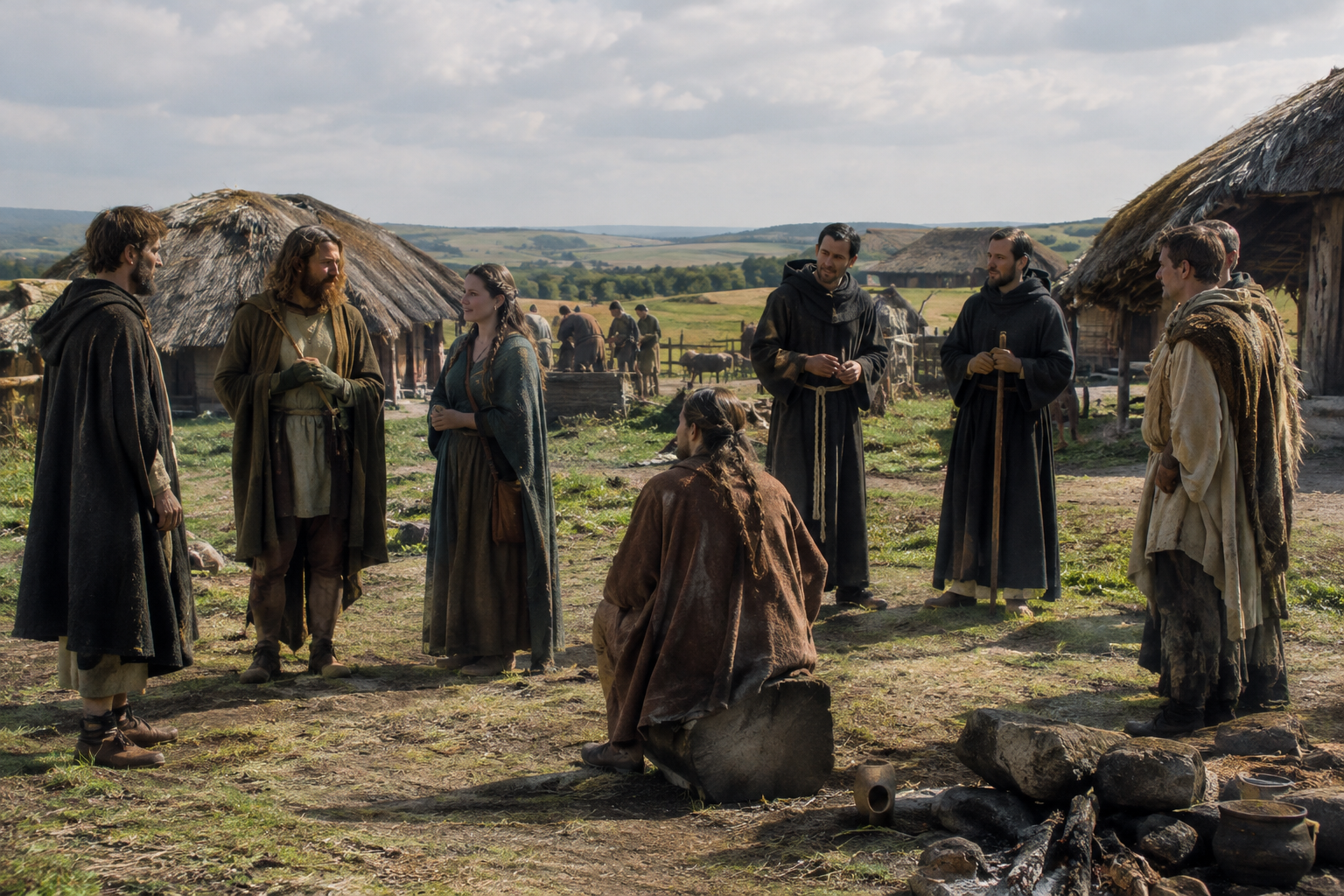
Some Y-chromosome lineages announce themselves in the ancient DNA record with a bang: a famous king, a spectacular princely grave, a neat historical label. Haplogroup R1b1a1b1a1a2c1a1d is more interesting precisely because it does not behave so obligingly. What the evidence supplied here suggests is not a single dramatic episode but a long, stubborn presence across Atlantic Britain, later appearing in Roman, post-Roman, and medieval settings farther afield. That makes it a fine reminder of what Y-DNA is actually good at: tracing one direct paternal line through time, not telling the whole story of a people, a nation, or a family.
In plain terms, a Y-DNA haplogroup follows the father-to-son line. It is only one thin branch of anyone's ancestry, but it can be a remarkably durable one. This very specific subclade sits within the wider R1b tree, a major paternal lineage in western Europe. For a branch as narrow as R1b1a1b1a1a2c1a1d, we have to be careful: we should not simply pour the entire history of broad R1b into it. Even so, the supplied ancient samples place related paternal lines in Bronze Age Britain and Ireland, Iron Age Yorkshire, Roman Dorset, Roman Dalmatia, post-Roman southern England, and medieval northwestern Europe. That is enough to tell a properly historical story.
The earliest clues in this sample set point toward the western seaways of Britain and Ireland. One especially striking individual is Rathlin2B, dated to the Ireland Copper Age Year:1880 BC. Another is I4950, from Bell Beaker Wiltshire Upavon England Year:2300 BC, alongside other early and middle Bronze Age men such as I2417 from Bronze Age Amesbury Down Wiltshire England Year:2300 BC, I3256 from Bronze Age Trumpington Meadows Cambridge England Year:2100 BC, I5377 from Early Bronze Age England Thames Year:1800 BC, and dfb002 from Bronze Age England Dorset Cranborne Chase Down Farm Pond Barrow Year:1900 BC.
These men do not prove that the exact narrow subclade already existed in all those places in the same form it does later. But they do place closely related paternal ancestry in Britain and Ireland very early. In other words, when we later meet this lineage among Iron Age Britons and Romano-British communities, we are not looking at something that necessarily arrived yesterday. Some paternal branches within wider R1b had clearly been established around these islands for a very long time.
Explore Celtic language origins and ancient DNA
The Iron Age evidence is particularly rich. East Yorkshire appears again and again: I14100 from Celtic Briton Pocklington Yorkshire England Year:320 BC; I14102 and I14104 from Briton Pocklington Yorkshire England Year:225 BC; I21978 from Celtic Briton Iron Age England East Yorkshire Pocklington Year:225 BC; and the remarkable I36995, an Elite Celtic Parisi Chariot Burial Iron Age England East Yorkshire Wetwang Slack Year:225 BC. Around them stands a whole crowd of Parisi and Arras Culture burials from Wetwang Slack, Melton, Burton Fleming, and nearby sites: I36889, I36880, I36883, I36885, I36974, I37335, I37336, I37342, I37344, I36843, I36844, I36972, and many others.
This concentration matters. It suggests that paternal lines related to this haplogroup were not rare curiosities in Iron Age eastern Britain. They were embedded in local communities, including at least one high-status chariot burial. That is not proof of a single dynasty, still less of a single tribe having one haplogroup. But it does show that this branch had become part of the social fabric of late pre-Roman Britain.
If Yorkshire gives us quantity, Dorset gives us continuity. At Duropolis Winterborne Kingston, a substantial set of individuals dated 125 AD appears under the label Celtic Durotriges England: WBK12, WBK20, WBK29, WBK41, WBK05, WBK30, WBK43, WBK06, WBK08, WBK18, and WBK191. There is something deliciously awkward here for anyone who wants history neatly divided into boxes labelled "Celtic" and "Roman." These men lived under Roman rule, but in a region strongly associated with the Durotriges, and their paternal lines show the persistence of local ancestry rather than a simple replacement.
Nearby in time and geography stands I11580 from Post Roman Era Worth Matravers Dorset England Year:600 AD. That pushes the story beyond the empire into the unsettled centuries after Roman administration collapsed in Britain. One paternal branch can thus be observed, cautiously, in a landscape that moved from Bronze Age barrows to Iron Age communities, then into Roman provincial life, and then into post-Roman society.
Yet the same broader lineage was not confined to Britain. The supplied list also includes I26776 from Imperial Roman Era Zadar Croatia Year:200 AD, R10656 from Late Roman Era Klosterneuburg Lower Austria Year:407 AD, R10488 from Late Roman Conimbriga Portugal Year:330 AD, and CGG023699 from Gallic France Parancot Year:497 BC. Add IND013 from a Merovingian Grave North Rhine-Westphalia Germany Alt-Inden Year:600 AD, ST2025 and ST1308 from Sint-Truiden in Belgium around 900 AD, and CGG101839 from Medieval Denmark Zeeland Ahlgade Holbaek Year:1325 AD, and the picture becomes broader still.
What does that prove? Not a single migration route that can be drawn with a felt-tip pen across a school map. What it does show is that paternal lines related to this haplogroup participated in the ordinary mobility of European history: Iron Age communities, Roman provincial society, frontier mixing, medieval towns, and regional settlement.
Read about Roman and early medieval Britain
One temptation with a lineage like R1b1a1b1a1a2c1a1d is to dress it too quickly in ethnic costume: Celtic, British, Norman, Irish, perhaps all before lunch. Better to resist. Haplogroups are not tribes. They are not surnames in deep time. A shared Y-branch can link men separated by vast distances, entirely different languages, and centuries of political change.
Still, there is a geographical logic to the samples. Britain dominates the early evidence, especially Yorkshire, Dorset, Wiltshire, Cambridge, Bedfordshire, Somerset, Oxfordshire, Orkney, and South Lanarkshire. Samples such as KD061 from Bronze Age Orkney Westray Links of Noltland Year:1498 BC, I16469 from Late Bronze Age Raven Scar Cave North Yorkshire England Year:995 BC, and I11991 from Iron Age Worlebury Somerset England Year:150 BC suggest this was not a narrowly local phenomenon. It belonged to a wider British and northwestern European setting in which some paternal lines endured while cultures, burial rites, and political masters changed around them.
Discover Iron Age Britain through ancient DNA
That brings us, by a long and crooked road, to Ashford Castle in County Mayo and the House of Guinness. The castle began as a stronghold built by the Anglo Norman de Burgo family in 1228 after defeating the native O'Connors. Over time it was rebuilt and expanded under successive powerful owners, including the Browne family in the eighteenth century. In the nineteenth century Sir Benjamin Lee Guinness transformed it into a grand Victorian mansion, and Lord Ardilaun later enlarged its gardens, woodlands, and interiors. In the twentieth century it became a hotel, preserving within its walls Norman and Victorian layers alike.
Why mention Ashford Castle in an article about a Y-haplogroup? Not because a castle proves anyone's Y-DNA. It does not. Nor can we leap from ancient British and Irish samples to a claim that the Guinnesses, the de Burgos, or any associated line definitely carried this exact branch unless documentary and genetic evidence specifically say so. But castles do preserve the memory of how paternal lineages mattered in historical society: inheritance, lordship, succession, territorial identity, and family prestige all tended to travel through male lines with particular force.
Ashford is especially apt because it sits at the meeting point of several historical layers that matter for this haplogroup's story: native Irish landscapes with deep prehistoric roots; Anglo-Norman expansion into Ireland; and the later reinvention of aristocratic identity in the Victorian age. Genetics and architecture are doing different jobs here, but they illuminate the same problem from opposite ends. Ancient DNA tells us about lineages before surnames. Castles tell us how later societies organized memory around family and land.
The strongest lesson of R1b1a1b1a1a2c1a1d is not that it "belongs" to one modern people. It is that direct paternal lines can persist through astonishing historical change. In the evidence supplied here, related lineages appear among Copper and Bronze Age island populations, among Iron Age Britons of the Parisi and Durotrigan worlds, in Roman-era contexts from Britain to Croatia and Portugal, and in medieval northern Europe. That combination of persistence and mobility is exactly what ancient DNA is so good at revealing.
Traditional genealogy usually begins with names, parchments, and churches. Ancient DNA begins with graves, bones, and mutations. Neither replaces the other. Together they give us something better: a way to see how the paternal lines remembered by medieval families and castles were only the latest chapter in a much older human story.
If you want to explore the broader backdrop of migration and continuity around the North Sea world, there is also a useful companion piece on long-term movement and settlement in the region.
Explore North Sea migrations to Britain
If your paternal line falls within R1b or one of its many branches, ancient DNA can offer a fascinating historical frame for that inheritance, whether the setting is a Yorkshire chariot burial, a Dorset Romano-British cemetery, or a medieval European town. MyTrueAncestry lets you compare your DNA with ancient individuals and past populations, helping you discover historical connections while keeping the proper distinction between genetic similarity and proven direct descent.






Comments