Haplogroup R1b1a1b1a1a2c1a1a1a1a1a1a2c

– 5 min read


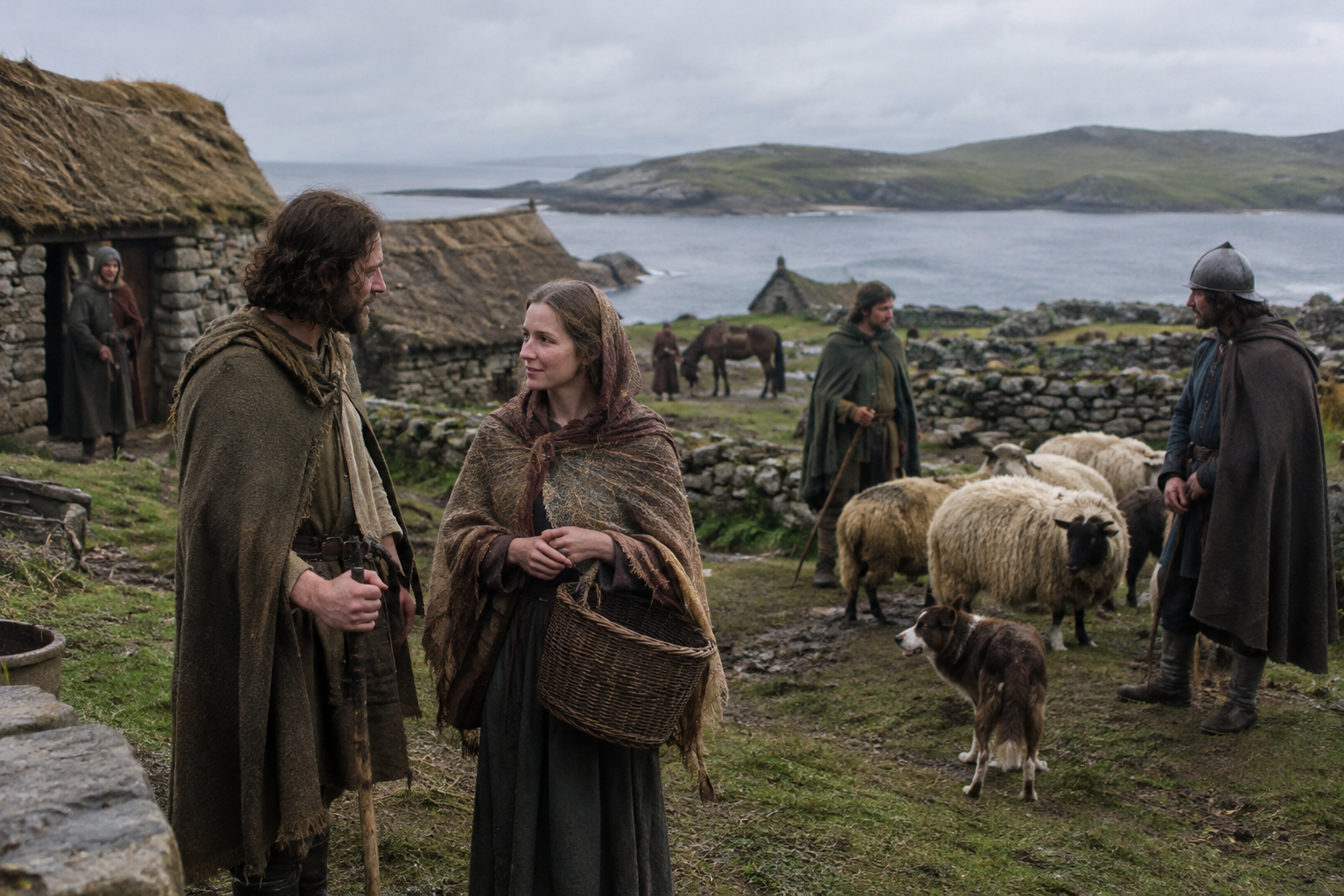
There is something arresting about a very long Y-DNA label. R1b1a1b1a1a2c1a1a1a1a1a1a2c does not exactly roll off the tongue, but that is part of the point. It is the name of a very specific branch on the human paternal tree, a tiny twig on a very old structure. And when such a branch turns up in ancient burials, it reminds us that the grand dramas of population history were carried forward not by abstractions, but by individual men, families, and communities living in particular places.
As with all Y-DNA haplogroups, this lineage traces only one line of descent: father to son to son. It is not a person's whole ancestry, nor does it define ethnicity, language, or status. Still, paternal lineages are useful historical tools. They allow us to ask where a male line appears in the ancient record, whether it seems regionally persistent, and how it sits within wider movements of people. In this case, the evidence supplied here points above all to medieval Ireland, with an intriguing later appearance in Belgium, and a historical setting tied to Ulster and the world around Lough Neagh.
This haplogroup belongs within the vast Y-chromosome family known as R1b, one of the major paternal lineages found in western Europe today. That broad fact is well established. What matters just as much, however, is scale. A very specific branch like R1b1a1b1a1a2c1a1a1a1a1a1a2c should not be treated as if it carries the entire history of all R1b men. The deeper story of R1b includes many prehistoric expansions and regional branches, but this particular subclade represents a much narrower paternal history.
What the present dataset strongly suggests is that this branch, or very near relatives of it, had a real foothold in medieval Ireland. That does not prove an Irish origin for the branch, still less an exclusive Irish identity. But it does make Ireland, and especially the northwest, an important historical landscape for understanding it.
Readers interested in the larger prehistoric background to Irish paternal history may also enjoy this broader look at Ireland before the medieval period.
Explore Neolithic Irish Kinship
The most striking feature of the evidence is not a single glamorous burial, but a cluster. Again and again, this haplogroup appears among individuals from Ballyhanna, County Donegal, Ireland. That matters. Ancient DNA becomes especially interesting when one lineage appears repeatedly in the same place across time, because repetition hints at local continuity, kin networks, or at least a stable regional presence.
The Ballyhanna material includes many individuals dated to 840 AD, among them Sk197a, Sk197b, Sk197c, Sk197d, Sk197e, Sk197f, Sk197g, Sk197h, Sk197i, Sk197j, Sk197k, Sk197l, and Sk197p. The same cemetery also includes other 840 AD individuals such as Sk197an, Sk197y, Sk197q, Sk197am, Sk197s, and HAN197x. Then, at 1209 AD, the pattern continues with an even larger set: HAN197aa, HAN197ab, HAN197ac, HAN197ad, HAN197ae, HAN197af, HAN197ag, HAN197ah, HAN197ai, HAN197aj, and many others including HAN197aq, HAN197ar, HAN197as, HAN197at, HAN197au, HAN197ba, and HAN197ca.
One should be careful here. A shared haplogroup does not mean all these men were close paternal relatives. Some may have been; some may not. Yet the density of finds from one cemetery is hard to ignore. Ballyhanna was not preserving an exotic outsider lineage that appeared once and vanished. It seems to have been part of the local medieval male population in Donegal over centuries.
That is historically suggestive. Donegal in the early and high medieval periods stood within a world shaped by Gaelic lordship, church networks, sea routes, and shifting regional power. Paternal continuity there is exactly the sort of thing ancient DNA can detect more clearly than written genealogy alone.
For a wider picture of how ancient DNA helps reconstruct such buried communities, this overview is worth reading.
See How Archaeogenetics Rebuilds History
The Irish evidence is not confined to one corner of the island. The supplied samples also include KIL041 and KIL044 from Medieval Ireland Kilteasheen Roscommon Bishops Seat Year:650 AD, as well as KIL014 from Medieval Ireland Kilteasheen Year:650 AD. That places this paternal branch, or closely related forms of it, in the Irish midlands as well as the northwest by the early medieval period.
Kilteasheen is especially evocative because of the "Bishops Seat" setting. This is not just a genetic dot on a map, but a reminder that early medieval Ireland was full of ecclesiastical centers, learned communities, and territorial politics. A paternal lineage found there belonged to men moving within a Christian landscape that was already old by 650 AD.
Then there is a later and geographically different appearance: STR129, STR129a, STR129b, STR129c, and STR129d from Late Medieval Belgium St. Rombouts Year:1553 AD. We should not overstate this. A match in Belgium does not magically convert an Irish medieval lineage into a Belgian one, nor prove direct movement from Donegal to Mechelen. But it does show that this paternal branch was not sealed within one island forever. By the later Middle Ages, related male lines could be found in the Low Countries as well.
That wider western European footprint makes good historical sense for an R1b-derived lineage. It also reminds us how mobile late medieval Europe could be, through trade, church institutions, mercenary service, migration, and urban growth.
The noble and regional association supplied here is Clan Devlin, set against the remarkable landscape of Lough Neagh. This is a useful reminder that historical identity is often tied not to a neat family tree, but to a place. Lough Neagh, the largest freshwater lake in Ireland and the British Isles, has been important for thousands of years. Its shores preserve evidence of prehistoric settlement, crannogs, farming, movement, and exchange. In medieval times it stood at the center of Ulster's political and economic life.
That matters for this haplogroup because the Irish ancient DNA evidence points toward long-term paternal presence in regions deeply entangled with Ulster and the northern half of the island. Clan Devlin belongs in that broader story of Gaelic lordship, territorial memory, and waterways as arteries of power. Lough Neagh was no passive backdrop. It provided fish, reeds, sand, transport, and routes of communication. It also accumulated legend: giants, floods, and the kind of mythic geography that clings to important landscapes.
We should be absolutely plain about the genetics. A historical association with Clan Devlin does not prove that every Devlin male carried this haplogroup, nor that any ancient Ballyhanna or Kilteasheen individual was a documented ancestor of the clan. What it does provide is context. If you want to understand how a paternal lineage could persist in Ireland, you must place it in landscapes like these: lakes, lordships, church seats, and communities that endured through conquest and change.
For readers interested in the historical background of the clan itself, MyTrueAncestry has a dedicated article.
So what do we learn from R1b1a1b1a1a2c1a1a1a1a1a1a2c? First, that a narrow paternal branch can still have a strong historical profile. Here that profile is distinctly medieval Irish, with repeated appearances in Donegal and early evidence in Roscommon. Second, that paternal lines may persist locally across centuries even as kingdoms, churches, and landholding patterns change. Third, that related branches can appear far from one another in later periods, as the St. Rombouts material from Belgium suggests.
Just as importantly, we learn the limits of the evidence. A haplogroup is not a surname. It is not a coat of arms. It cannot by itself prove descent from a clan chief or membership in a noble house. Ancient DNA and documentary history answer different questions. One tracks biological lineages; the other records property, power, memory, and law. When the two overlap, the result is illuminating, but never automatic.
If you would like to explore broader patterns of later population movement around Britain and Ireland, this related piece adds useful context.
This is exactly where MyTrueAncestry becomes so interesting. A haplogroup like R1b1a1b1a1a2c1a1a1a1a1a1a2c is not just a string of letters and numbers. In the right archaeological setting, it opens onto real medieval cemeteries, real regional histories, and real questions about continuity and movement. If your DNA points toward similar ancient populations, you may find unexpected connections to places like Ballyhanna, Kilteasheen, or the wider historical world of Ulster. Those connections do not by themselves prove direct descent from any ancient individual or noble family, but they can offer a fascinating new angle on your ancestry.






Comments