Haplogroup R1b1a1b1a1a2c1a1a1a1a1a1a1a

– 6 min read


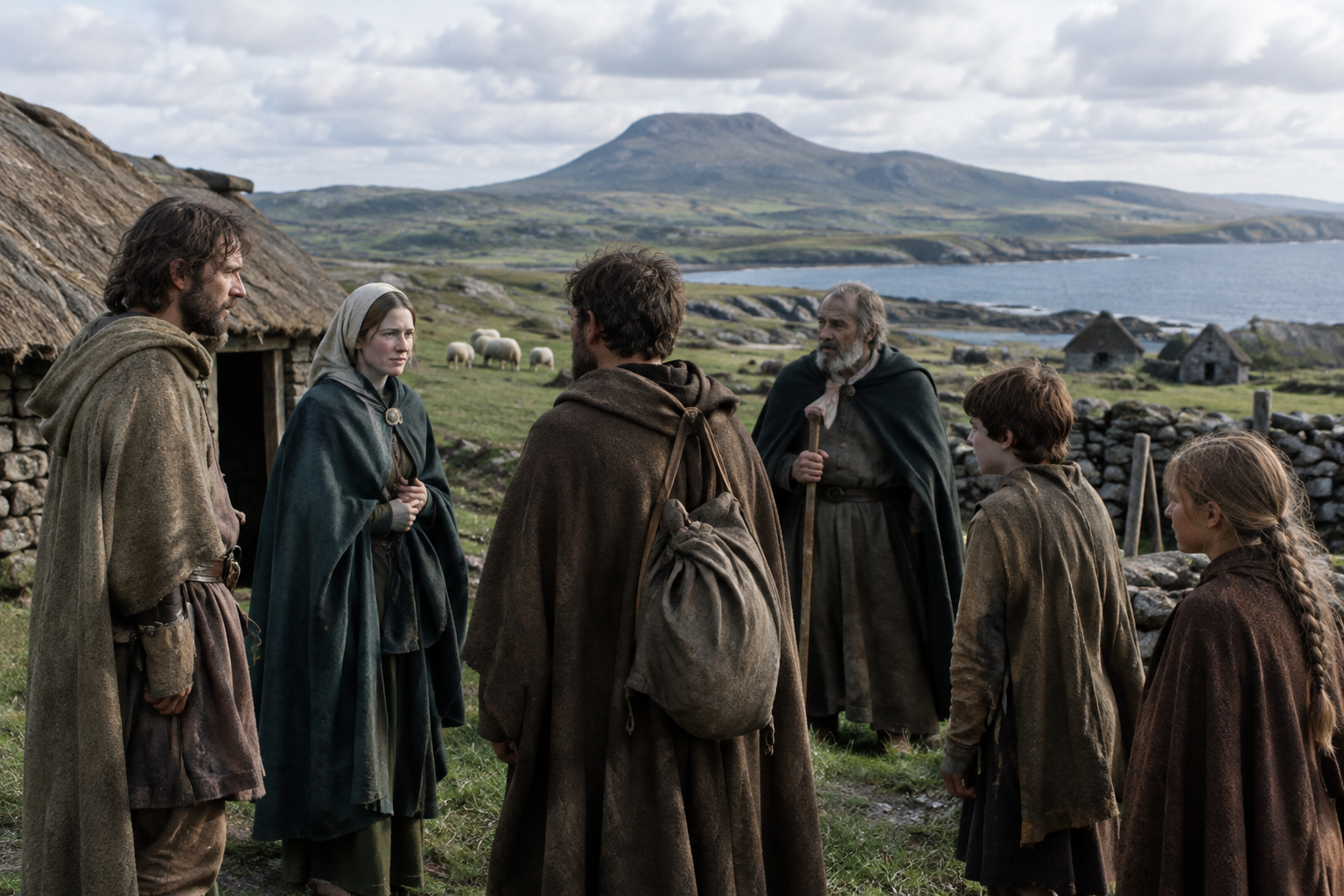
Some Y-chromosome lineages arrive in history with a trumpet blast: imperial tombs, famous dynasties, neatly labeled migrations. Others appear more obliquely, through churchyards, ruined fortresses, and the stubborn survival of paternal lines in particular corners of Europe. The haplogroup R1b1a1b1a1a2c1a1a1a1a1a1a1a belongs to that second kind of story. It sits deep within the vast and complicated R1b branch of the Y-chromosome tree, a paternal lineage famous in western Europe but far too broad to be treated as a single historical tribe or people.
That is the first thing worth saying clearly. A Y-DNA haplogroup traces one direct paternal line only: father to father to father. It does not represent a person's whole ancestry, still less a ready-made ethnic label. But when ancient DNA places related paternal branches in medieval Ireland and late medieval Belgium, and when historical memory preserves noble houses like the Peverels in Norman England, we begin to see how genetics and history can illuminate the same landscape from very different angles.
This extraordinarily specific lineage is a very narrow downstream branch within haplogroup R1b, one of the major Y-chromosome families in western Eurasia. For the broader R1b family, archaeogenetics has linked important expansions to later prehistory, especially the Bronze Age spread of steppe-derived ancestry into much of Europe. But one must be careful here: that broad background belongs to large upstream branches of R1b, not automatically to every tiny descendant twig.
What we can say with more confidence is that this subclade belongs to a paternal framework that became deeply established across parts of Atlantic and western Europe over long stretches of time. By the Middle Ages, branches of R1b were common in many regions from Ireland to Britain and across the Low Countries and beyond. The real interest of a lineage as specific as R1b1a1b1a1a2c1a1a1a1a1a1a1a lies not in sweeping claims about "Celts" or "Normans," but in how it appears in actual excavated people.
Readers interested in the larger prehistoric backdrop to western European paternal lineages may enjoy this broader look at Bell Beaker expansion in one of the key regions for later R1b history.
The most striking evidence supplied here comes not from a single glamorous burial, but from a remarkable cluster of medieval individuals from Ballyhanna, County Donegal, Ireland. The site appears repeatedly in the dataset, with individuals dated to 840 AD and 1209 AD. That alone is historically suggestive. We are looking at the same broad region across several centuries, from the early medieval world into the high medieval period.
Among the earlier Ballyhanna individuals are samples such as Sk197an, Sk197y, Sk197q, Sk197am, and HAN197x, all listed at 840 AD. Then the site reappears in abundance at 1209 AD, with individuals including HAN197aq, HAN197ar, HAN197as, HAN197at, HAN197au, HAN197ba, and many others. One should not assume all these men were close paternal kin, nor that every one carried the exact same terminal branch at the same resolution. But the repeated appearance of related paternal ancestry in one Donegal burial landscape points to something important: continuity of male lines in the northwest of Ireland across generations.
That matters because medieval Ireland was not static. Donegal lay within a world of local kingdoms, ecclesiastical networks, seaborne contact, and occasional violence. The dead of Ballyhanna are not abstract dots on a phylogenetic tree. They were part of a living community in which paternal lines persisted, shifted, and mingled over time. Genetics gives us a way of seeing that durability even when written records are patchy or silent.
The Irish material is complemented by other medieval samples from Ireland, notably KIL041 and KIL044 from Kilteasheen, Roscommon, Bishops Seat, dated to 650 AD, and KIL014 from Kilteasheen in the same year. These do not prove a single unbroken pedigree from Roscommon to Donegal, of course. But they do help place this paternal branch in an unmistakably medieval Irish setting, spread across more than one region and site.
If you want to see how ancient DNA is transforming our picture of family structure and burial communities in Ireland, this related article is an excellent companion.
The dataset also includes a late medieval cluster from St. Rombouts, Belgium, dated to 1553 AD: STR129, STR129a, STR129b, STR129c, and STR129d. Again, caution first. We should not leap from a handful of Belgian burials to a grand theory of one clan marching from Donegal to Mechelen. But their presence does show that this paternal branch, or a very closely related one, was not confined to Ireland.
That is historically plausible. The medieval and early modern North Sea world was full of movement: merchants, clerics, soldiers, settlers, craftsmen, and noble retinues. The Irish Sea, the Channel, and the southern North Sea were not barriers so much as busy corridors. A lineage that appears in both Ireland and Belgium fits comfortably within that wider pattern of western European mobility and continuity.
For readers interested in how the Low Countries fit into longer population history, especially in the broader Rhine-Meuse zone, this article adds useful context.
This is where the historical story becomes particularly evocative. The supplied noble association is the House Peverel, tied to Peveril Castle above Castleton in Derbyshire. Built soon after the Norman Conquest, probably by William Peverel in the late 11th century, it was plainly intended as a statement of royal authority in the Peak. There is something very Norman about that: not just conquest, but conquest planted onto a hilltop in stone.
Peveril Castle later passed to the Crown after Peverel's son fell from favor. In the 12th century Henry II rebuilt much of it in stone, including the great keep that still dominates the site. It was never the largest of royal fortresses, but it controlled a valuable upland district rich in lead and looked formidable in its dramatic setting. By the later Middle Ages its military importance waned and it decayed, yet its ruins still preserve the memory of Norman rule and royal ambition in the English countryside.
Now, genetically speaking, one must not overreach. A historical association between this haplogroup and the House Peverel does not prove that every Peverel male belonged to this exact branch, nor that the Ballyhanna or St. Rombouts men were ancestral to the family. What it does offer is context. The Norman world that produced families like the Peverels was one of mobile male lineages moving between England, northern France, the Low Countries, and the Irish Sea zone. A western European R1b lineage turning up in both medieval Ireland and Belgium fits neatly into that broad geographic theatre, even if it does not prove a specific family connection.
Readers who want to follow the noble side of this story further can continue with the family article devoted to this house.
The most sensible way to read R1b1a1b1a1a2c1a1a1a1a1a1a1a is not as a badge of a single people, but as evidence of durable paternal ancestry in the western European world. In the supplied material, it appears above all in medieval Irish burials, with additional presence in late medieval Belgium. That combination hints at both local continuity and wider regional connectedness.
Ancient DNA is especially useful here because it does something medieval chronicles cannot. It shows us paternal structure among ordinary buried communities as well as elite associations remembered in castles and surnames. Written genealogy tends to preserve the famous and the landed. DNA preserves, or at least sometimes recovers, the obscure as well. That is why a burial ground in Donegal can be just as revealing as a fortress in Derbyshire.
So the real fascination of this haplogroup lies in scale. At one scale, it belongs to the great R1b story of western Eurasia. At another, much more intimate scale, it connects actual excavated men from Ballyhanna, Kilteasheen, and St. Rombouts to the long historical landscapes of Ireland, the Low Countries, and Norman Britain. Not proof of direct descent. Not proof of noble blood. But a powerful reminder that paternal lines can survive through monasteries, villages, ports, and lordships long after individual names are forgotten.
If your own Y-DNA falls on one of these western European branches, MyTrueAncestry can help place that paternal line in deeper archaeological context. You may find links to ancient individuals like KIL041, Sk197an, or HAN197aq, or to the broader medieval populations among whom such lineages were living. Those comparisons do not prove that you descend from a specific excavated person or noble house, but they can reveal how your direct paternal line fits into the human history written in bones, burials, and old stones.






Comments