Haplogroup R1b1a1b1a1a2c1a1

– 6 min read


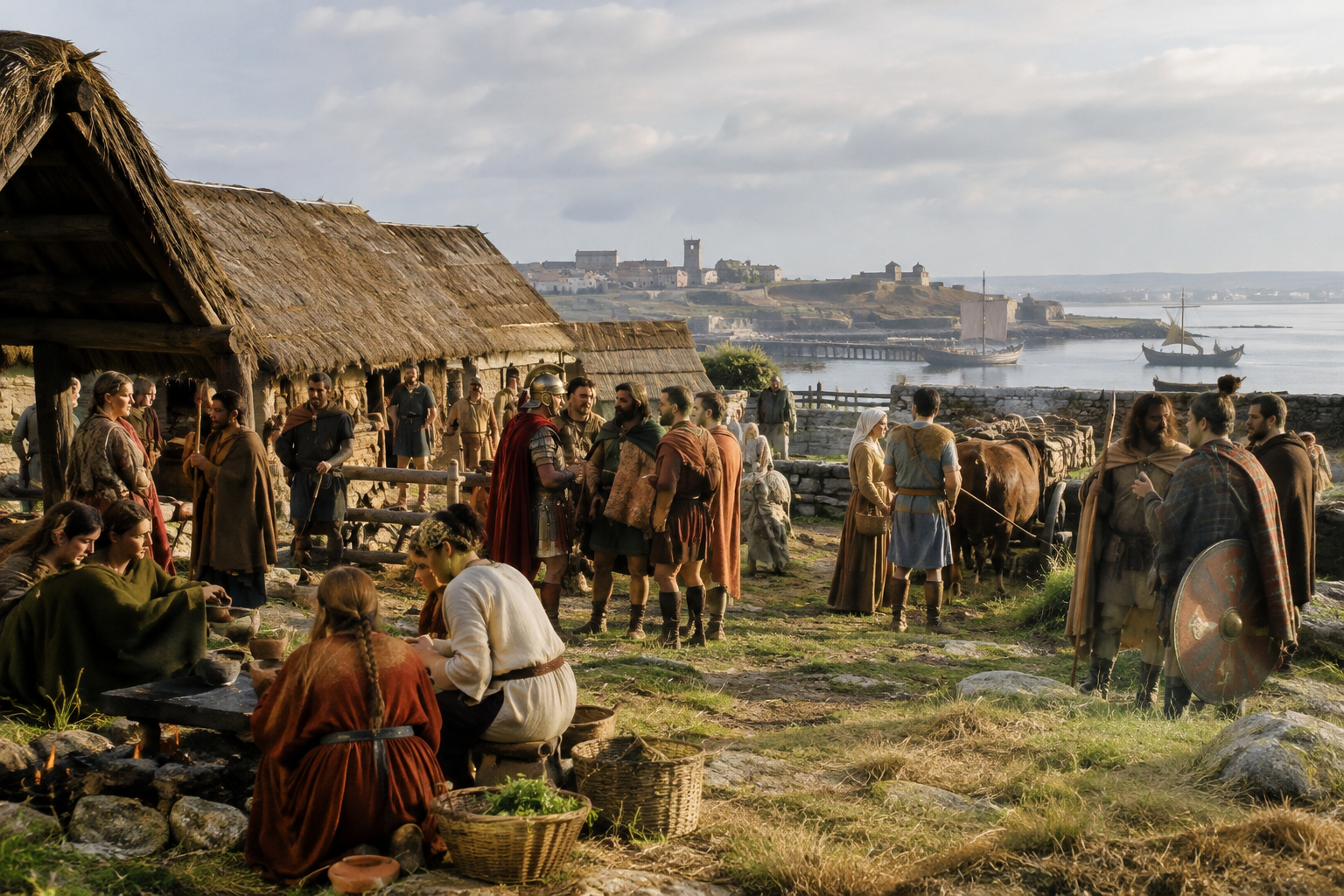
Some Y-DNA haplogroups turn up like a single flash in the archive. Others keep appearing, century after century, in enough places to suggest not a dynasty in the narrow sense, but a durable paternal thread moving through whole landscapes. R1b1a1b1a1a2c1a1 belongs to that second category. It sits deep within the wider R1b tree, a branch of one of the major Y-chromosome lineages of western Eurasia, and the evidence supplied here places it in a particularly interesting historical setting: from Bronze Age steppe-connected worlds, through Iron Age Britain and the Roman era, into medieval northern Europe and the Atlantic fringe.
That matters because Y-DNA traces one line only: father to son to son across time. It does not describe a person's full ancestry, culture, or identity. But in the hands of archaeology, it can still be wonderfully revealing. With this haplogroup, the ancient DNA record suggests a paternal lineage associated across many periods with populations in Britain, parts of continental Europe, and later medieval communities farther north and west. What it offers is not a fairy tale of pure blood, but something better: a historically grounded glimpse of how male lineages could persist, spread, and settle in the real world.
The broad upstream story of this lineage begins with the larger R1b family, which is strongly associated in ancient DNA research with major population changes in later prehistory. One important early anchor in the supplied material is I3525, an Early Bronze Age Hungary Yamnaya Sarretudvari-Orhalom individual dated to 2450 BC. It would be careless to collapse the whole history of this very specific subclade into the entire history of steppe-derived R1b, but a sample like I3525 reminds us of the larger background: some paternal branches later common in western Europe are tied, at higher levels of the Y tree, to those Bronze Age movements out of the Pontic-Caspian steppe zone and into Europe.
By the Bronze Age, the branch represented here seems to be well at home in Britain. The list includes I2565 from Bronze Age Amesbury Down Wiltshire England dated to 2287 BC, I2417 from Bronze Age Amesbury Down Wiltshire England dated to 2300 BC, I4950 from Bell Beaker Wiltshire Upavon England dated to 2300 BC, and I5379 from Bell Beaker Canada Farm Dorset England dated to 2383 BC. Add to that KD061 from Bronze Age Orkney Westray Links of Noltland dated to 1498 BC, and the geographical spread is striking. This is not a one-valley curiosity. It is a paternal line visible from Wessex to Orkney.
That pattern fits a broader archaeological picture in which Beaker and post-Beaker Britain saw major shifts in ancestry and in male-line representation. But the specific lesson of R1b1a1b1a1a2c1a1 is narrower and more interesting: some descendant branches of those Bronze Age paternal systems lasted locally for a very long time.
Explore Bell Beaker population change
If the Bronze Age gives us the opening act, Iron Age Britain gives us the crowd scene. This haplogroup appears repeatedly among ancient individuals from eastern and southern Britain, especially in communities associated with the Parisi and other Brittonic groups. The sheer number of samples matters here. At Wetwang Slack in East Yorkshire, we see a remarkable concentration: I36889, I36880, I36883, I36885, I36974, I36976, I37332, I37335, I37336, I37337, I37342, I37344, and many others, mostly dated to 225 BC. Nearby are I21955 and I21978 from Celtic Briton Iron Age England East Yorkshire Pocklington, and elite burials such as I36995 and I36892, both listed as Elite Celtic Parisi Chariot Burial Iron Age England East Yorkshire Wetwang Slack Year:225 BC.
One should not make the lazy leap from a Y lineage to "the Celts" as though this solved language, identity, and politics in one stroke. But these burials do show something important. This paternal line was not confined to marginal men or isolated hamlets. It appears in ordinary burials, formal cemeteries, and high-status contexts. In other words, it participated in the full social range of Iron Age Britain.
The same is true farther south and west. There are samples from Dorset and Somerset, including the Durotrigan world of WBK12, WBK20, WBK29, WBK41, WBK05, and others from Celtic Durotriges England Duropolis Winterborne Kingston Year:125 AD. There are also western and southern British examples such as I19656 from Celtic Durotriges Ham Hill Fort Somerset England Year:250 BC, I16380 from Celtic Iron Age Harlyn Bay Cornwall Year:200 BC, and I21302 from Late Iron Age Hillfort South Cadbury Somerset Britain Year:35 AD.
What emerges is not a single tribal badge, but a lineage with substantial staying power across different Iron Age regions of Britain.
Read about ancient DNA and Celtic expansions
One of the most useful things about this dataset is that the story does not stop when Rome arrives. We can watch the lineage continue through changing political worlds. In Roman Britain there is KNF006 from Roman Era England Knobbs Farm Somersham Year:200 AD. There is also CGG018915 and CGG018915x from Pict Era Scotland Orkney Mine Howe Year:115 AD, showing the branch in a northern insular setting that later written sources would describe in very different ethnic terms from southern Britain.
Beyond Britain, the line appears in Roman and post-Roman contexts such as I26776 from Imperial Roman Era Zadar Croatia Year:200 AD, R10656 from Late Roman Era Klosterneuburg Lower Austria Year:407 AD, and SZL013 from Post Roman Period Szeleste Savaria Pannonia Prima Hungary Year:525 AD. These finds suggest a wider European footprint, though of course not every occurrence implies the same local history. In some places we may be seeing long-established regional lineages; in others, the mobility of the Roman world and its aftermath.
The medieval record is equally revealing. In England, the lineage is present in ATP_PSN_68 from Medieval England Cambridge St Johns Hospital Year:1250 AD and in ATP_PSN_512 and ATP_PSN_520 from Medieval England Augustinian Friars Year:1290 AD. In Ireland it appears at Kilteasheen in Roscommon through KIL012, KIL015, and KIL025, each dated to 650 AD. There are also Iberian examples at Las Gobas in northern Spain: ldo039 dated to 650 AD, and ldo052 and ldo242 dated to 1000 AD.
That is a useful corrective to overly tidy national stories. This paternal branch belongs to no single modern people. It appears in Britain, Ireland, Iberia, Italy, the Low Countries, and central Europe because the past was mobile, layered, and untidy.
Discover Roman and early medieval Britain
How, then, do we move from these burials to later noble families without making a nonsense of the evidence? Carefully. The supplied family association is Clan Rutherford, linked here with Hunthill Castle in Aberdeenshire. The castle was not a great royal fortress but a lairdly house, apparently beginning in the later 16th century when the Leslies of Balquhain held the estate and built a tower house there. In time it was enlarged into a more comfortable residence, following a familiar Scottish pattern: from defensible tower to country home, and later into ruin as tastes and fortunes changed.
That history is useful precisely because it is so grounded. Hunthill's remains speak of local power, family prestige, and the gradual taming of the older martial landscape. It is easy to romanticize such places, but the real story is better. A house like Hunthill preserves the memory of how paternal lines, landholding, alliance, and residence became entangled in early modern Scotland.
What it does not do is prove that every Rutherford, every Leslie, or every man associated with the estate carried R1b1a1b1a1a2c1a1. A clan connection in a haplogroup article is a historical association, not automatic genetic proof. Still, when one sets the Scottish evidence beside ancient samples from Orkney, East Lothian, Applecross, and Moray, including I2859x from Late Bronze Age Covesea Caves Moray Scotland Year:860 BC and I3566 and I3567 from Iron Age Highland Applecross Scotland Year:70 BC, one can see why northern Britain is such an important stage for this lineage's long history.
Explore the history of Clan Rutherford
The most interesting thing about R1b1a1b1a1a2c1a1 is not that it can be made to fit a slogan about Celts, Britons, or nobles. It is that it refuses to stay in one neat historical box. The supplied ancient DNA places it in Early Bronze Age Hungary, Bronze Age Britain, Iron Age Yorkshire, Roman England, Pict-era Orkney, early medieval Ireland, northern Spain, and medieval English religious houses. That is the kind of evidence that allows us to think historically rather than mythically.
For anyone who carries this haplogroup today, the lesson is not "you are descended from X tribe" or "you belong to Y castle family." The lesson is subtler. Your direct paternal line may belong to a branch that was present in some of the most important population transformations of later prehistoric and historic Europe, and that remained visible in the British Isles for a very long time indeed.
That is one of the pleasures of archaeogenetics. Written genealogy usually begins late and favors the literate, the landed, and the lucky. Ancient DNA widens the cast. It lets us glimpse men buried in barrows, cave sites, hospitals, monasteries, hillforts, and farming cemeteries, and to see how some paternal lines survived the collapse of cultures, the arrival of empires, and the rewriting of identities.
If you want to explore whether your own DNA connects you with ancient individuals like I3525, I2565, KNF006, or the many Iron Age Britons of Wetwang Slack and Pocklington, MyTrueAncestry can help place your results in that deeper archaeological setting. Those comparisons do not prove direct descent from a specific ancient person or noble family, but they can offer a fascinating new way of seeing your ancestry in the long human past.






Comments