Haplogroup R1b1a1b1a1a2a1a1a2

– 7 min read


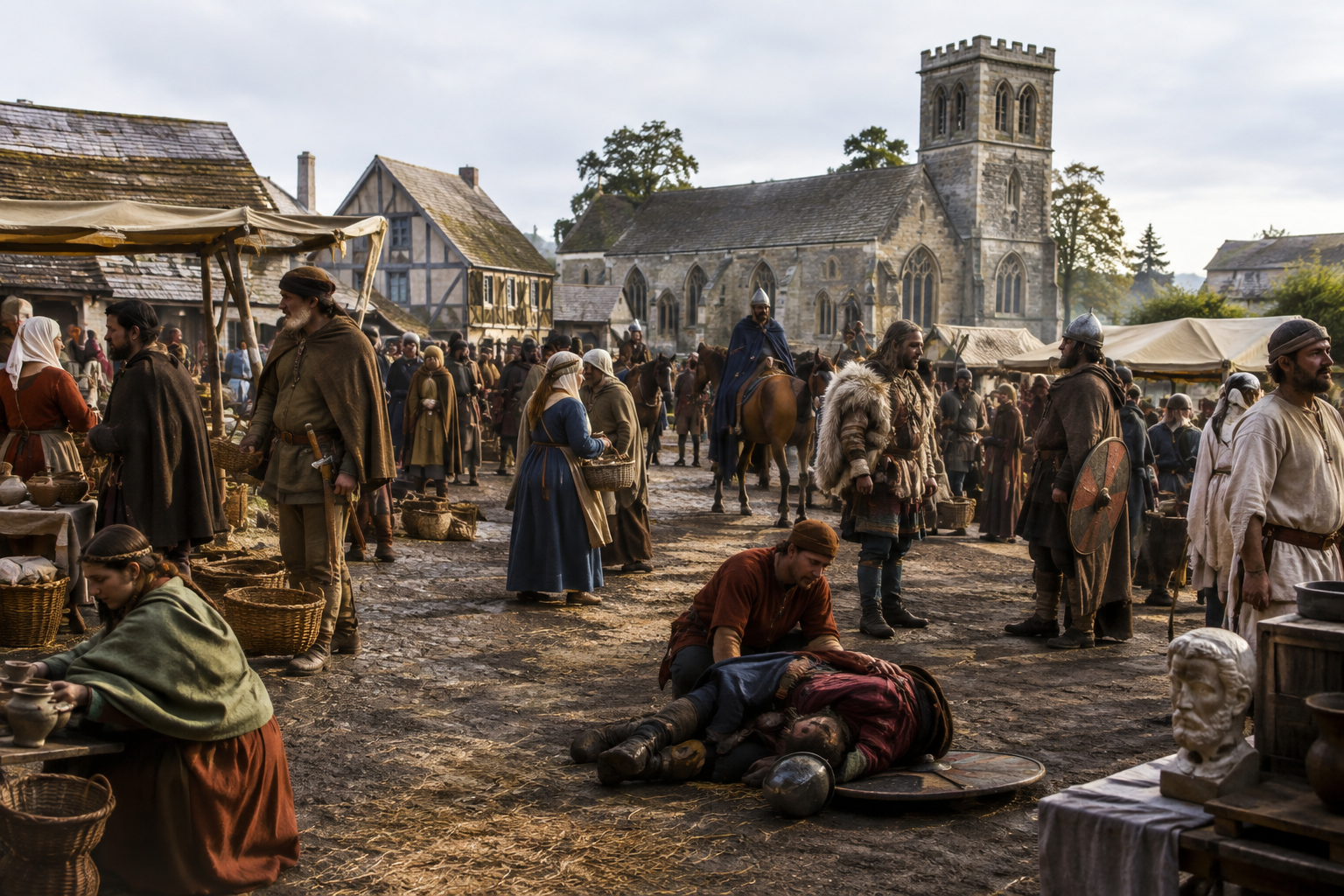
Some Y-chromosome lineages announce themselves with a great historical fanfare. Others are quieter, tucked away inside a long chain of letters and numbers like R1b1a1b1a1a2a1a1a2, and need to be coaxed into view. But once you begin following this branch through ancient DNA, what emerges is not a single tribe, dynasty, or national story. It is something more interesting: a paternal line appearing across the middle of Europe, in Iron Age Gaul, in post-Roman Iberia, in Anglo-Saxon and Viking Age northern Europe, and in the medieval towns of England and Belgium.
That is exactly why this haplogroup matters. Y-DNA traces one very particular inheritance path, from father to son across generations. It does not describe a person's whole ancestry, nor does shared Y-DNA automatically mean close kinship. But it can reveal striking patterns of continuity, movement, and survival. In the case of R1b1a1b1a1a2a1a1a2, the evidence points to a branch within the wider R1b family that belongs to one of the best-known paternal frameworks in western Eurasia, while its own narrower story must be told much more carefully, through actual finds rather than grand assumptions.
The broad parent haplogroup R1b is deeply important in the genetic history of Europe, especially western Europe, and it often appears in discussions of Bronze Age population change. But one must be careful not to dump the whole history of broad R1b onto every tiny downstream twig. A subclade as specific as R1b1a1b1a1a2a1a1a2 is better understood as one branch within that larger paternal landscape, not as a shorthand for all R1b history.
What the supplied ancient samples do suggest is a lineage with a wide west-and-central European footprint over a very long period. One early anchor is UZH028 from Bronze Age Austria Unterhautzenthal, dated to 1900 BC. That matters because it places this paternal line, or a closely related level of it, in Bronze Age central Europe rather than only in later medieval populations. From there, later samples turn up in Gaul, Iberia, England, Belgium, Hungary, and Viking Age Denmark. That pattern hints at mobility across connected European worlds, but also at regional continuity. Both things can be true at once.
For readers interested in the larger prehistoric setting in which such paternal lines spread and diversified, this background on early farming and later population shifts is well worth exploring.
Explore Europe's Early Population Shifts
The most enjoyable part of archaeogenetics is that it rescues these lineages from abstraction. We stop talking about a code and start talking about people.
Take CGG023685, from Gallic France Sequani Tribe Parancot, dated to 579 BC. Here the haplogroup appears in Iron Age eastern Gaul, in the world of the Sequani, a people living before Rome absorbed their region into imperial order. This does not mean the haplogroup was uniquely "Gallic." It does mean that one branch of this paternal line was present in Celtic-speaking Iron Age Europe.
Then there is I3324, the Ullastret Ligurian Head Girona sample from 280 BC. That places the lineage in northeastern Iberia in a fascinating cultural zone touched by indigenous Iberian, Mediterranean, and wider continental influences. Again, no single ethnic label can do all the work here. What the DNA gives us is a man in Iron Age Catalonia whose paternal ancestry fits a broader western European pattern.
The Iberian thread continues with CGG022051 from Visigothic Migration Period Spain Estevillas Virgen de la Torre, dated to 552 AD. This is precisely the sort of sample that reminds us how misleading tidy textbook categories can be. "Visigothic" is a historical label from the Migration Period world, but the men and women living in sixth-century Spain were part of a mixed and changing society. A shared Y-line with earlier western European finds does not prove ethnic identity; it shows that older paternal lineages persisted through political upheaval.
In northern Europe, the lineage appears repeatedly in early medieval settings. At Sedgeford in Norfolk we have SED018, SED020, and SED021, all from Anglo-Saxon Sedgeford England Norfolk and dated to 760 AD, with SED020 noted as an Anglo-Saxon Sedgeford Battle Victim England Norfolk. Nearby in the wider North Sea world we also find VK329 from Viking Age Ribe Jutland, dated to 786 AD. These are not proof that the haplogroup was specially Anglo-Saxon or specially Viking. Rather, they show it turning up on both sides of a maritime zone where people, goods, and ideas moved constantly.
And then there are the medieval town populations: ST2107 from Medieval Belgium Sint-Truiden Groenmarkt, dated to 1050 AD, and ATP_PSN_905 from Medieval England Cambridge St Johns Hospital, dated to 1250 AD. By this point we are no longer in the world of tribal names and migration-period labels, but of established Christian towns, hospitals, markets, and local communities. The lineage has not vanished into prehistory. It is still there, carried by ordinary men in everyday medieval settings.
If you want to dig deeper into one of these exact places, the Sint-Truiden material has its own particularly useful context.
Read About Medieval Sint-Truiden DNA
Put these finds side by side and a broad picture begins to emerge. UZH028 in Bronze Age Austria suggests that this paternal branch, or its close upstream form, was already present in central Europe during a period of major social and demographic change. Later appearances in Gaul and Iberia show that it belonged within the western European world of the Iron Age. The northern finds from Norfolk and Ribe show that it was also at home in the North Sea sphere of the early Middle Ages.
One particularly intriguing sample is SZA-7, from the Hungarian Conqueror Period Commoner Szegvar-Szolokalja, dated to 950 AD. That does not make this haplogroup a "Hungarian conqueror haplogroup" in any exclusive sense. But it does underline a central fact about medieval Europe: conquest-period societies were rarely made of newcomers alone. Old regional paternal lines could persist within newly formed kingdoms, just as new elites might overlay older populations.
This is where ancient DNA becomes so valuable. Written history often notices kings, conquests, and dynasties. Genetics often notices continuity. Between the two, a more human picture appears.
Readers interested in the broader Iberian background to these transitions may enjoy this companion piece on long-term change in Roman and post-Roman Spain.
Explore Roman Hispania's Genetic Legacy
How, then, do later noble families fit into this picture? Carefully. A historical association between a haplogroup and a noble house is not proof that every bearer of that surname or dynasty shared the same paternal line. Nor can one leap from an ancient sample to a documented aristocratic pedigree. Still, noble houses and their residences help us place these paternal histories inside real landscapes of power.
The House of Bernadotte brings us to Stockholm Palace, standing in the heart of Gamla Stan on the site of the medieval Tre Kronor castle, destroyed in the great fire of 1697. The present palace, built in grand Baroque style to the designs of Nicodemus Tessin the Younger, became not merely a royal home but a theater of monarchy, ceremony, and state memory. It is a vivid reminder that dynastic history is always layered: beneath the palace lies the castle, beneath the castle lies the earlier town, and beneath that lie centuries of population history often invisible in written records.
Far to the southwest, the House de Sousa is associated here with Penafiel Castle in Castile and Leon. The site began as a frontier fortress in the 10th century and was fought over, rebuilt, and enlarged between the 11th and 15th centuries as Christian and Muslim powers contested Iberia and as noble rivalries shaped the region. Its striking, ship-like form owes much to 15th-century works under Don Juan Manuel and later lords. Here too, the castle is a memory machine. It does not prove a haplogroup. It does preserve the political world in which paternal lineages, family strategies, and territorial identities mattered greatly.
That makes the Iberian ancient samples especially evocative. A line seen in Iron Age Girona and Migration Period Spain belongs, geographically at least, to the same broad historical peninsula in which later strongholds like Penafiel became symbols of noble endurance. The connection is contextual, not genealogically proven, but it is still historically illuminating.
For readers who want to follow that family angle further, MyTrueAncestry has a dedicated article on the de Sousa lineage.
R1b1a1b1a1a2a1a1a2 is a good example of how ancient Y-DNA works best when handled with restraint. It does not hand us a simple badge reading Celt, Visigoth, Viking, or nobleman. What it offers instead is a documented paternal thread running through Bronze Age central Europe, Iron Age Gaul and Iberia, the North Sea world of the early Middle Ages, and later medieval urban communities.
That is already remarkable enough. It shows how one paternal lineage could persist through enormous cultural changes: the Bronze Age reshaping of Europe, the rise of Iron Age societies, Rome's imperial reach, the Migration Period, Anglo-Saxon England, Viking Age exchange, and the medieval consolidation of towns and kingdoms. Ancient DNA is so exciting precisely because it lets us see beneath the labels. Kingdoms come and go. Castles burn and are rebuilt. But some paternal lines continue quietly through it all.
And if the later royal and noble settings interest you, the Bernadotte story provides a useful modern endpoint for thinking about how dynastic memory survives in stone, ceremony, and public history.
Explore the Royal House of Bernadotte
If your own Y-DNA belongs somewhere within the vast R1b family, ancient comparisons can open a wonderfully unexpected view onto the past. They may reveal similarities to men buried in Bronze Age Austria, Iron Age France, Viking Age Jutland, or medieval England and Belgium. That does not prove direct descent from any one ancient individual or membership in a noble house. But it can place your paternal line inside the long and complicated history of Europe.
Upload your DNA to MyTrueAncestry and see which ancient people and historical populations your results may resemble.






Comments