Haplogroup R1b1a1b1a1a1f1

– 7 min read


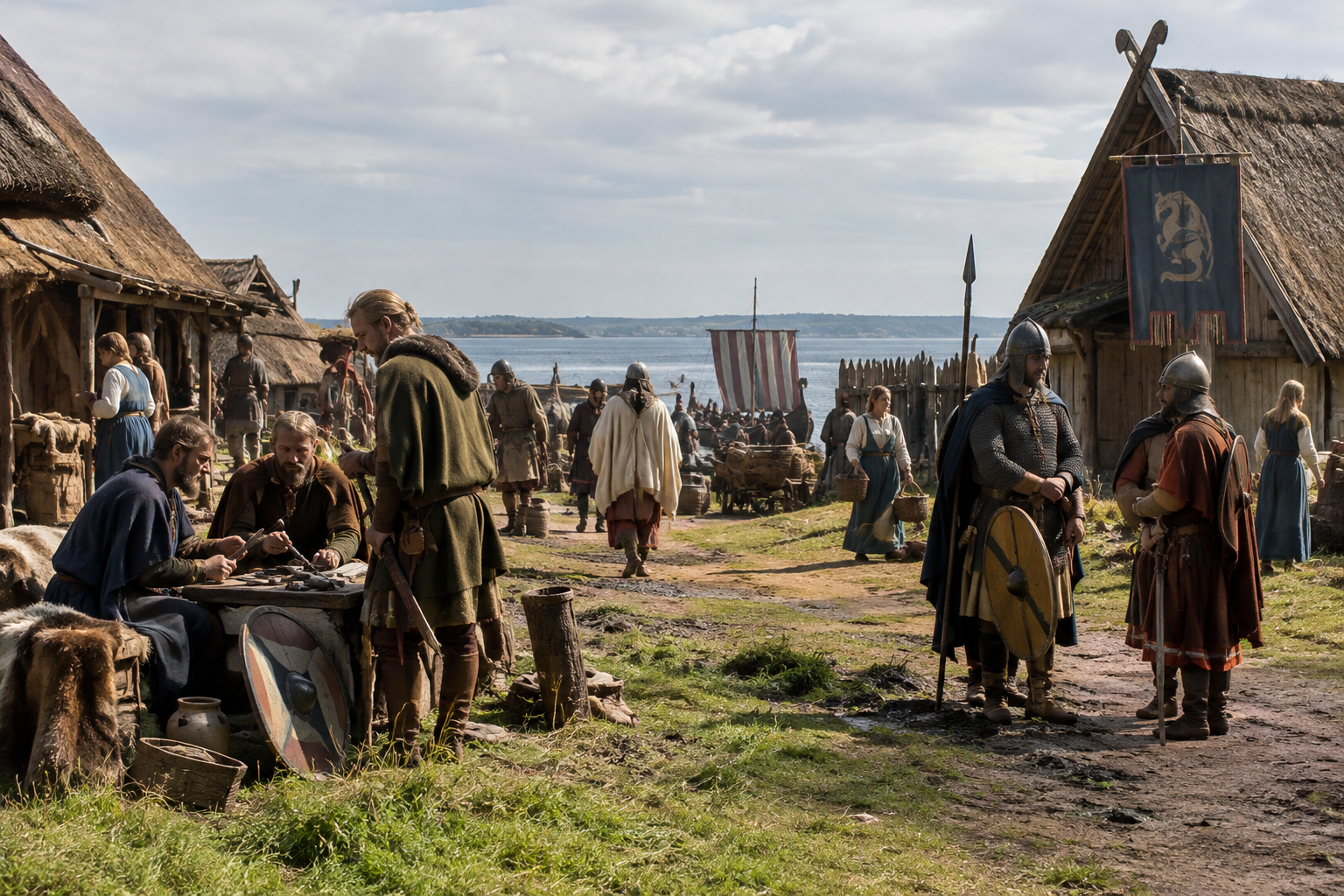
Haplogroup R1b1a1b1a1a1f1 sits inside one of the great Y-chromosome branches of western Eurasia, but that long string of letters and numbers is best understood not as a badge of identity, but as a clue. Y-DNA traces one direct paternal line only: father to son to son across the centuries. It does not describe a person's whole ancestry, and it certainly does not assign anyone neatly to a people, kingdom, or noble house. What it can do, however, is something wonderfully arresting. It lets us watch one narrow thread of male-line history appear in graves, cemeteries, borderlands, and towns from prehistory into the Middle Ages.
The evidence supplied for this branch points to a particularly interesting historical corridor: central and northwestern Europe, the North Sea world, and the migration routes that linked Bronze Age communities, Iron Age societies, Roman frontier populations, early medieval Germanic groups, and later Britain. That does not mean every sample listed belonged to the exact same fine-scale sub-branch in the modern phylogenetic sense. It means that the broader paternal neighborhood around this haplogroup keeps turning up in places where European history was being made, from Unetice-era Germany to Anglo-Saxon England, Viking Age Scandinavia, and medieval Flanders.
For a lineage like R1b1a1b1a1a1f1, the temptation is to tell an overconfident origin story. Better to resist it. What we can say responsibly is that this branch belongs within a wider R1b framework that became important in large parts of Europe over later prehistory, especially after major population changes associated with Bronze Age and post-Neolithic movements. But a specific downstream branch should not simply be handed the entire history of broad R1b. Fine branches often formed later, spread unevenly, and acquired their own local histories.
Still, the ancient samples here do suggest a striking arc. One early point comes from the Late Neolithic Vlaardingen/CordedWare Netherlands Mienakker sample I12902, dated 2682 BC. Another appears in Scandinavia with RISE98, from Battleaxe Sweden L Beddinge 56, dated 2079 BC. These are not proof that the exact later medieval branch was already widespread in precisely the same form, but they do place related paternal ancestry in the northern European zone very early, in societies often discussed alongside Corded Ware and Battle Axe horizons.
Then there is LEU007 from Bronze Age Unetice Thuringia Leubingen Sommerda Germany, dated 1950 BC. Unetice matters because central Europe in the Early Bronze Age was not a static map of tribes but a landscape of exchange, hierarchy, and movement. If one wants to understand how a paternal line later found in Saxon England or medieval Belgium might have deeper roots in continental Europe, central German sites like this are precisely the sort of evidence to take seriously.
By the Iron Age, the geographical spread becomes broader still. CGG101214 from Celtic Iron Age Austria Hallstatt, dated 550 BC, and Hung160 from Iron Age Hungary Kesznyeten-Szeruskert, dated 150 BC, show that related paternal lines were present in regions tied to very different cultural worlds. The point is not that this haplogroup was "Celtic" or "Germanic" in any simple sense. The point is that paternal lines move through cultural labels, and archaeology keeps reminding us how mixed and mobile European populations really were.
Once we reach the Roman and post-Roman world, the samples become especially vivid. I15527 from Imperial Roman Viminacium Serbia Pecine Necropolis, dated 100 AD, and OSIJ003 from the Roman-period Germanic Warrior Mursa Croatia Third Century Crisis, dated 260 AD, place related paternal ancestry in the militarized and highly mobile Danube frontier. So does R11121 from Imperial Roman Era Isola Sacra, dated 200 AD, and even TAQ013 from Etruscan Tarquinii Italy, dated 400 BC, which reminds us that lineages in this paternal cluster were not confined to one language family or one frontier identity.
The Migration Period samples are, if anything, even more revealing. We find GYS029 in Germanic Late Antique Pannonia Arrabona Szechenyi Square Hungary, dated 425 AD. We find SZL050, SZL051, and SZL076 in Longobard Period Pannonia Savaria Szeleste Barbaricum Hungary, each dated 525 AD. We find STR393b and STR316b in Germanic Tribe Bavaria Straubing-Bajuwarenstrasse, dated 410 AD, and AED92b from a Germanic Tribe dated 505 AD. This is exactly the sort of archaeological spread that warns us against tidy ethnic storytelling. Male lines crossed confederations, client networks, armies, and resettlements.
Then the trail reaches England with great force. There is BRC006x from Saxon Migration Period Saxony-Anhalt Bruecken, dated 500 AD, and RTW012 from Migration Period Germany Rathewitz Saxony-Anhalt, also 500 AD, which provide continental context. On the English side appear BUK012, BUK060, BUK064, BUK070, and BUK007 from Buckland Dover England, dated 400 AD; OAI006 and OAI013 from Oakington England, dated 470 AD; I11583, I11584, and I20652 from West Heslerton Yorkshire, dated 500 AD and 550 AD; and EDI064c from Anglo-Saxon Edix Hill Cambridgeshire, dated 545 AD.
That concentration matters. It suggests that paternal ancestry connected to this branch was well represented among groups associated with the Anglo-Saxon settlement horizon in England. That is a pattern, not a pedigree. It cannot tell us that a modern man with this haplogroup is "an Anglo-Saxon" in any exclusive sense. But it does show how direct male lines can illuminate the formation of early medieval English populations in a way surnames and chronicles alone cannot.
The later samples push the story into the North Sea trading zone. In Lower Saxony, HID003 and HID004 from Migration Period Lower Saxony Germany Hiddestorf, dated 400 AD, are followed by DUN006, DUN009, and DUN011 from Dunum, dated 840 AD. Then there is SWG001 from Post Viking Age Hedeby Schleswig Rathausmarkt Southern Jutland, dated 1140 AD, and urm160x from Viking Age Sigtuna Sweden, dated 935 AD. Add CGG106724 from the Danii Tribe Denmark Sjaelland Kalundborg Simonsborg, dated 175 AD, and a North Sea picture begins to emerge.
Medieval Belgium strengthens that picture. ST2969 from Carolingian Belgium Sint-Truiden Groenmarkt, dated 795 AD, and ST0323, ST0786, and ST0024 from Medieval Belgium Sint-Truiden Onze-Lieve-Vrouwekerk, dated 900 AD and 1090 AD, suggest continuity of related paternal ancestry in an urbanizing Low Countries setting. WPK005 from Post Carolingian Flanders Wulpen, dated 1162 AD, fits neatly into that same coastal world of commerce, lordship, and maritime links. This is a reminder that haplogroups do not belong only to warriors and conquerors. They also belong to townsmen, traders, farmers, and churchyard burials.
By the time we reach the later medieval and modern record, the evidence changes in character. Ancient burials give way to surnames, estates, and documented families. That material cannot be read like an excavated genome, but it does show how paternal lines, whatever their deeper prehistoric origins, became embedded in recognizable local histories.
Among the later families associated with this haplogroup are Clan Maxwell and the Gladstone family, both rooted in Scotland but representing rather different kinds of historical prominence. As ever, such associations should be handled carefully. They point to reported links in paternal-line research, not to the claim that every historical Maxwell or Gladstone man carried exactly this same branch.
The Maxwells belong to the old border world of southwest Scotland, especially Dumfriesshire and Galloway, where kinship, lordship, and frontier politics were inseparable. This was a region shaped by the long tension between the Scottish and English crowns, and families such as the Maxwells mattered not simply because they were locally powerful, but because the border itself was one of the key pressure points of medieval and early modern Britain. To encounter the Maxwell name in connection with a paternal lineage is to be reminded that Y-DNA often survives not only in famous dynasties but in the durable male lines of regional society.
The Gladstones bring us into a later chapter of Scottish and British history. Their prominence is especially associated with Aberdeenshire and, in the 19th century, with one of the most famous political figures in modern Britain, William Ewart Gladstone, who served four times as prime minister. In this case the family connection is interesting precisely because it shows how a haplogroup story can continue far beyond the medieval world of fortified lordship and into the age of parliamentary politics, empire, and large landed estates. The shift from Maxwell to Gladstone is a useful historical reminder: one paternal lineage can pass through very different social settings over time, from marchland conflict to the drawing rooms of high Victorian politics.
The strongest architectural symbol of the Maxwell connection is Caerlaverock Castle in Dumfries and Galloway. Built by the Maxwells in the late 1200s after an earlier nearby castle was abandoned, it is one of the most memorable fortresses in Britain: a rare triangular moated castle in red sandstone, at once defensive and unmistakably theatrical. Its fame was secured in 1300 when Edward I besieged it during the Wars of Scottish Independence. That alone fixes Caerlaverock in the great political struggles of the age, but its later history is just as revealing. It was repaired and fought over repeatedly during border warfare and later civil conflicts before being slighted after a siege in 1640. The ruins that survive today still make clear why it has such a hold on the historical imagination.
The Gladstone family is associated not with a medieval fortress but with Fasque House in Aberdeenshire. Built in 1809 for Sir John Gladstone, it later became especially famous as the family home of William Ewart Gladstone. Fasque belongs to a different landscape from Caerlaverock: not the war-scarred western marches, but the world of the grand country house, landed improvement, and national political influence. In the 20th century it passed out of Gladstone hands and went through periods of decline and restoration, yet it remains historically important as a place bound up with both Scottish family history and the career of one of Britain's most consequential statesmen.
Neither Caerlaverock nor Fasque can prove ancestry on its own. What they do offer is something more concrete than an abstract surname list: real places in which families associated with this haplogroup lived, governed, defended status, and left traces in stone. For readers exploring a paternal line, that grounding in landscape and architecture helps connect genetic history with the documented world of later Scotland.
R1b1a1b1a1a1f1 is historically interesting not because it can turn DNA into a coat of arms, but because it appears to sit within a paternal story stretching across central Europe, the Roman frontier, the Germanic migration world, the North Sea coast, Anglo-Saxon England, Viking Age Scandinavia, and medieval Flanders. The supplied samples show recurrence across many centuries and settings. That pattern suggests durability, movement, and adaptation rather than one simple homeland tale.
For anyone carrying this haplogroup today, the most sensible conclusion is also the most exciting one: your direct paternal line may belong to a branch that has passed through some of the most archaeologically visible regions of European history. But shared haplogroups do not prove direct descent from any specific ancient individual, nor do they make anyone a Maxwell, a Gladstone, or a denizen of Caerlaverock by right. They offer context, not entitlement; historical depth, not fantasy genealogy.
If you want to see how your own DNA compares with ancient individuals like EDI064c, LEU007, ST2969, or urm160x, MyTrueAncestry can place your results beside real archaeological discoveries and help you explore the populations, regions, and periods that may illuminate your past.


Comments