Haplogroup R1b1a1b1a1a1c2b2b1a

– 6 min read


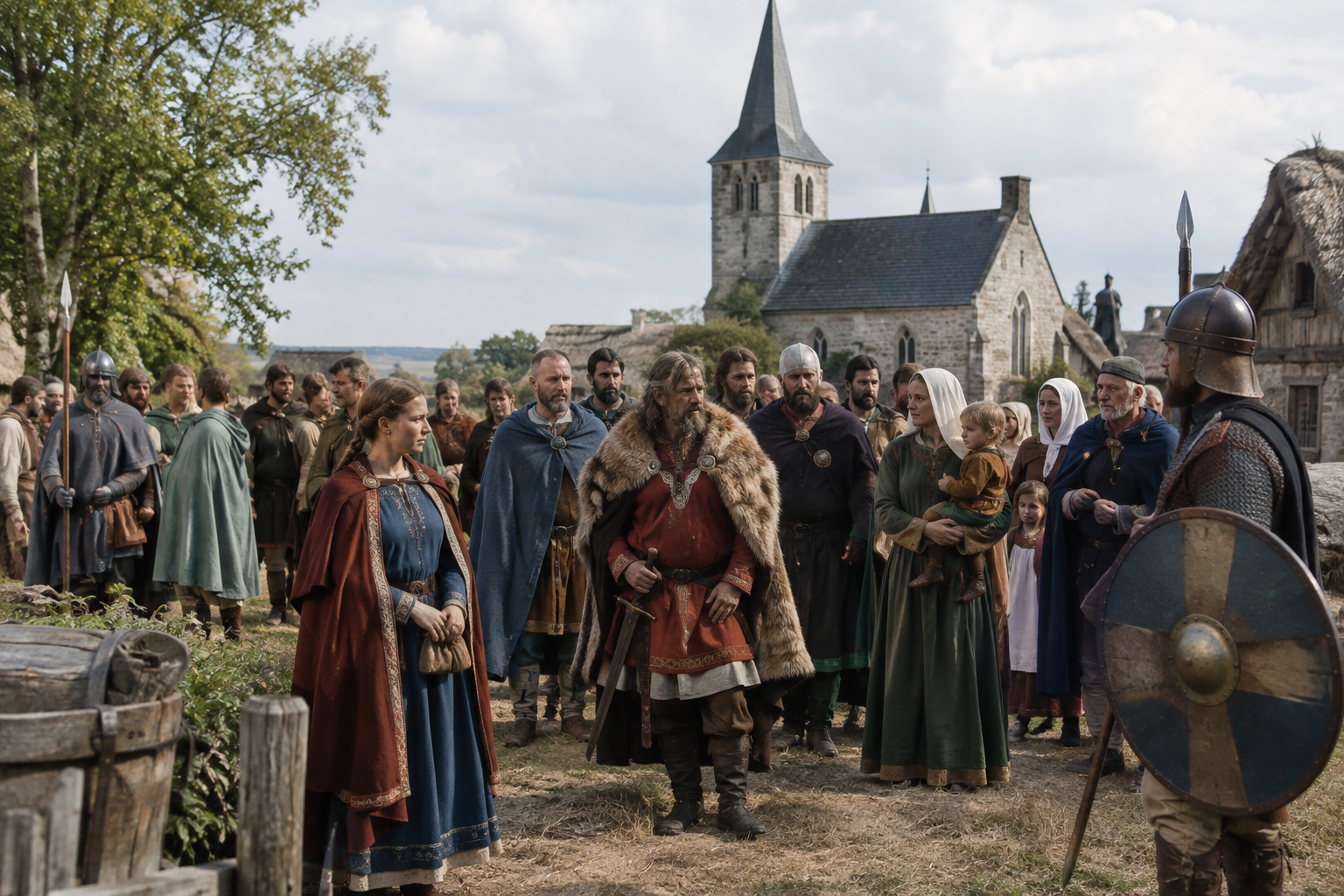
Some Y-DNA haplogroups turn up in one corner of history and seem content to stay there. Others behave rather differently. Haplogroup R1b1a1b1a1a1c2b2b1a belongs to that second category, at least from the evidence supplied here: it appears in an Iron Age elite burial in southwest Germany, in Migration Period and Merovingian contexts across the old heartlands of western and central Europe, in Lombard and Anglo-Saxon settings, in Viking Age Scandinavia, in medieval Belgium, and even among a Hungarian conqueror elite burial.
That does not mean every man in those worlds shared the same exact paternal line, nor that this subclade can be made to stand for a whole people. Y-DNA traces one direct male line only: father to son to son across time. It is a powerful tool, but a narrow one. Still, when a lineage keeps appearing in archaeologically important burials across so many centuries, it gives us a remarkable way of tracking how paternal lines could persist, travel, and embed themselves in very different historical societies.
This very specific lineage sits deep within the wider haplogroup R1b, one of the major Y-chromosome branches in western Eurasia and especially well known in much of Europe. But one must be careful here. The grand, sweeping history often told about R1b as a whole cannot simply be dumped wholesale onto a narrow downstream branch like R1b1a1b1a1a1c2b2b1a. The more specific the lineage, the more modest we need to be.
What the supplied ancient evidence does suggest is that this branch, or closely related paternal lines, were already present in central Europe by the Iron Age and then continued through the mobile and politically unsettled centuries after the Roman Empire. That alone is historically interesting. It places the lineage in exactly the periods when archaeologists and geneticists are trying to understand how Celtic-speaking communities, Germanic-speaking groups, Roman provincial populations, frontier soldiers, migrants, and medieval elites were connected - or not connected - to one another.
The earliest supplied anchor is MBG002, an Elite Celtic Burial Germany Magdalenenberg Villingen-Schweningen Year:530 BC. That is not merely an early date. It is an early date in a burial explicitly marked as elite and Celtic. It tells us that this paternal line was present in the world of later Iron Age central Europe well before the medieval kingdoms and clans that tend to dominate popular imagination.
Explore Central European Celtic Origins
From there, the lineage becomes visible in a striking run of early medieval contexts. In central Germany and neighboring regions, several samples place it amid the world of post-Roman political reshaping: OBM053 from the Thuringii Tribe Germany Obermoellern Year:500 AD, BRC025x and BRC004x from Germanic Tribe Migration Period Saxony-Anhalt Bruecken Year:500 AD, RTW017 from Migration Period Germany Rathewitz Saxony-Anhalt Year:500 AD, and ADN004 from a Saxon Grave Lower Saxony Hannover-Anderten Germany Year:400 AD.
These are not all the same community, and they should not be flattened into one tidy ethnic label. But taken together, they show this paternal line moving through - or persisting within - regions deeply involved in the transformations of late antiquity: the weakening Roman frontier, new confederations, local continuity, migration, military service, and social reorganization.
The Merovingian evidence is especially dense. We have Mln28a from Merovingian Period Frankish Moemlingen Germany Year:650 AD, Btb100 from Merovingian Period Frankish Buettelborn Germany Year:600 AD, and a notable cluster of high-status individuals: NIEcap12b listed as Merovingian Noble Year:605 AD, NIEcap12c as Merovingian Warrior Year:605 AD, NS9 as Merovingian Lord Year:605 AD, NS12b as Merovingian Noble Year:605 AD, NS12c as Nordic Alemannic Merovingian Burial Year:605 AD, NS1 as Merovingian Noble Year:605 AD, NS6 as Young Merovingian Noble Year:605 AD, and NS3a as Merovingian Noble Year:605 AD.
This cluster does not prove a single dynasty or direct family chain, but it does show something important: this paternal lineage was present in socially elevated circles in the Merovingian world. That matters because the early medieval aristocracy was one of the main engines through which lineages, loyalties, and landholding were reproduced.
Read Post-Roman Central Europe
The same branch also turns up beyond the Frankish and central German sphere. CGG021981, from Longobard Migration Period Czech Holubice Year:562 AD, and COL_034x, from Lombard Era Collegno Northern Italy Year:580 AD, place it in the orbit of Lombard movement from central Europe into Italy. Here genetics is especially useful, because written narratives of "migrating peoples" often sound more coherent than the archaeology really allows. A Y-line turning up along that corridor does not prove a simple tribal march, but it does fit a world of long-distance mobility and male-mediated migration.
England offers another chapter. BUK010 from Early Anglo Saxon Period Buckland Dover England Year:400 AD, I17272 from Early Medieval Yorkshire England Norton Bishops East Mill Year:550 AD, LAK013 from Early Medieval Suffolk England Lakenheath Year:650 AD, and later ATP_PSN_190 from Medieval England Cambridge St Johns Hospital Year:1209 AD suggest that related paternal lines were present in England from the earliest Anglo-Saxon centuries into the high Middle Ages.
Nor does the story stop there. CGG107386 from Viking Age Denmark Outlier Bilidt Year:800 AD, VK468 from Viking Age Gotland Kopparsvik Sweden Year:975 AD, VK178 from the Viking St. Brice Massacre Oxford Year:1002 AD, VK425 from Viking Age Skara Varnhem Sweden Year:1050 AD, and SWG012 from Post Viking Age Hedeby Schleswig Rathausmarkt Southern Jutland Year:1105 AD show that this lineage also participated in the Scandinavian and North Sea world.
Meanwhile, the medieval Low Countries are represented by ST2329 from Medieval Belgium Outsider Sint-Truiden Onze-Lieve-Vrouwekerk Year:900 AD, ST2326 from Year:990 AD, ST2638 from Year:1030 AD, and ST0062 from Year:1300 AD, all at Sint-Truiden Onze-Lieve-Vrouwekerk. A sequence like that is a gift to historians: not because it proves one family enduring for centuries, but because it lets us see a paternal line recurring in an urbanizing medieval setting over a long span.
Discover Medieval Sint-Truiden DNA
How, then, do we move from burials and chromosomes to noble houses and ancestral seats without getting silly? By proceeding carefully. A later family associated with this haplogroup is not automatically proven to descend from any ancient sample above. But noble estates do preserve the historical geography in which paternal lines endured, shifted, and were remembered.
Take Clan Cunningham and Finlaystone House in Renfrewshire. The site stands in a landscape with a very long political memory, linked first to the ancient kings of Strathclyde and later to the Stewart family, who held nearby Castle Stewart before moving their chief seat there in the 14th century. The estate later passed by marriage to the Shaw Stewarts, and the present house was largely rebuilt in the 18th century, with further changes in the 19th and 20th. In other words, this is not a frozen medieval fortress but a place where lordship, marriage, inheritance, and landscape design all layered themselves on top of one another. If a haplogroup like R1b1a1b1a1a1c2b2b1a tells us about one paternal thread, Finlaystone reminds us how those threads were woven into much larger political fabrics.
The House of Lemieux, associated here with Limeux in the Cher department of central France, offers a different but equally instructive setting. This is not the France of dramatic frontier castles so much as the France of deep rural continuity: the old territory of the Bituriges, reshaped under Rome by roads, fields, and estates; then folded into the medieval mesh of parishes, seigneurial rights, market towns, and church authority. By the modern era, Limeux remained marked by agriculture and local memory rather than grand dynastic spectacle. That is valuable in its own right. Haplogroups did not survive only in kings and warriors; they survived in villages, farms, churchyards, and ordinary seigneurial landscapes too.
So the castles and landed houses here are not genetic proof-machines. They are better than that. They are reminders that paternal lineages moved through real territories: Strathclyde, Renfrewshire, Berry, the Frankish lands, Saxony, Lombard Italy, and the North Sea world. Archaeology gives us skeletons, history gives us names and estates, and genetics sometimes allows the two to sit in the same conversation.
Explore the Royal House of Stewart
If there is one lesson from R1b1a1b1a1a1c2b2b1a, it is that a paternal lineage can be both very specific and historically wide-ranging. In the supplied evidence it appears among Iron Age elites, Migration Period burials, Merovingian nobles, Lombard-associated individuals, Anglo-Saxon and medieval English burials, Viking Age Scandinavians, medieval townspeople in Belgium, and a Hungarian Conqueror Elite Hungary Tiszanana-Cseh tanya Year:950 AD ID:TCS-5. That is not a neat ethnic badge. It is a record of how one male line could travel through many societies that historians too often keep in separate boxes.
For anyone exploring paternal ancestry, that is both thrilling and sobering. Thrilling, because Y-DNA can connect your direct male line to some of the most dramatic population shifts in European history. Sobering, because a shared haplogroup is not proof of direct descent from a named warrior, nobleman, clan chief, or castle-owning family. What it offers is something subtler and, frankly, more interesting: evidence that your paternal line may belong to a branch that has been present in the making of Europe for a very long time.
If you want to see whether your own DNA shows links to ancient individuals like MBG002, COL_034x, ST0062, or VK178, MyTrueAncestry can help you explore those connections. Ancient DNA matches can open remarkable windows onto the past, while still stopping short of claiming direct genealogical descent or noble status.






Comments