Haplogroup R1b1a1b1a1a1c2b2a1b1b1a5
– 5 min read


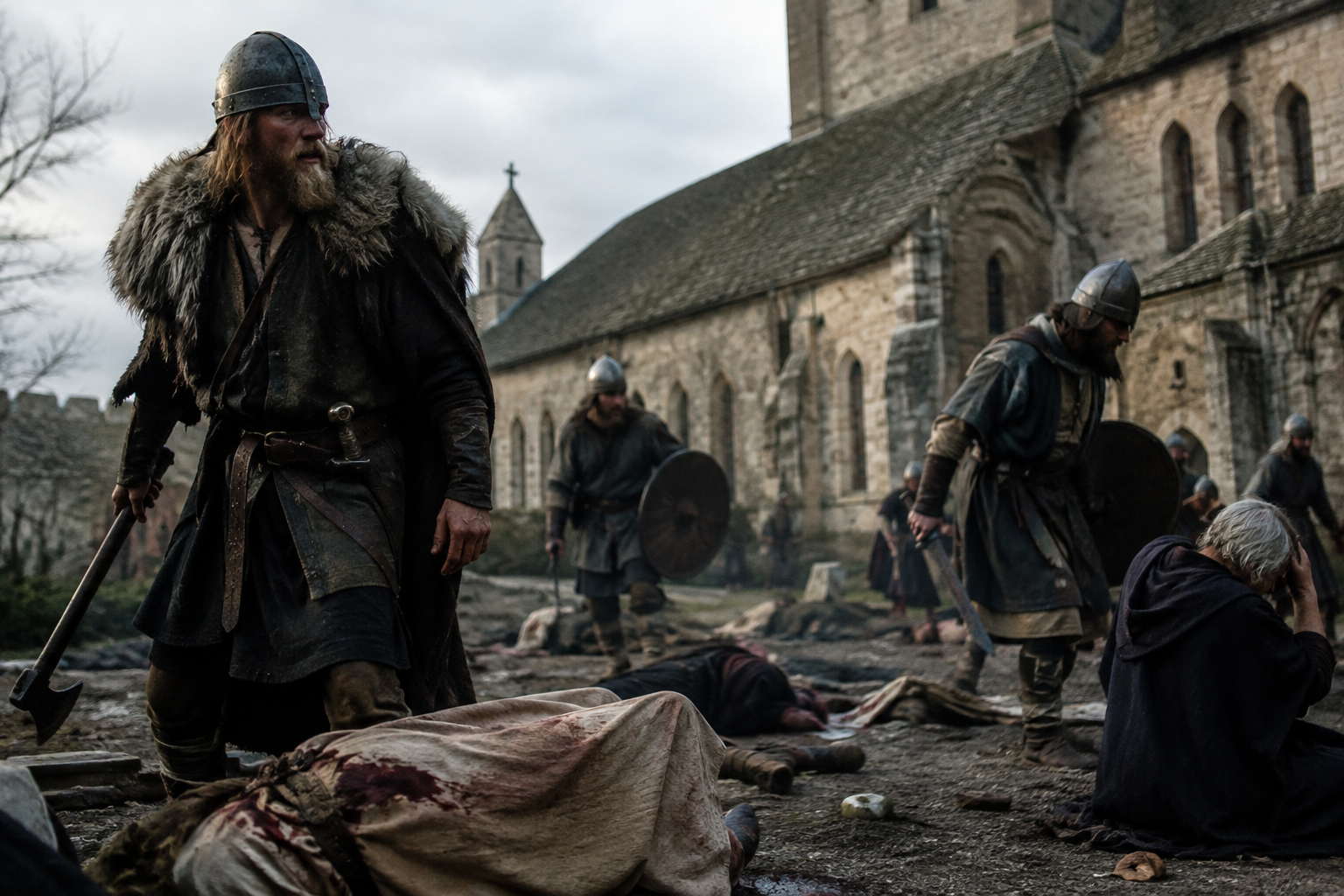
One of the most arresting medieval discoveries in England is not a royal tomb or a monastery grave, but a mass burial linked to sudden violence: the St. Brice's Day massacre at Oxford in AD 1002. Among the men recovered from that context is the individual identified as VK174, a person associated here with the Y-DNA haplogroup R1b1a1b1a1a1c2b2a1b1b1a5. That formidable string is a very precise paternal label, far narrower than the broad and widespread R1b family to which it belongs.
The Oxford burial matters because it places this paternal line inside a moment of crisis that is exceptionally well known from written history. King Aethelred II ordered the killing of Danes living in England in 1002, and the Oxford remains are among the most vivid pieces of physical evidence for the event. A Y-chromosome lineage traces only one direct male line, not a person's whole ancestry or identity, but when a lineage appears in such a charged archaeological setting, it becomes a useful thread for thinking about movement, settlement, and violence in the Viking Age North Sea world.
VK174 comes from the Oxford mass grave associated with the St. Brice's Day massacre, a grim episode in the late Anglo-Saxon kingdom. The historical background is clear enough: England at the turn of the 11th century was tied into a dense and unstable network of Scandinavian raiding, mercenary service, migration, and settlement. The archaeological find gives that history a body count.
What makes this especially interesting for haplogroup study is that we are not dealing with a vague regional tradition or a legendary pedigree. We have a named archaeological event, a specific place, and a dated context around AD 1002. In other words, this branch is not appearing in a timeless fog of "Viking ancestry"; it is turning up in a sharply defined historical moment in England, among men caught up in conflict between an English kingdom and Scandinavian communities within it.
A preprint on ancient genomics and the spread of Germanic-speaking populations helped bring wider attention to these kinds of early medieval connections across northern Europe, including the value of combining archaeology, history, and ancient DNA rather than treating any one of them as sufficient on its own: research on ancient genomics in Germanic-speaking regions.
At first glance, the haplogroup name looks almost absurdly long. But that length is the point. R1b1a1b1a1a1c2b2a1b1b1a5 is not a label for all R1b men, nor even for all men in medieval Britain or Scandinavia. It is a terminal or near-terminal branch within a much larger paternal family tree, and each added segment narrows the line further.
That matters because broad R1b lineages are common across large parts of western Europe, and simply saying "R1b" would tell us very little. A branch this specific is more useful for genetic genealogy, where the question is not whether a paternal line was once somewhere in Europe, but whether it can be tied to tighter networks of kinship and later historical populations. The Oxford evidence does not, by itself, reveal where the branch first formed, nor does it prove that every bearer of the branch in later centuries descends from Viking settlers in England. What it does show is that this paternal line was present among men caught in the Scandinavian-English entanglement of the early 11th century.
The Oxford burial is best understood not as an isolated atrocity, but as part of the wider North Sea zone that linked England, Denmark, Norway, and the Norse diaspora. By AD 1002, Scandinavian men in England could be raiders, traders, mercenaries, settlers, craftsmen, or the sons of earlier migrants. Written sources often flatten those distinctions, but archaeology and genetics make them harder to ignore.
That is one reason a sample like VK174 is so valuable. It reminds us that "Viking" is a historical shorthand, not a biological type. The dead at Oxford were living in England, yet at least some were likely seen as Danish or Scandinavian enough to become targets. Their Y-DNA, including the lineage associated with this article, belongs in that story of mobility and contested belonging rather than in any tidy national origin myth.
The broader pattern has become much clearer through recent work on Britain and the North Sea basin, where ancient genomes show that early medieval communities were often more mixed, mobile, and locally varied than older textbook narratives allowed.
There is a temptation, when a lineage appears in a dramatic context, to leap straight from DNA to ethnicity: Danish Y-DNA, English Y-DNA, Viking Y-DNA. Real history is messier. A paternal line can persist through many language shifts, political changes, and family movements. By the time VK174 was buried in Oxford, his father's line may already have crossed the North Sea more than once.
That is exactly why the archaeological context matters so much. The significance of VK174 is not that he supplies a simple ethnic badge. It is that he anchors this branch in a documented episode of anti-Scandinavian violence in late Anglo-Saxon England. The sample therefore speaks less to timeless origins than to one specific and turbulent historical setting: a kingdom where migration had already blurred boundaries, even as rulers and chroniclers tried to sharpen them.
In that sense, the Oxford dead fit well with the larger picture emerging from ancient DNA in early medieval Britain, where ancestry, cultural identity, and political allegiance do not line up neatly. The same broad region could contain long-rooted local families, recent arrivals, and people whose family histories already mixed both.
Ancient DNA articles sometimes seem to promise sweeping certainty from tiny traces. In truth, one sample rarely tells the whole story of a haplogroup. But one sample can still matter enormously when its context is this good. VK174 is attached to a famous event, a well-defined date, and a landscape where history and archaeology genuinely meet.
For someone researching R1b1a1b1a1a1c2b2a1b1b1a5, that makes the Oxford find more than a technical datapoint. It places the lineage in the human geography of the Viking Age and in the political tensions of Aethelred's England. It suggests that at least one branch of this paternal line was part of the Scandinavian-linked population present in England at the start of the 11th century, when the boundary between resident, migrant, and enemy could become lethally unstable.
The distinctive value of this haplogroup, in the evidence we have here, is not that it unlocks a grand dynasty or a heroic saga. It is that it appears in a starkly documented early medieval context: Oxford in AD 1002, among the dead of the St. Brice's Day massacre. For modern bearers of this paternal branch, that does not prove direct descent from this individual, but it does place the lineage within the real historical world of Scandinavian-linked communities in England at the end of the Viking Age.






Comments