Haplogroup R1b1a1b1a1a1c2b2a1b1b1a2a

– 6 min read


There is something wonderfully chastening about a Y-DNA haplogroup this specific: R1b1a1b1a1a1c2b2a1b1b1a2a. It sounds less like a family name than a filing error in a Roman archive. Yet behind that forbidding string lies one of the great rewards of archaeogenetics: the chance to follow a narrow paternal branch through the much broader history of Europe, and to see how ancient bones, battlefields, estates, and aristocratic memory can occasionally be set beside one another without pretending they are the same thing.
Y-DNA traces a direct paternal line, father to son, across many generations. That makes it powerful, but also limited. It does not describe a person's whole ancestry, culture, language, or identity. And with a lineage this fine-grained, caution matters even more. Much of what can be said securely belongs to the wider R1b family and to the northern European settings in which related branches appear; much less can be claimed with confidence for this exact terminal twig. Still, even a narrow branch can open a large historical landscape.
This haplogroup sits within the huge Y-chromosome family known as R1b, one of the most studied paternal lineages in western Eurasia. Broadly speaking, R1b lineages became historically important across large parts of Europe over the long stretch from later prehistory into the Bronze Age and after. Ancient DNA has shown again and again that paternal history in Europe is not static: lineages expand, contract, and shift as populations move, mix, and reorganize.
For that reason, it is important not to dump the whole story of R1b onto one very narrow descendant branch. The deeper history of R1b includes multiple expansions and many regional subclades. What we can say more responsibly is that a lineage like R1b1a1b1a1a1c2b2a1b1b1a2a belongs to a paternal framework deeply embedded in the making of later European populations, including those around the North Sea and in Britain. Its significance lies less in some tidy ethnic label than in its usefulness for tracking paternal continuity and change across time.
For readers interested in the bigger prehistoric background to lineages in northwestern Europe, the Lower Rhine-Meuse region is particularly revealing, where ancient DNA has helped disentangle continuity, migration, and the Bell Beaker horizon.
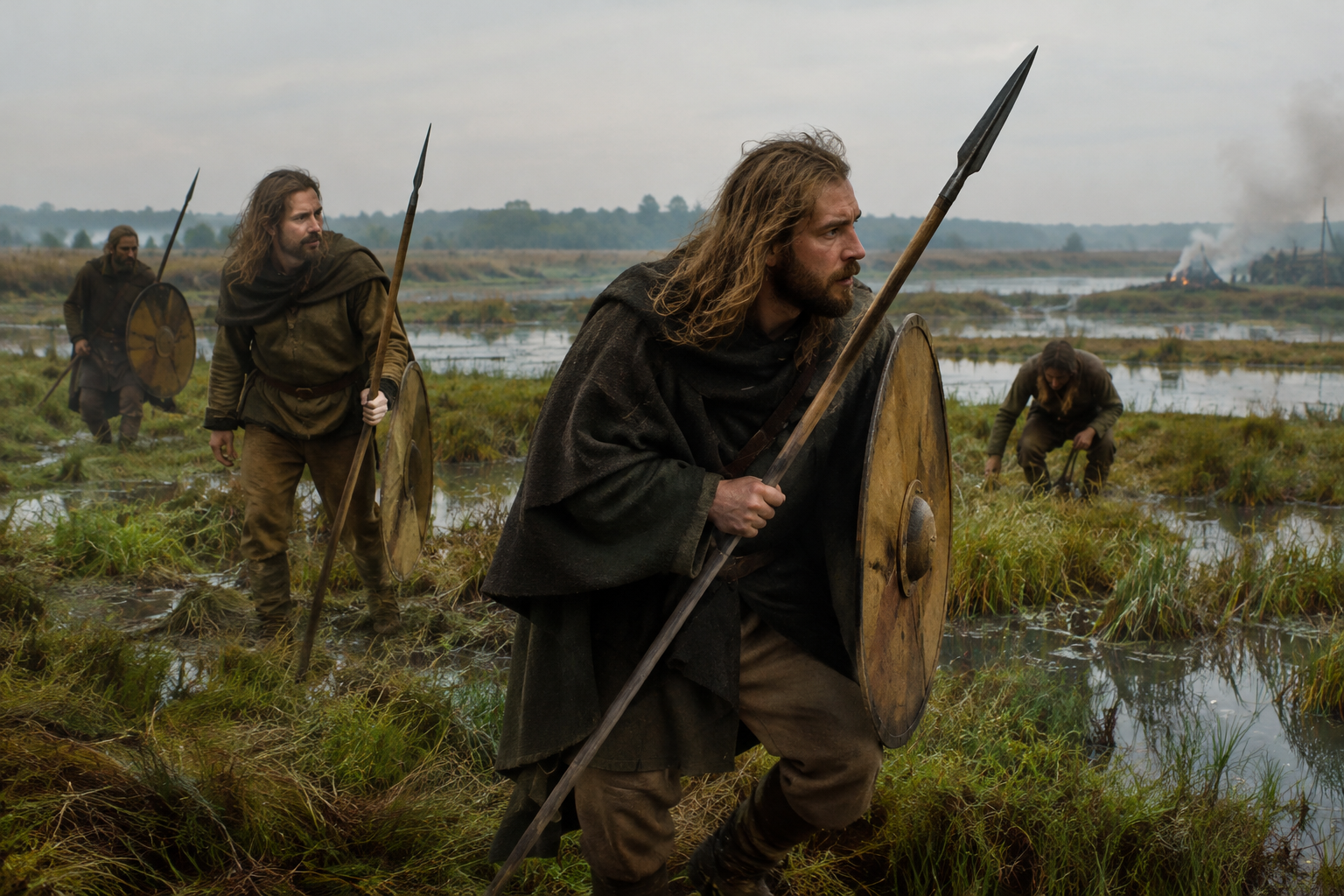
The most vivid clue supplied here comes from Denmark: Ancient Individual:Jute Early Roman Era Denmark Jutland Bog War Alken Enge Year:88 AD ID:CGG019209. Even set out plainly, it has drama enough. Alken Enge, in Jutland, is one of those sites that reminds us ancient history was not composed only of kings, law codes, and heroic speeches. It was also made of broken bodies in wet ground.
The Alken Enge finds are associated with a violent episode in the Early Roman Era, when the remains of large numbers of men were deposited in a bog landscape. Archaeology has made the site famous as evidence for organized conflict in northern Europe at a time when the Roman world loomed to the south, but did not rule Jutland. The sample CGG019209, dated in the supplied material to 88 AD, anchors this haplogroup in that world of northern marshes, war bands, and local societies living in the shadow of empire but not inside it.
Now, one must be careful. Sharing a haplogroup or nearby branch with an ancient individual does not make that person your direct ancestor, nor does one sample define an entire people. But what it does do is place this paternal line in a very concrete historical setting: Iron Age or Early Roman-era northern Europe, among communities in Denmark whose lives were shaped by warfare, mobility, and regional loyalties.
That setting matters because it gives this lineage a geography. Jutland was no backwater. It was part of the wider North Sea zone that later linked Scandinavia, the German coast, the Low Countries, and Britain. If you are trying to understand how a paternal branch might later appear in the British Isles, this is exactly the sort of region you would want to watch closely.
For a broader look at how ancient DNA illuminates the deep population history of Denmark beyond a single dramatic site, this community article is an excellent companion.
The supplied description identifies the ancient individual as "Jute Early Roman Era Denmark Jutland." That wording is suggestive, though it should not be over-pressed. The Jutes are best known from later historical traditions connected with migrations to Britain in the post-Roman centuries, alongside Angles and Saxons. It would be rash to claim that one man from 88 AD proves anything direct about those later movements. But geographically and historically, the connection is certainly interesting.
Ancient DNA has made one point very clear about the North Sea world: it was a region of repeated movement, not a neatly sealed set of peoples. Men carrying related paternal lines could have lived in Denmark in the Roman period, in Britain centuries later, and in later medieval families without there being any simple one-step story from one to the other. That is the lesson of population genetics at its best: not fairy-tale descent, but layered continuity mixed with migration.
Readers interested in how these North Sea movements later shaped early medieval England may want to continue with the MyTrueAncestry discussion of Anglo-Saxon genetic formation.
Read about Anglo-Saxon ancestry
That brings us, by a perfectly historical route and not a magical genetic one, to the House of Lowther in Cumbria. Lowther Castle, as it stands today, is not a medieval fortress but a grand Gothic performance, built between 1806 and 1814 by Robert Smirke. Its purpose was not really defense. It was display: wealth, power, continuity, pedigree. In other words, it was architecture doing what genealogies often do - turning inheritance into landscape.
There is something almost comic, and rather moving, in that ambition. A great aristocratic shell in northern England proclaiming ancient standing, while modern genetics reminds us that paternal lines are both older and messier than any noble house liked to admit. The Lowther family rose through law, politics, and landholding, and the castle became one of the major aristocratic seats of the north. But its splendid confidence did not last. The building was enormously expensive; the twentieth century was unkind to such places; the army used it during the Second World War; much of the interior was stripped after the war; and in 1957 part of the shell was demolished. What survives is the ruin - romantic, theatrical, and rather honest about the fate of status.
Today, the site has been restored as a heritage attraction with gardens and exhibitions. That final turn is perhaps the most modern part of the story. Lowther Castle now preserves not simply family memory, but public history. And that is where it sits neatly beside ancient DNA. Both are ways of recovering the past, though by very different means: one through documents, stone, and curated memory; the other through molecules in bone.
What we cannot say is that the ancient Danish sample CGG019209 proves descent to the Lowthers, or that every historical Lowther male belonged to this haplogroup. The evidence supplied does not justify such a claim. What we can say is that northern England, like the North Sea zone more generally, has long been shaped by the movement and persistence of paternal lineages whose deeper roots reach into the same broad northern European world as Iron Age Jutland.
For readers who want the house itself in fuller detail, the dedicated community feature is the obvious next step.
The value of R1b1a1b1a1a1c2b2a1b1b1a2a is not that it hands you a ready-made identity. It does something more interesting. It places one direct paternal line inside a long northern European story that includes prehistoric expansions within the wider R1b family, Iron Age conflict in Denmark, and the later historical worlds of Britain and its landed families.
The Alken Enge individual CGG019209 gives us a sharply focused glimpse of one man from 88 AD in Jutland. Lowther Castle gives us a much later vision of lineage turned into architecture in Cumbria. Between those two points lies nearly two millennia of migration, survival, reinvention, and historical forgetting. Genetics and history do not collapse those centuries into a single family tree. But together they let us ask better questions about how paternal lines endure, travel, and become attached to places.
If this branch appears in your own Y-DNA results, that does not make you a Jute warrior or a Lowther lord. But it may place your direct paternal line in the same broad historical corridors that carried men through the bogs of Jutland, across the North Sea, and into the later landscapes of Britain.
Upload your DNA to MyTrueAncestry to explore ancient matches, archaeological contexts, and the deeper history behind your paternal line. You may discover links to ancient individuals and historic populations that illuminate your ancestry, even when they do not prove direct descent from any one person or noble house.






Comments