Haplogroup R1b1a1b1a1a1c2b2a1b1a4a1a1a

– 6 min read


Some Y-DNA haplogroups come with short, neat labels that fit comfortably into familiar historical stories. This one does not. R1b1a1b1a1a1c2b2a1b1a4a1a1a is a very narrow paternal branch, the sort of lineage that reminds us how fine-grained modern genetic research has become. It sits within the great wider family of R1b, one of the major Y-chromosome lineages found across western Eurasia, but this highly specific subclade is not the same thing as the whole R1b story. That distinction matters.
Y-DNA traces one direct paternal line only: father to father to father. It does not describe a person's full ancestry, culture, language, or identity. But when ancient DNA, archaeology, and medieval history are read together, even a very narrow branch like this can become a useful historical clue. It can point us toward patterns of male-line continuity, migration, and settlement across centuries, especially in regions shaped by seaborne movement and political upheaval, such as Scandinavia and Normandy.
The broad parent haplogroup R1b has deep importance in European population history, especially in western Europe. Ancient DNA has shown that different branches of R1b expanded in different times and places, often in connection with major prehistoric and later movements of people. But one must be careful here: the long subclade name in this article represents a far more recent twig on that enormous tree than the prehistoric expansions usually discussed for R1b as a whole.
So what can responsibly be said? First, this lineage belongs within a paternal framework that became historically prominent in parts of Europe. Second, a narrow downstream branch may have spread not through one grand prehistoric migration alone, but through a mixture of later regional processes: local continuity, Viking Age movement, medieval settlement, lordship, and family expansion. In other words, the grand map of prehistory gives the backdrop, but the close-up action may belong to the first millennium and the Middle Ages.
That is one reason MyTrueAncestry readers interested in deep background may also enjoy broader studies of early paternal and population change in Europe, including northern France and nearby regions.
Explore Neolithic France and Ancient DNA
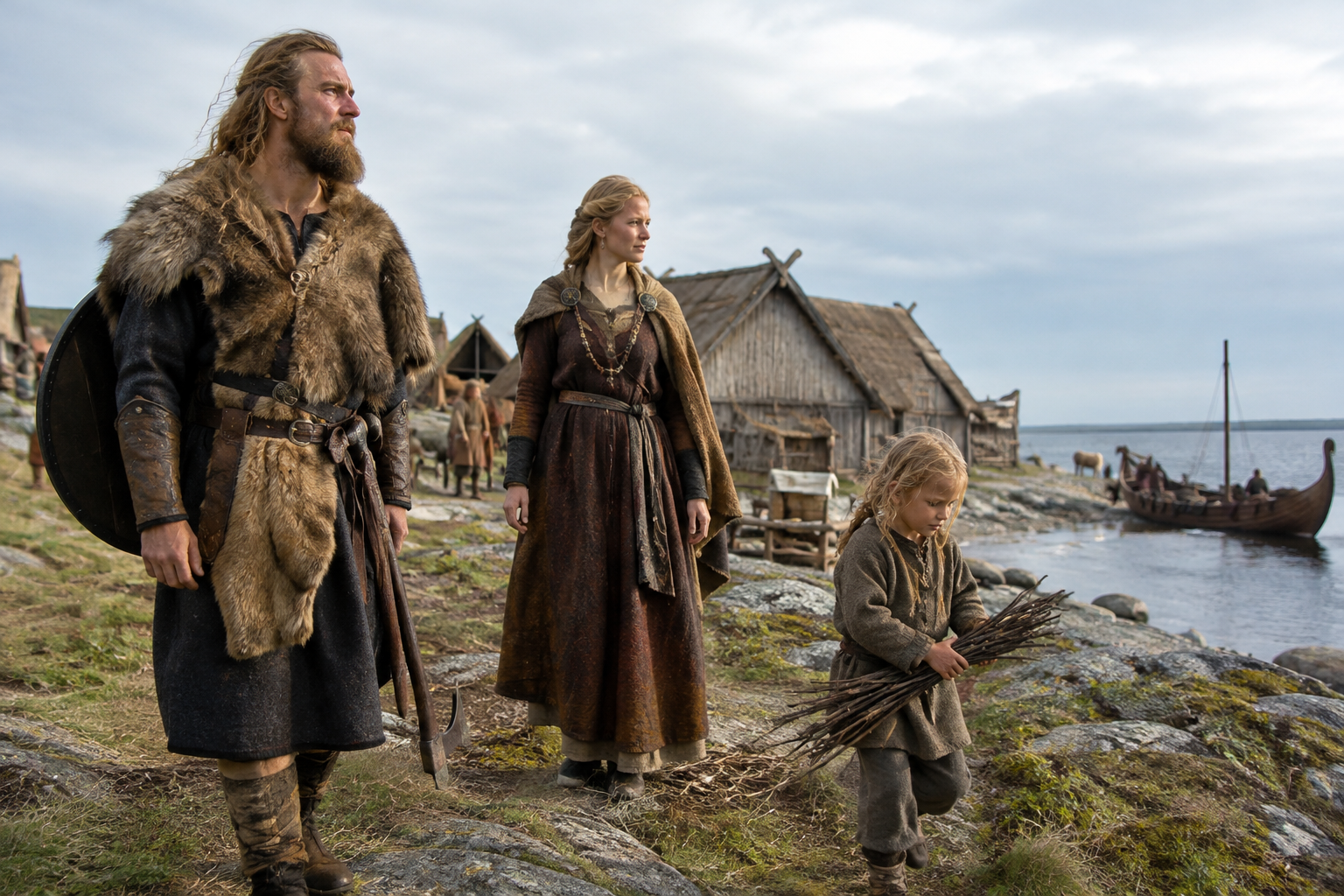
The most concrete anchor supplied for this haplogroup is an ancient individual from the Baltic world: VK469, from Viking Age Gotland Kopparsvik Sweden, dated to 975 AD. That is already enough to place this paternal line in a vivid historical setting. Gotland in the late 10th century was not some remote backwater at the edge of Europe. It was a busy island crossroads in the Baltic, tied into trade, travel, raiding, diplomacy, and the movement of people stretching from Scandinavia toward the east and south.
Kopparsvik, near Visby, belongs to a landscape where graves, goods, and bones have repeatedly shown how interconnected Viking Age society could be. A man such as VK469 was living in a world of ships, silver, Christian missions, older pagan traditions, and widening social horizons. His Y-chromosome does not tell us his profession, rank, or mother tongue. It does, however, preserve one paternal thread from that Baltic society and shows that this narrow lineage was present in Viking Age Sweden by 975 AD.
That matters because ancient DNA turns abstraction into biography. Instead of saying vaguely that a lineage "may have existed in Scandinavia," we can point to a named sample, a place, and a date. VK469 is not proof of direct descent for any later family. But he is proof that one branch within this paternal neighborhood was alive in the Viking Age world of Gotland.
Readers who want more on the island context should look at research on Gotland's deeper genetic past, where ancient burials reveal just how long and varied the island's human story has been.
Discover Gotland's Deeper Ancient DNA Story
Now comes the historical question that makes this sort of article fun. How do we think about a Viking Age Scandinavian sample and medieval Norman noble settings in the same frame without collapsing into fantasy? The answer is: cautiously, geographically, and historically.
Normandy itself was shaped by Scandinavian settlement layered onto an older Frankish and Gallo-Roman landscape. By the 10th and 11th centuries, men of northern seaborne backgrounds and their descendants had become part of a new Norman political society. That does not mean every Norman lineage was Scandinavian in paternal origin, nor that every Scandinavian-related lineage in Normandy came through one simple route. But it does mean that comparisons between Viking Age Scandinavia and Norman aristocratic regions are historically meaningful.
The supplied noble associations place us in exactly that landscape. House de Aubigny is linked to Saint-Martin-Aubigny in Manche, in the Cotentin of Normandy. This is not the flamboyant Normandy of tourist brochures, but the real medieval countryside: parishes, fields, local lordship, and long continuity under changing political masters. Villages like Saint-Martin-Aubigny were the cellular structure of Norman society. If one wants to imagine how paternal lines endure, divide, and spread, it is here, among churches, farms, and inherited local influence, not only in famous royal courts.
The same is true of the setting attached to the House of Mowbray, where the key monument is Coutances Cathedral. Standing on its hill in Normandy, the cathedral embodies the layered history of the region. Christian worship there likely succeeded earlier sacred use; the early medieval bishopric survived disruption; and after the Viking Age the church was rebuilt, notably under Bishop Geoffrey de Montbray, a major figure close to William the Conqueror. Much of the present structure belongs to the 13th-century Gothic rebuilding, with its soaring nave, lantern tower, and twin western towers.
There is something rather splendid in that contrast. On one side, VK469 in Viking Age Gotland. On the other, Norman churches and lordships transformed into the architecture of conquest, reform, and aristocratic memory. Genetics cannot prove that one leads directly to the other. But history explains why such worlds belong in the same conversation.
If you want to explore one of those Norman families more directly, MyTrueAncestry has a dedicated piece on the de Aubigny line.
Read About the de Aubigny Family
It is tempting, when a haplogroup is associated with noble houses, to start drawing straight lines in ink from an ancient skeleton to a medieval pedigree. That is precisely what we should not do. Noble families were complicated social organisms. They included cadet branches, adoptions of identity, inheritance through women, illegitimacy, remarriage, and political reinvention. A historical association with a haplogroup is not proof that every bearer of a family name shared the same Y-chromosome, still less that a modern tester does.
Yet the noble settings are still valuable. Saint-Martin-Aubigny speaks for the rootedness of lordship in the Norman countryside. Coutances Cathedral speaks for ecclesiastical and aristocratic power in a region rebuilt after Viking Age disruption. Together they show how paternal lines, whether local, migrant, or mixed into new ruling societies, became embedded in enduring institutions: parish churches, landed communities, episcopal centers, and family memory.
The Mowbray connection is especially suggestive in this wider Norman context. Coutances Cathedral is not a castle, strictly speaking, but it functioned as a monumental stronghold of authority, just in clerical rather than military form. Stone, after all, has many uses. Some stones make towers and keeps; others make choirs and vaults. Both preserve the ambitions of families and patrons long after the men themselves are gone.
For readers interested in how Norman-linked lineages and medieval Britain intersect in genetic history, one especially relevant article looks at the mixed Viking, Saxon, and French background of the Norman world after 1066.
What, then, does R1b1a1b1a1a1c2b2a1b1a4a1a1a reveal? First, it shows how narrow paternal branches can connect very different kinds of evidence: a Viking Age burial from Gotland, the historical geography of Normandy, and the remembered worlds of houses such as de Aubigny and Mowbray. Second, it reminds us that paternal ancestry is both powerful and limited. Powerful, because a Y-chromosome line can sometimes be followed across startling stretches of time. Limited, because it is only one ancestral thread among thousands.
Ancient DNA gives us something written genealogies cannot: access to male lines centuries before surnames, charters, and heraldry. Written history gives us something genetics cannot: names, institutions, architecture, politics, and context. Put together, they do not hand us a fairy tale of perfect descent. They give us something better: a more honest picture of how people, places, and lineages persisted, mixed, and changed.
If your own Y-DNA falls on a narrow branch like this one, that does not make you a Viking, a Norman lord, or a member of a medieval noble house. But it may place one of your paternal lines in the same broad historical landscapes that produced men like VK469 and the later societies of Scandinavia and Normandy.
MyTrueAncestry lets you compare your DNA with ancient individuals and historical populations, offering a fresh way to think about the past behind your family story. Those matches do not necessarily prove direct descent from a particular ancient person or noble lineage, but they can open remarkable windows onto the worlds your ancestors once inhabited.






Comments