Haplogroup R1b1a1b1a1a1c2b2a1b1a

– 6 min read


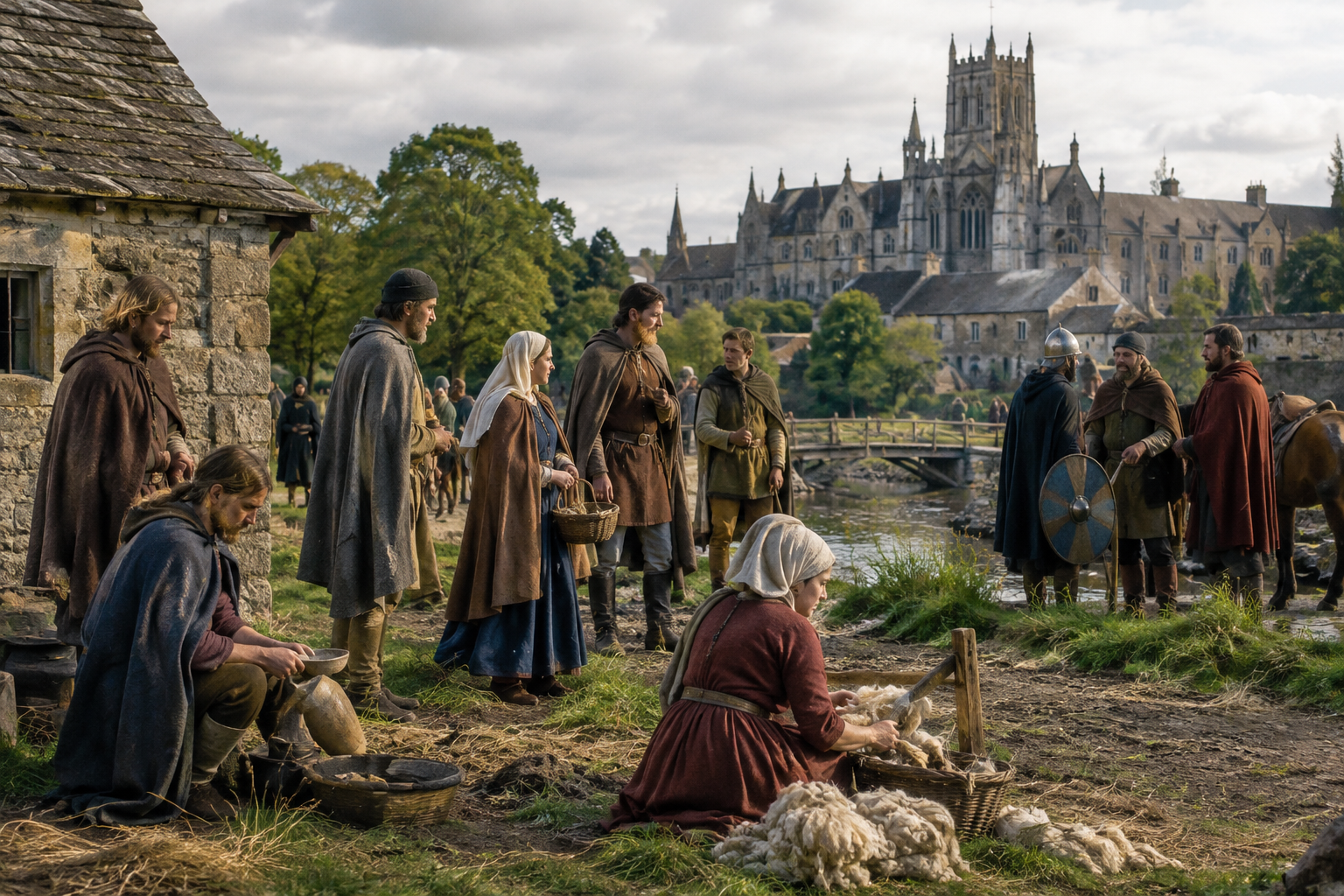
Some Y-chromosome lineages are easiest to understand when you stop thinking of them as labels in a database and start thinking of them as trails across a map. The haplogroup R1b1a1b1a1a1c2b2a1b1a is one of those. It belongs to the wider R1b family, a major branch of paternal ancestry in western Eurasia, but this very specific subclade becomes most interesting not in sweeping claims about all of R1b, but in the narrower pattern revealed by ancient burials from northern and central Europe.
What makes this lineage so arresting is its appearance in contexts tied to the post-Roman world: Franks, Saxons, Jutes, Thuringii, Longobards, western Slavs, Viking Age Scandinavians, and medieval England. That does not mean the haplogroup "belongs" to any one people. Y-DNA traces only one direct paternal line out of the countless ancestors each person has. Still, when the same branch appears in graves scattered from Lower Saxony to Dover, from Pannonia to Funen, and from early medieval cemeteries to medieval Cambridge, it gives us a rare chance to watch one paternal thread move through the great social rearrangements of Europe after Rome.
The broader R1b tree has deep roots in Eurasian prehistory and is often discussed in connection with major Bronze Age population shifts in Europe. But caution matters here. A highly specific branch such as R1b1a1b1a1a1c2b2a1b1a cannot simply be handed the entire prehistory of R1b as if nothing happened in between. What the evidence here supports more clearly is a later story: this branch shows up in early medieval and medieval settings across the North Sea world and parts of central Europe.
In practical terms, that makes it a useful lineage for studying paternal continuity and movement in the centuries after the collapse of Roman authority in the West. This was the age in which military federates became kingdoms, local populations mixed with incomers, and identities like Frankish, Anglo-Saxon, Longobard, and Thuringian were being made and remade in real time. Ancient DNA does not solve every historical argument, but it does let us see that the men buried under those labels were not abstractions. They carried lineages with histories of their own.
See how archaeogenetics changed history
The strongest impression from the supplied ancient samples is geographical breadth combined with a very recognizable historical setting. In Lower Saxony, two men from Hannover-Anderten, ADN014 from a Frankish grave dated to 400 AD and ADN002 from a Saxon grave dated to 400 AD, place this lineage in a frontier region where Roman influence, local communities, and emerging Germanic polities met. It is hard to imagine a better reminder that paternal lines do not obey modern ethnic boxes. One branch can appear in neighboring burials assigned to different cultural labels.
Then there is Kent, the old gateway to England. At Buckland, Dover, the samples BUK040, a Jute from the Early Anglo Saxon Period dated to 400 AD, and BUK011, BUK001, and BUK006, all dated to 400 AD in early medieval or early Anglo-Saxon contexts, show the lineage present in one of the key landing zones of the North Sea migrations. Add HAD011 from Hatherdene Close, Cambridgeshire, dated to 500 AD, and the picture broadens inland. These are exactly the centuries when England was being reshaped by migration, local survival, and cultural fusion.
In central Germany the branch also appears among the Thuringii: OBM054 from Obermoellern, dated to 500 AD, and DRH010 from Deersheim, Saxony-Anhalt, also dated to 500 AD. These finds matter because Thuringia sat in a zone repeatedly drawn into wider struggles among Franks, Saxons, and other powers. A paternal lineage appearing there as well as in Lower Saxony and England suggests not a neat tribal signature, but a northern-central European network of related male lines spread across communities involved in the making of early medieval Europe.
Further southeast, two Longobard-period samples from Pannonia carry the story into the Carpathian Basin: SZL070 from Savaria Szeleste Barbaricum, Hungary, dated to 525 AD, and MFC016 from Arrabona Menfocsanak Barbaricum, Hungary, dated to 550 AD. These burials are especially intriguing because Longobard movements linked the middle Danube to central Europe and, eventually, Italy. They show that this paternal branch was not confined to the shores of the North Sea.
Explore post-Roman DNA in Hungary
The later samples are just as revealing. VK133, from Viking Age Galgedil on Funen, Denmark, dated to 925 AD, places the lineage squarely in the Scandinavian world of the Viking Age. Again, one must resist easy conclusions. Sharing a haplogroup does not prove that a Viking from Funen was closely related to a Jute in Kent or a Frank in Lower Saxony. But taken together, the finds fit a broader North Sea and continental corridor in which people, ships, warbands, marriage networks, and dynasties were constantly on the move.
By the high Middle Ages, the lineage appears in England in a very different setting. ATP_PSN_78, from Medieval England Cambridge St Johns Hospital, dated to 1250 AD, belongs not to a migration cemetery but to an institutional Christian landscape of hospitals, towns, clerics, and the ordered life of medieval society. And in between sits SDN003, a western Slav settler from Steuden in Sachsen-Anhalt, Germany, dated to 1050 AD, a reminder that eastern settlement and frontier mixing also formed part of the medieval story of central Europe.
If there is a lesson here, it is not that one haplogroup defines Franks, Jutes, Slavs, Longobards, Vikings, or Englishmen. The lesson is almost the opposite. The same paternal branch can pass through very different political worlds while remaining recognizably itself. Ancient DNA helps us see continuity where written categories alone can suggest only rupture.
Read about Anglo-Saxon migration DNA
The supplied noble connection brings us to House Basset and Drayton Manor in Staffordshire. Here the story becomes less about proving a lineage and more about understanding historical setting. Drayton Manor began as a country estate and manor house with medieval roots, passing through landed families before entering a strikingly modern chapter under the Bryan family. In 1950 George and Vera Bryan opened the grounds to visitors, and the estate eventually became one of Britain's best-known theme parks.
That is, frankly, marvellous. Not because rollercoasters prove anything genetic, of course they do not, but because the site preserves a long English truth: landscapes outlast regimes, and estates accumulate lives. Beneath the modern attractions lies the older framework of manor, landholding, and aristocratic memory. A place like Drayton Manor is a good reminder that the medieval world was built on earlier demographic foundations laid down over centuries by populations not yet called English in any straightforward sense.
It would be irresponsible to claim that House Basset as a whole is genetically proven to belong to this exact haplogroup merely because the family is associated here with the article's theme. Noble families are genealogically complex, and documentary history is not the same as genetic confirmation. But historically, the Bassets belong to the same broad English world in which lineages like this one had already been present for centuries, as the Cambridge and Anglo-Saxon-era burials suggest.
So Drayton Manor stands not as genetic evidence, but as a memorial in stone, land, and ownership patterns to the later social world built atop those older paternal landscapes. One can move from Buckland Dover to medieval Cambridge to Staffordshire and see not a single family tree, but a succession of historical layers.
Discover the story of House Basset
So what can we responsibly say about R1b1a1b1a1a1c2b2a1b1a? First, it appears to have been part of a paternal landscape stretching across northern and central Europe in the early medieval period. Second, its presence in Frankish, Saxon, Jutish, Thuringian, Longobard, Slavic, Viking Age, and medieval English contexts shows how one lineage can move through many historical identities without being reducible to any one of them. Third, the combination of burial archaeology and Y-DNA is especially powerful for periods where texts are thin, partisan, or silent.
This is where archaeogenetics is at its best. It does not replace chronicles, charters, place-names, or noble pedigrees. It sits beside them and occasionally corrects our assumptions. A cemetery in Dover, a grave in Lower Saxony, a Longobard burial in Hungary, a hospital cemetery in Cambridge, and a manor landscape in Staffordshire all belong to different chapters of history. Yet they can still be part of the same broader human story of movement, settlement, inheritance, and survival.
If you enjoy the North Sea dimension of this lineage, the wider setting is well worth exploring further, especially the interplay between Scandinavia and Britain across many centuries.
Explore North Sea migrations to Britain
With MyTrueAncestry, you can explore whether your own DNA shows connections to ancient individuals, archaeological cultures, and historical populations like those discussed here. Such matches can offer fascinating clues about the deeper background of your ancestry, even though they do not by themselves prove direct descent from a particular ancient person or noble house.






Comments