Haplogroup R1b1a1b1a1a1c2b1a1a

– 5 min read


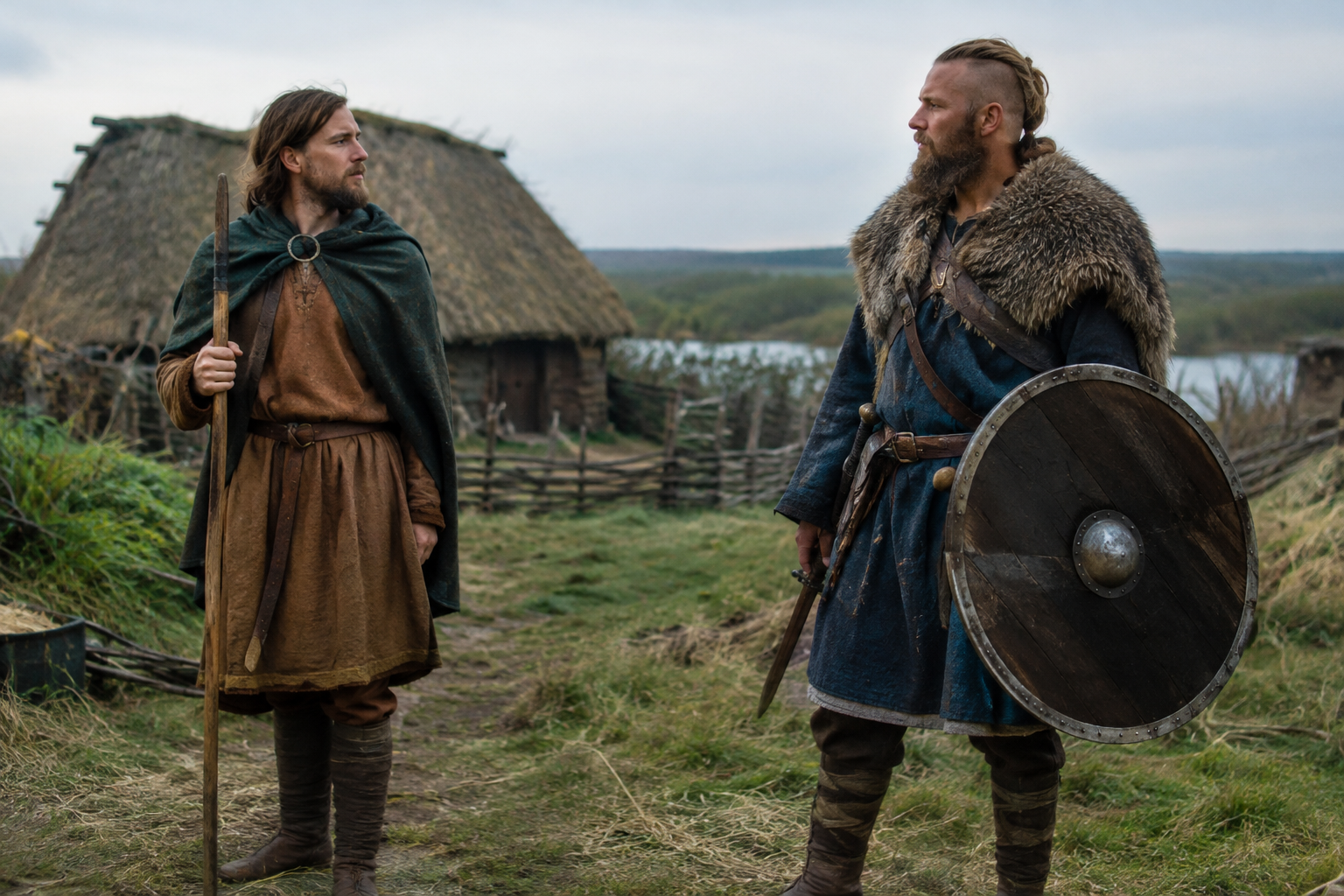
Some Y-chromosome lineages announce themselves with great historical fanfare. Others do something more interesting: they turn up quietly in exactly the places where the history of northern Europe became entangled - in early medieval England, in Viking Age Denmark, and in later family landscapes on the British side of the North Sea. Haplogroup R1b1a1b1a1a1c2b1a1a belongs to that second sort of story.
That formidable string of letters and numbers marks a very specific paternal branch within the wider haplogroup R1b, one of the major Y-DNA lineages found across western Eurasia. As ever with Y-DNA, a quick reminder is in order: this traces one narrow line of descent, father to son to son, and not a person's full ancestry. But narrow does not mean trivial. Quite the reverse. A Y-line can preserve the outline of movements, settlements, and male-line continuity across centuries in a way that written genealogy often cannot.
Because this is such a specific subclade, we should be careful. It would be wrong to dump the whole long history of broad R1b onto this one tiny twig and pretend the matter settled. What we can say responsibly is that this lineage sits deep within the R1b tree, a paternal structure whose broader branches became very important across parts of Bronze Age and later Europe. Ancient DNA has shown again and again that paternal histories in Europe were reshaped over time, especially through later prehistoric and early historic population movements.
For a subclade this narrow, the most useful evidence often comes not from sweeping claims about prehistory, but from where it actually appears in datable ancient remains. In this case, the evidence supplied points us toward the North Sea world: eastern England and Jutland. That alone is suggestive, not because it proves an ethnicity, but because it places this paternal line in one of the great contact zones of the early Middle Ages.
If you want the broader archaeological background for how ancient DNA has transformed these questions, MyTrueAncestry has a useful overview in Ancient DNA and the Rise of Archaeogenetics.
The clearest way into this haplogroup is through two ancient individuals: LAK007 from Lakenheath, Suffolk, England, dated to 650 AD, and VK384 from Hesselbjerg, Jutland, Denmark, dated to 875 AD. They are not presented as direct relatives, and they do not prove some neat little family saga crossing the sea. But together they show this paternal branch, or a closely relevant placement within it, in exactly the historical corridor where England and Scandinavia were bound together by migration, trade, war, and settlement.
LAK007, from early medieval Suffolk, belongs to a period when eastern England was already the product of generations of movement and mixture after the end of Roman rule. Suffolk was no remote backwater. It lay within one of the most active regions of early Anglo-Saxon England, facing the North Sea and tied into networks that connected Britain with the Low Countries, northern Germany, and southern Scandinavia. A Y-line found here in 650 AD matters because it places this paternal ancestry in England before the height of Viking settlement.
Then there is VK384 from Hesselbjerg, Jutland, dated to 875 AD. This is the Viking Age proper, not the prologue. Jutland was one of the main Scandinavian homelands linked to the raiding, trading, and settlement networks that reached across the British Isles and beyond. Again, caution first: one Viking Age man in Denmark does not define the haplogroup. But taken with LAK007, he helps sketch a distribution around the North Sea that fits the historical geography remarkably well.
That larger setting is explored nicely in North Sea Migrations to Britain: From Vikings to Industrial Revolution, which gives a wider sense of just how enduring those sea-borne connections were.
There is a temptation, always, to look at a Y-line in Suffolk and another in Jutland and start attaching labels at once: Anglo-Saxon, Dane, Viking, settler, invader, founder. History is not so obliging. Y-DNA does not speak a language, carry a shield, or sign a charter. What it does is show paternal continuity and distribution. The rest must be built from archaeology and history.
Still, the context is striking. Eastern England in the 7th century and Denmark in the 9th century were not separate worlds. They formed part of an interconnected northern zone in which people, goods, fashions, and kin groups moved repeatedly. A lineage found in both places across that span may reflect older shared ancestry around the North Sea, later movement between the two shores, or both. Ancient DNA is particularly good at reminding us that such possibilities are not literary fantasy but biological fact.
For readers interested in England specifically, Exploring the Genetic Legacy of the Anglo-Saxon Migration: Formation of the Early Medieval English Gene Pool offers a wider frame for the world in which LAK007 lived.
Read About Anglo-Saxon England
The supplied later historical association takes us to the House Dykes and to Dovenby Hall near Cockermouth in Cumbria. Here one has to resist another common misunderstanding. A family being associated with a haplogroup in a community context does not prove that every historical bearer of the surname carried that Y-line, nor that an ancient man from Suffolk or Jutland was an ancestor of the family. What it does offer is a historically meaningful regional and genealogical frame in which to think about paternal continuity.
Dovenby Hall is not a medieval fortress looming above a border river. In some ways it is more revealing than that. It began as a country house in the late 18th century, expanded into a substantial estate in the 19th, and then veered into a thoroughly modern afterlife as the base of the M Sport World Rally Team in the early 21st century. It is a marvellously British sequence: Georgian ambition, Victorian improvement, and then turbocharged engineering. The point is not that the building proves a Y-line, of course. Rather, it preserves the historical memory of a family rooted in a particular place, and shows how landed identity continued to matter long after the age of longships and migration cemeteries.
Cumbria itself adds another layer. This is a region where Norse influence, Anglo-Scottish frontier politics, older Brittonic survivals, and later gentry culture all meet. That does not let us assign the haplogroup to any one of those histories. But it does make the Dykes association an apt reminder that paternal lineages do not stop in the early Middle Ages. They pass into documentary history, surname history, estate history, and local memory.
Readers curious about that family context can follow it further in The Dykes Family.
What makes R1b1a1b1a1a1c2b1a1a so appealing is not that it comes with a grand single-civilization label. It does not. It is interesting because it appears in the real working landscape of early medieval northern Europe: on both sides of the North Sea, in periods when communities were being remade by migration and contact. It then resonates, at least contextually, with later family histories in Britain, where landed houses like Dovenby Hall preserved names and regional identities long after the original movements had faded from memory.
This is exactly where ancient DNA is at its best. Written genealogy can take you into the age of records, heraldry, and property. Archaeology can take you into cemeteries, settlements, and graves. Genetics does something rather different: it reveals lines of biological continuity and connection that run beneath all that, sometimes confirming expectations, sometimes complicating them. A man in Suffolk in 650 AD and a man in Jutland in 875 AD are not characters in the same family tree we can simply draw in ink. But they are part of the same wider human story, and this haplogroup helps us see that story more sharply.
If you carry this haplogroup, or a nearby branch, your Y-DNA may connect you to the same broad paternal history that surfaces in sites like Lakenheath and Hesselbjerg and in later regional family traditions such as the House Dykes. That does not prove descent from any specific ancient individual or noble line. But it can place your paternal ancestry inside a much larger historical landscape.
Upload your DNA to MyTrueAncestry to explore ancient DNA matches, compare yourself with archaeological samples, and see how your ancestry may fit into the long history of peoples around the North Sea and beyond.






Comments