Haplogroup R1b1a1b1a1a1c2b1
– 5 min read


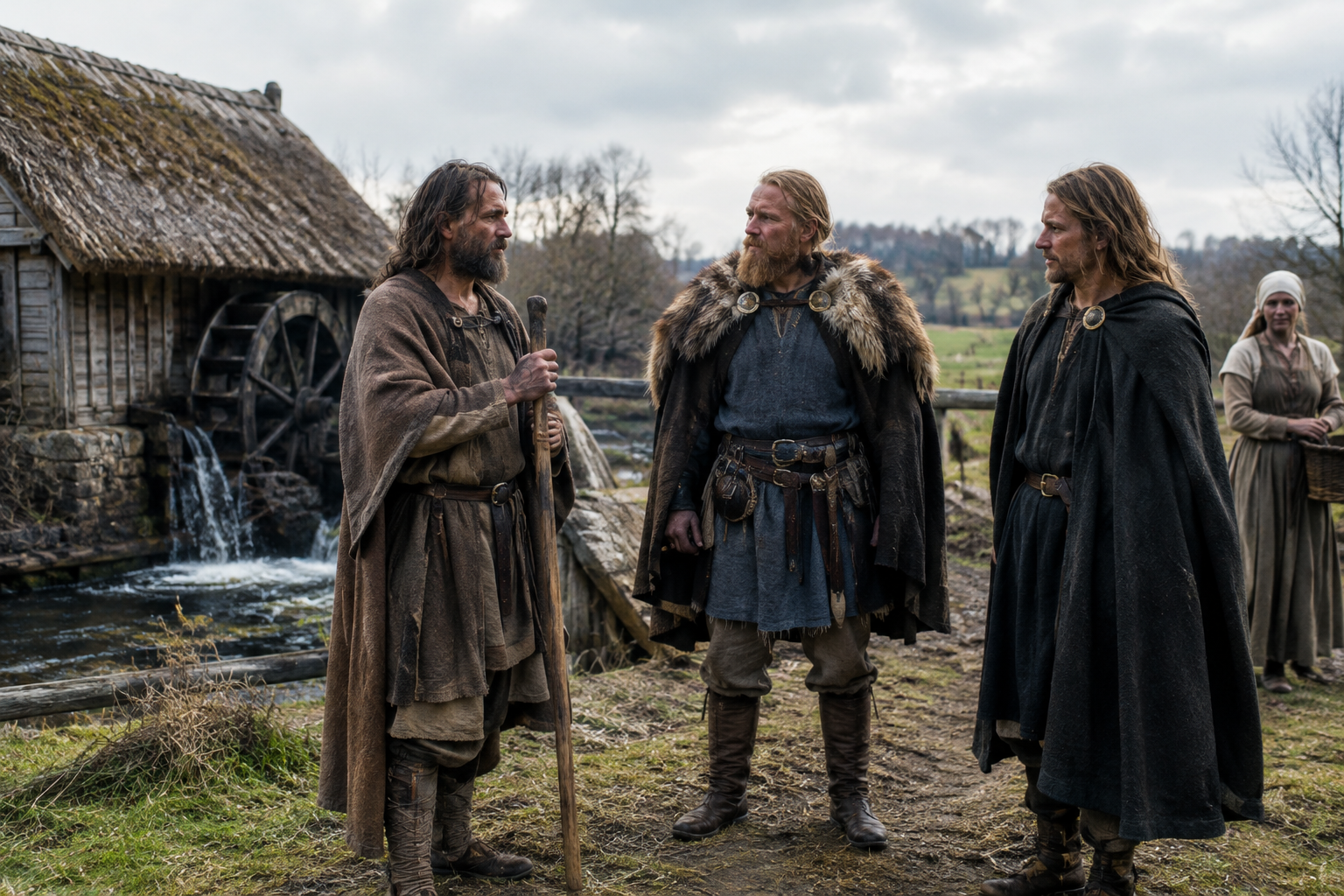
At Norton Bishops East Mill in Yorkshire, an early medieval man identified as I17274 offers a useful starting point for thinking about the Y-DNA haplogroup R1b1a1b1a1a1c2b1. He lived around AD 550, in the unsettled centuries after Roman rule in Britain had ended and new political worlds were taking shape across eastern and northern England. On its own, one male line does not explain a whole population. But when a paternal branch like this appears again in later Scandinavian contexts, it becomes historically interesting for a rather practical reason: it places the lineage inside the North Sea world at exactly the period when Britain, Denmark, and Sweden were deeply entangled.
That is the real value of these finds. R1b1a1b1a1a1c2b1 is a very specific paternal branch within the wider R1b family, and Y-DNA tracks only one direct male line out of the thousands of ancestors any person has. Even so, ancient cases can show where that line turns up in the archaeological record. Here, the pattern is not prehistoric and diffuse, but early medieval and Viking Age, anchored by three men from Yorkshire, Funen, and Varnhem.
The earliest of the three is I17274 from Norton Bishops East Mill, dated to around AD 550. That date matters. It sits in the period often described as early Anglo-Saxon England, though the label can sometimes flatten a much messier reality of migration, local survival, intermarriage, and regional variation. Yorkshire was not an empty stage onto which one people simply marched. It was a landscape where older Romano-British communities, incoming groups from across the North Sea, and new local identities were being formed together.
A genetic study of early medieval England, linked to this region through research on the formation of the early English gene pool, helps frame why a sample like I17274 matters. The broader lesson from such work is not that every burial can be neatly assigned to a single ethnic label, but that eastern and northern England were genuinely connected to continental and North Sea migration. In that setting, a lineage such as R1b1a1b1a1a1c2b1 belongs to a mobile and mixed historical zone rather than to a sealed national story.
What I17274 gives us, then, is not a grand dynasty but a foothold: this paternal branch was present in early medieval northern England at a time when communities were being reorganized after Rome and before the Viking Age. That alone makes the later Scandinavian appearances more than a coincidence of geography.
The second sample, VK134, comes from Galgedil on Funen in Denmark and dates to about AD 925. Now the setting is unmistakably Viking Age. Funen sits at the heart of the Danish archipelago, and in the 10th century it belonged to one of the most connected maritime landscapes in Europe. Ships, trade, raiding, warfare, settlement, and political alliance all moved through these waters, linking Denmark not only to Norway and Sweden, but to England, Frisia, the Baltic, and beyond.
This is where the repeated appearance of the branch becomes more pointed. If I17274 shows the line in early medieval Yorkshire, VK134 shows it in a Danish setting a few centuries later, inside the period when Scandinavian activity in Britain is historically visible and archaeologically abundant. That does not prove that the man buried at Galgedil had family in Yorkshire, still less that he descended from I17274. But it does show the same paternal branch on both sides of the North Sea in periods when the sea acted less as a barrier than as a corridor.
The Viking world is often described in terms of spectacular movement, yet the more revealing truth is that these movements created durable communities. Men with Scandinavian cultural affiliations settled in England; men from Britain could end up in Scandinavian spheres; and lineages circulated within a web of marriage, fosterage, service, colonization, and local continuity. R1b1a1b1a1a1c2b1 fits neatly into that sort of history: not a single migration event, but an enduring northern European network.
The third sample, VK424, comes from Viking Age Skara Varnhem in Sweden and is dated to around AD 1050. This is a fascinating moment. By the mid-11th century, Scandinavia was not ceasing to be Scandinavian, of course, but it was changing politically and religiously. Kingdoms were consolidating, bishoprics were becoming more important, and Christianity had become a major organizing force in burial and memory.
Varnhem is especially evocative because it belongs to one of the best-known early medieval landscapes in Vastergotland, a region central to debates about the formation of the Swedish kingdom. A man from this setting carrying the same paternal branch found in Yorkshire and Denmark hints at a lineage with real traction in the Scandinavian world. Again, caution matters: one Y-chromosome does not define Varnhem, and it does not tell us the man's language, rank, or full ancestry. But across these three finds, the line appears not at the fringes but within core zones of early medieval North Sea and Scandinavian history.
One useful supporting lead for this wider Scandinavian context is the preprint at https://www.biorxiv.org/content/10.1101/703405v1, which has circulated in connection with Viking Age population studies. Without forcing claims beyond the evidence here, that broader research environment helps explain why a branch seen in Denmark and Sweden should be read as part of a connected Viking Age demographic landscape rather than as an isolated curiosity.
There is a temptation with long Y-DNA labels to treat them like miniature ethnic flags. They are not. R1b1a1b1a1a1c2b1 is better understood as a highly specific paternal signature that turns up here in three historically charged settings: post-Roman Yorkshire, Viking Age Denmark, and Viking Age Sweden. The important point is not that the branch "belongs" to one modern nation, but that its ancient evidence sits squarely in a zone of migration, settlement, and political change around the North Sea.
It is also worth distinguishing the narrow branch from the wider R1b umbrella. R1b as a whole is vast and spread across much of Europe and beyond; that broader history should not be casually projected onto this exact subclade. What the present evidence really supports is something smaller and more solid: this paternal line was present among men living in early medieval and Viking Age societies in Britain and Scandinavia.
If your own paternal ancestry falls under R1b1a1b1a1a1c2b1, these ancient samples suggest a lineage at home in the northern European world of the 6th to 11th centuries. The clearest picture is not one of a single tribe or a single kingdom, but of a line appearing in the very places where Britain and Scandinavia were repeatedly linked by migration, settlement, and exchange. That is a modest conclusion, but a meaningful one: this is the kind of haplogroup evidence that places a direct male line inside real historical landscapes, among real excavated individuals, rather than in abstraction alone.






Comments