Haplogroup R1b1a1b1a1a1c1a2b

– 7 min read


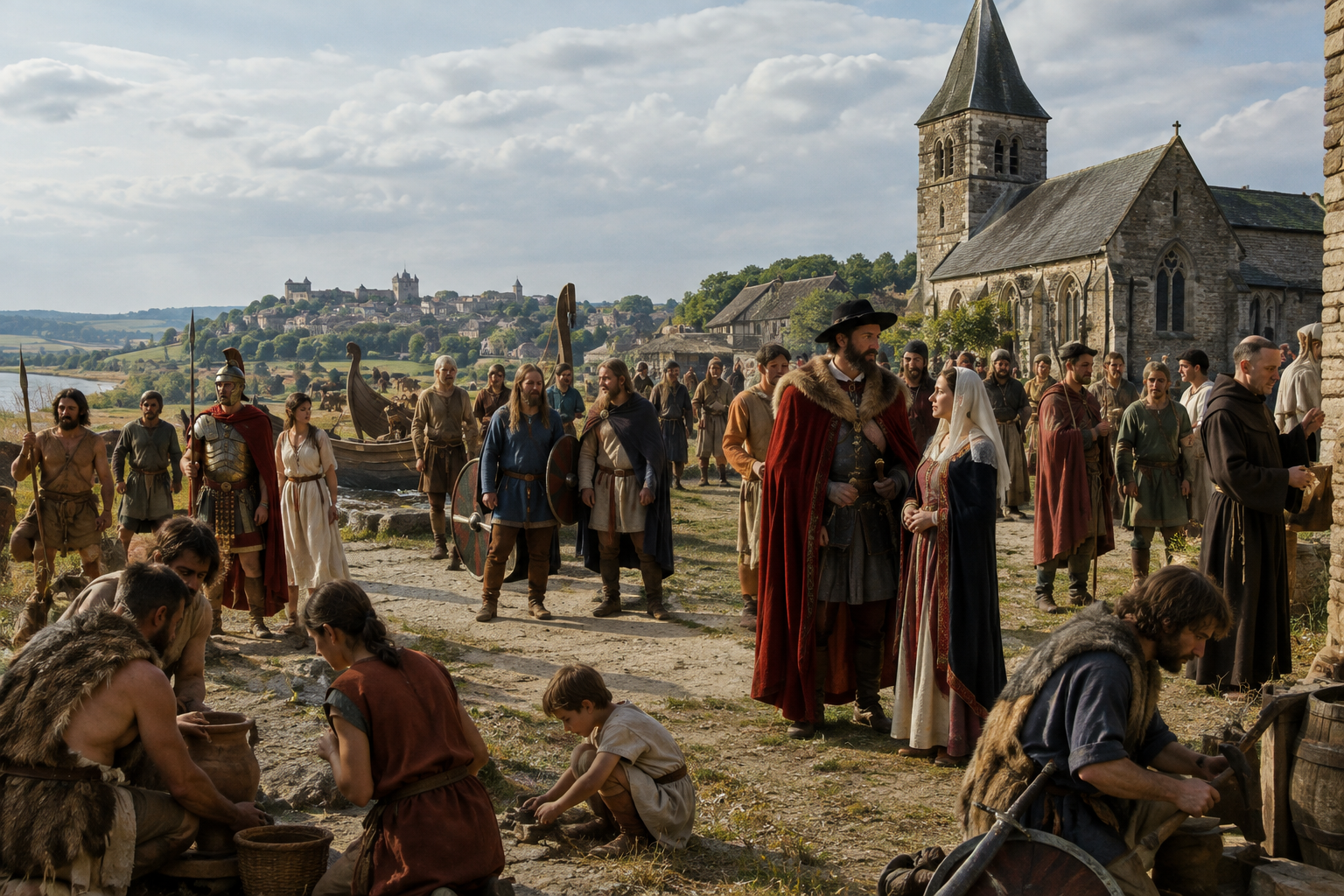
Some Y-chromosome lineages turn up in one place and seem content to stay there. Others behave more like regulars in the grand historical drama of Europe, appearing in frontier communities, market towns, royal domains, churchyards, and the burials of men who lived in very different worlds. The Y-DNA haplogroup R1b1a1b1a1a1c1a2b belongs to that second sort of story: not a single people, not a neat national label, but a paternal line that appears across a remarkably broad sweep of European history.
That point matters, because Y-DNA can be both revealing and misleading if treated too simply. A Y-haplogroup traces one direct paternal line only: father to father to father, across many generations. It does not describe a person's whole ancestry, culture, language, or identity. Even so, when archaeologists recover Y-DNA from ancient burials, we get something very precious: a way to watch one thread of male-line ancestry pass through changing societies, from the Bronze Age to medieval kingdoms and early modern noble houses.
The clade R1b1a1b1a1a1c1a2b is a very specific downstream branch within the broader haplogroup R1b, one of the major Y-chromosome lineages in western Eurasia and especially well known in much of Europe. But caution is essential here. The deep history of R1b as a whole is far broader than the history of this particular subclade. We should not simply paste the entire prehistory of all R1b men onto this narrower branch.
What the supplied ancient evidence does suggest is that this lineage, or very close related branches around it, had a long presence in parts of temperate Europe, especially in the broad corridor stretching from the Low Countries and the Rhine-Meuse region through central Europe and into the North Sea world. That is not proof of one uninterrupted dynasty. It is evidence that the same paternal branch kept appearing in regions tied together by trade, migration, war, and settlement.
In practical terms, this is why ancient DNA is so useful. Written history tends to privilege kings, bishops, and literate elites. DNA gives us something humbler and in many ways more interesting: a glimpse of ordinary and extraordinary men alike, buried in cemeteries, churchyards, and elite contexts, whose paternal lines can still be read centuries later.
Explore the rise of archaeogenetics
The chronological range of the samples is striking. One of the earliest anchors is I17019, from Early Iron Age Vlaardingen-Krabbeplas Netherlands, dated 1320 BC. That places this paternal line in the Low Countries well before Roman conquest, Frankish kingdoms, or medieval lordship. Nearby in the wider central European zone, we also find I13788 from Late Bronze Age Teplice Bohemia, dated 800 BC, and I15950 from Germanic Iron Age Teplice Radosevice Bohemia, dated 435 BC.
Already, then, this is not a story confined to one medieval realm. It is a story about a paternal lineage showing up in the landscapes of later Czechia and the Netherlands, in societies that archaeologists usually describe through material culture rather than surnames. These were centuries of changing exchange networks, emerging elites, and long-distance links across central Europe. Ancient Y-DNA cannot by itself tell us what language these men spoke or how they identified themselves. But it does show that the paternal branch had a foothold in precisely those regions that later fed into Celtic, Germanic, and Roman frontier histories.
The Low Countries provide especially good continuity in the evidence. I12907, the Late Iron Age Frisian Boy Aak Uitgeest-Dorregeest Holland, dated 200 BC, sits geographically not so far from I17019. Then in the Roman period we meet two men from the Batavi: CGG107745 from Batavi Germanic Tribe Netherlands Valkenburg Marktveld, dated 214 AD, and CGG107751 from the same site, dated 250 AD.
That pair is especially evocative. The Batavi are familiar from Roman history as a frontier people deeply entangled with the empire, serving in the army while retaining local identities in the Rhine delta. A paternal lineage appearing in Batavian contexts suggests not some exotic intrusion, but a line very much at home in the Roman frontier world of the lower Rhine. Here the haplogroup belongs not in a static ethnic box, but in a contact zone.
Discover the Lower Rhine frontier world
By late antiquity and the early medieval period, this paternal line appears across the very regions transformed by migration-age and post-Roman politics. In England, two burials from Early Anglo Saxon Period Buckland Dover England Year:400 AD, BUK059 and BUK027, place it in the world of early Anglo-Saxon settlement. On the continental side of the North Sea, DUN010 from Saxon Coast Lower Saxony Germany Dunum Year:840 AD and Alh_247 from Merovingian Period Bavaria Altheim Germany Year:600 AD show its presence in both Saxon and Frankish spheres.
This is exactly the sort of evidence that warns us against tidy historical categories. The same paternal lineage appears in areas associated with Frisians, Batavians, Saxons, Franks, and later English populations. That does not mean all these groups were "the same people." It means paternal lines persisted while political labels, burial customs, and ruling powers changed above them.
The medieval evidence broadens further. In Belgium, the cemetery of Sint-Truiden Onze-Lieve-Vrouwekerk yields ST0632 dated 900 AD, ST3006 dated 970 AD, and ST0052 dated 1300 AD. This is useful because it hints at regional persistence over several centuries in one urban ecclesiastical setting. Meanwhile, PCA0193 from Medieval Poland Piast Dynasty Lad Year:950 AD carries the lineage eastward into the world of the early Polish state.
That Piast-period sample is particularly intriguing. It does not prove descent from any known royal line merely by sharing a haplogroup, but it does place this paternal branch in the orbit of one of medieval Europe's formative dynastic zones. Readers interested in that question will enjoy the wider discussion in the MyTrueAncestry articles on the Piasts.
Read about the medieval Piasts
The Scandinavian material adds yet another layer. VK323 from Viking Age Ribe Jutland Year:1000 AD, VK143 from the Viking St. Brice Massacre Oxford Year:1002 AD, and CGG100493 from Medieval Jutland Denmark Vor Frue Kirkegard Aalborg Year:1275 AD place the lineage squarely in the Viking and post-Viking North Sea world. Again, this does not make the haplogroup "Viking" in any exclusive sense. It shows that men carrying this paternal branch were part of the same mobile maritime zone that tied Denmark, England, Frisia, and the lower Rhine together.
At first glance, the Italian samples look almost like interlopers, but in fact they are a reminder that European paternal history rarely respects modern boundaries. R10339 from Etruscan Roman Republic Tarquinii Italy Year:150 BC places the branch in central Italy in the late Republican world, while R58 from Medieval Villa Magna Italy Year:1100 AD shows it there again in the Middle Ages.
These finds should not tempt us into claiming a single direct line from Etruscan Tarquinii to medieval Villa Magna. What they do suggest is that this paternal branch, or close relatives of it, was present in more than one part of Europe and could travel through the great arteries of Roman and post-Roman life. Armies, merchants, clerics, settlers, and marriage alliances all moved men across the map long before modern passports.
The supplied noble-family material is uneven, and that too is worth saying plainly. For Clan Barron, the accompanying text is not historical description but a placeholder request: "Please share the location you want described. I can then give you a single paragraph in plain ASCII with no commas." So we should not invent a castle, seat, or genealogy that has not actually been supplied. What we can say is that the Barron name belongs in the later medieval and early modern world of hereditary surnames, family memory, and regional identity - precisely the sort of setting where Y-DNA studies often become attractive to descendants today.
By contrast, one supplied individual gives us a much firmer bridge into aristocratic history: PER01, identified as Elek Bathory Hungarian Knight Pericei Year:1568 AD. This is an arresting sample because it connects the haplogroup not just to an archaeological culture or a regional cemetery, but to a named knight in the orbit of the Bathory world of early modern Hungary and Transylvania. It is one of those moments where ancient DNA stops feeling anonymous.
Still, the rules of evidence remain the rules of evidence. A haplogroup match with PER01 does not prove descent from the Bathory family, nor does a Bathory association mean every historical Bathory male necessarily carried the same exact downstream branch unless independently documented. But it does place this paternal lineage in a social world of noble service, landed power, and fortified households.
If there is a moral to the story of R1b1a1b1a1a1c1a2b, it is that paternal ancestry is best understood as historical context, not heraldic magic. This lineage appears in Bronze Age Bohemia, Iron Age and Roman-period Netherlands, Anglo-Saxon England, Merovingian Bavaria, Viking-age Denmark, medieval Belgium, Piast Poland, Italy, and a named Hungarian knight. That is not the fingerprint of one nation. It is the outline of a long-lived European paternal branch moving through changing political and cultural worlds.
Ancient DNA does something wonderfully awkward to old-fashioned genealogy. It reminds us that before there were surnames, there were lineages; before there were castles, there were settlements; and before chroniclers wrote down noble pedigrees, men carrying these Y-chromosome branches were already living, moving, marrying, fighting, farming, and being buried in the landscapes archaeology now uncovers.
If you want to place this haplogroup in an even broader prehistoric setting, the Low Countries and surrounding regions are especially relevant, as shown by discussions of Bell Beaker and later population change in the Rhine-Meuse zone.
Explore Rhine-Meuse population change
For MyTrueAncestry users, that is the real excitement. A Y-DNA result may not hand you a neat medieval pedigree, but it can place your direct paternal line in a landscape populated by Batavi on the Rhine frontier, Anglo-Saxons in Kent, townsmen in Sint-Truiden, Vikings in Jutland, or knights in early modern Hungary. That is a larger, older, and often more interesting inheritance than most family legends manage.
Upload your DNA to MyTrueAncestry to explore whether your paternal ancestry shows links to ancient individuals like PER01, PCA0193, VK323, or the Batavian samples from Valkenburg. These comparisons can offer remarkable historical perspective, even when they do not prove direct descent from a specific noble family or medieval dynasty.






Comments