Haplogroup R1b1a1b1a1a1c1a2

– 7 min read


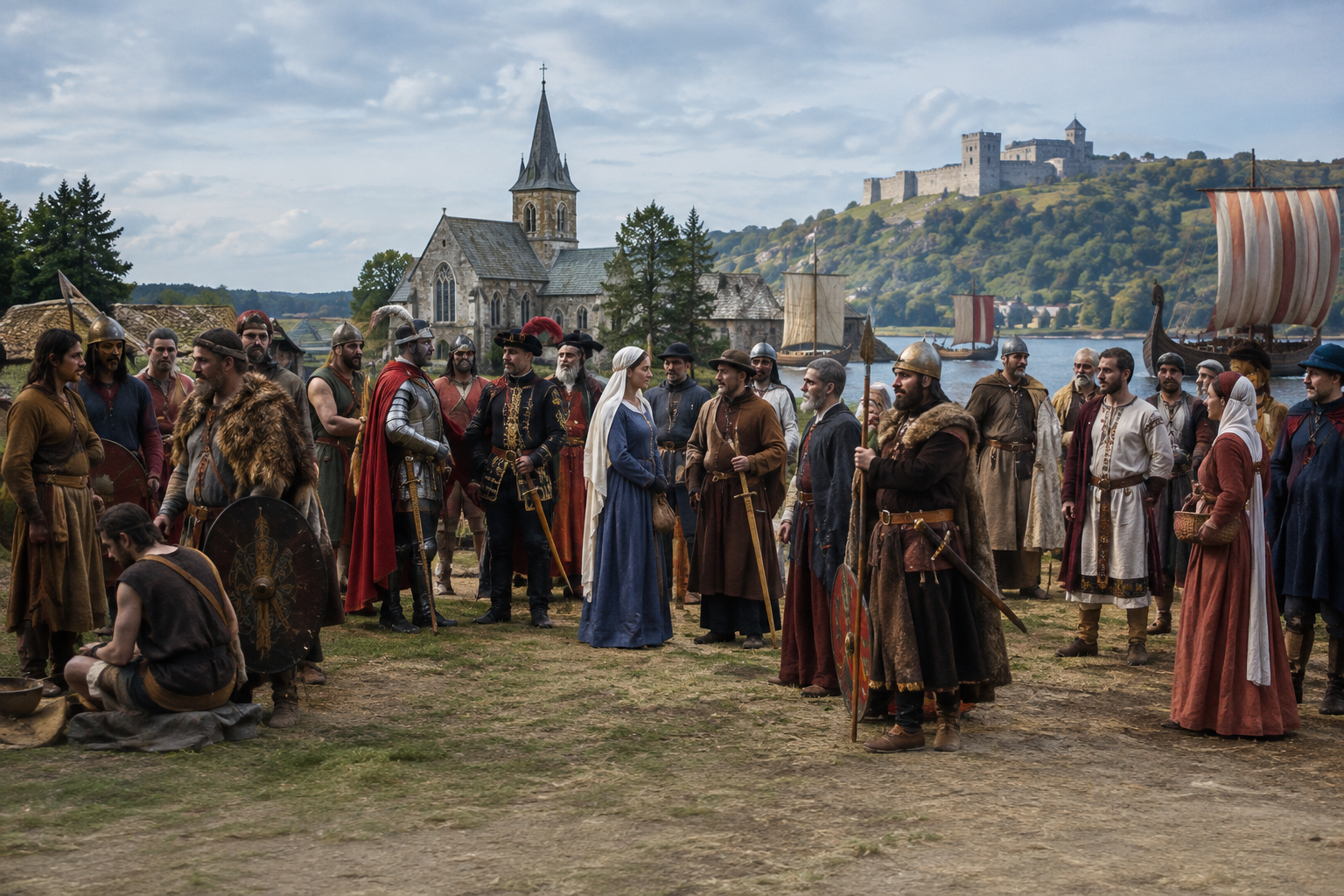
Some Y-DNA lineages are easy to tell broad stories about. Others are more interesting precisely because they resist tidy labels. Haplogroup R1b1a1b1a1a1c1a2 belongs to that second category. It sits within the great R1b family of paternal lineages that appears again and again in the archaeology of western and central Europe, but this particular branch is best understood not as a badge of one people, one kingdom, or one surname, but as part of a long male-line history that turns up in very different settings: Iron Age Bohemia, Belgic France, Roman frontiers, Anglo-Saxon England, Viking-age Scandinavia, medieval Belgium, and even among later nobles.
That is what makes Y-DNA so useful and so easy to misuse. A Y-haplogroup traces one direct paternal line only: father to father to father. It does not describe a person's whole ancestry, culture, language, or identity. Still, when ancient DNA begins placing related paternal branches across centuries and landscapes, it gives us something wonderfully concrete. Not a myth of pure descent, but a map of male-line persistence, movement, and survival.
Because this is a very specific downstream branch, we should be careful. It would be wrong simply to dump the entire history of broad R1b onto R1b1a1b1a1a1c1a2 as though nothing changed along the way. What the sample pattern here does suggest, however, is a branch embedded in the history of central and northwestern Europe, especially from the later Bronze Age onward.
Some of the earliest signposts come from Bohemia and the Low Countries. The Late Bronze Age Teplice Bohemia sample I13788, dated to 800 BC, and the Germanic Iron Age Teplice Radosevice Bohemia sample I15950, dated to 435 BC, place this paternal story in the heart of central Europe over many centuries. Add to that 2909a from Iron Age Czech Prague, dated 100 BC, and you begin to see a pattern: not one isolated appearance, but a continuing presence in the Bohemian world across changing archaeological periods.
To the northwest, another early marker appears in the Netherlands: I17019 from Early Iron Age Vlaardingen-Krabbeplas, dated to 1320 BC. If we are looking for the broad zone in which this lineage was active in later prehistory, central Europe shading into the Rhine-Meuse and North Sea world seems a sensible place to start. That is not the same as proving an origin point, but it is a meaningful archaeological horizon.
Explore Central European Iron Age DNA
One of the liveliest things about this haplogroup's sample trail is how often it appears in places we know were busy corridors rather than secluded backwaters. At Bucy-le-Long in France, among the Belgic Suessiones, we find three Iron Age individuals: CGG022463 dated 511 BC, CGG022431 dated 486 BC, and CGG022438 dated 375 BC. This is not a one-off burial turning up by chance. It suggests the paternal line, or close neighboring branches, had a real footing in Belgic northern Gaul before Rome ever arrived.
Then, under Rome, the same wider paternal signature turns up where empire and local society met. The Batavi Germanic Tribe Netherlands Valkenburg Marktveld samples CGG107754 dated 143 AD, CGG107745 dated 214 AD, and CGG107751 dated 250 AD are particularly striking. The Batavian zone on the lower Rhine was one of those places where tribal identity, military service, and imperial administration all collided. A Y-line appearing there makes good historical sense: this was a region of recruitment, movement, and local continuity all at once.
There are Roman-era southern and central European appearances too, such as R10339 from Etruscan Roman Republic Tarquinii Italy dated 150 BC, and R10659 from the Roman Klosterneuburg Fortress Lower Austria dated 126 AD. These do not mean the haplogroup was "Roman" in any ethnic sense. Rather, they remind us that the Roman world was full of men from provincial backgrounds, frontier networks, and long-settled European populations whose paternal lines moved with trade, garrisons, colonization, and ordinary family life.
Read About Roman Soldiers on the Lower Rhine
By late antiquity and the early medieval period, this paternal thread is firmly in the world of Germanic-speaking populations around the North Sea and central Europe. We see it in OBM023 from the Thuringii Tribe Germany Obermoellern, dated 500 AD, and in BRC031x from Migration Period Germany Saxony-Anhalt Bruecken, also dated 500 AD. The Elite Germanic Tribe Warrior Bavaria sample AED106, dated 495 AD, and Alh_247 from Merovingian Period Bavaria Altheim Germany, dated 600 AD, show the same broader paternal world extending into the south.
Across the Channel, two especially evocative samples are BUK059 and BUK027 from the Early Anglo Saxon Period Buckland Dover England, both dated 400 AD. Dover was no sleepy corner. It was a gateway. If a paternal lineage linked to continental North Sea populations appears there in the early Anglo-Saxon period, that fits neatly with what archaeology and ancient DNA have been showing more generally: early medieval England was shaped by migration, but also by mixture and local adaptation.
There is more. DUN010 from the Saxon Coast Lower Saxony Germany Dunum, dated 840 AD, places the lineage back on the continental North Sea shore, while I11149 from an Iron Age Briton Cambridgeshire England, dated 460 BC, hints that some related paternal branches may already have been present in Britain long before Anglo-Saxon migration. That is exactly the kind of complication that makes ancient DNA so useful: the same broad lineage can arrive by more than one historical route.
Discover Anglo-Saxon Migration DNA
By the Viking Age and high Middle Ages, the geography widens still further. VK323 from Viking Age Ribe Jutland, dated 1000 AD, and VK143 from the Viking St. Brice Massacre Oxford, dated 1002 AD, place this paternal line in the Scandinavian and Anglo-Scandinavian world. Medieval Denmark adds CGG100493 from Vor Frue Kirkegard Aalborg, dated 1275 AD, and CGG100951 from Tjrby Randers Municipality, dated 1325 AD.
Medieval Belgium is another important cluster. At Sint-Truiden Onze-Lieve-Vrouwekerk we have ST1232 and ST0632, both dated 900 AD, ST3006 dated 970 AD, and ST0052 dated 1300 AD. This looks less like a wandering accident and more like durable local male-line continuity inside a medieval urbanizing landscape.
There are also intriguing noble and dynastic signals. PCA0193 from Medieval Poland Piast Dynasty Lad, dated 950 AD, connects the lineage to one of the formative ruling houses of medieval eastern Europe. Even more explicitly, the later samples PER01, Elek Bathory Hungarian Knight Pericei, dated 1568 AD, and PER03-1, Ferenc Bathory Hungarian Knight Pericei, dated 1589 AD, bring us into the documented noble world of the Bathory family. That is fascinating, but the scientific caution matters: these samples illuminate a paternal association within that family context; they do not mean every Bathory male across every branch necessarily carried the same exact subclade, still less that modern bearers of similar haplogroups can claim direct descent.
The supplied noble connection here is not a fortress on a crag or a conqueror's citadel, but something in many ways more English and more revealing: Greens Norton in West Northamptonshire. The village has roots in Anglo-Saxon England, appears in the Domesday Book of 1086 as Norton, and seems to have grown around farming, the manor, and the parish church of St Bartholomew, parts of which are medieval.
This matters because paternal lineages do not live only in battlefields and royal tombs. They also persist in villages, manors, churches, and field systems. Greens Norton was shaped by local lords, open-field agriculture, and the routines of medieval rural life. Later it remained a rural community even as roads, trade, and nearby towns altered the surrounding region. The association with Greens Norton Hall, rebuilt in the eighteenth century, adds the layer of a gentry or landed household preserving status in a place whose deeper continuity reaches back much further.
For a haplogroup like R1b1a1b1a1a1c1a2, this is exactly the right kind of historical setting. The story told by the ancient samples is not one of sudden appearance from nowhere, but of long male-line continuity across the North Sea and central European worlds, with repeated appearances in England, the Low Countries, Germany, Denmark, and beyond. The House of Green of Greens belongs to that later documentary landscape where surnames, estates, and parish memory begin to fix people in records in a way prehistory never could.
But here too the caution is essential. A historical association between a family and a haplogroup is not proof that every man in that family line carried it, nor that an ancient sample from Dover, Jutland, or Sint-Truiden was an ancestor of the Greens of Greens Norton. What we can say is more modest and more interesting: the geography overlaps, the chronology fits a pattern of long-term regional continuity, and genetics gives us a way to place later family history against a much older paternal backdrop.
If one had to sum up the evidence, this haplogroup seems to belong to a paternal landscape stretching from later prehistoric central Europe into the Rhine-Meuse region, the North Sea coast, early medieval Germanic zones, England, Scandinavia, and parts of the medieval aristocratic world. The samples do not point to one clean ethnic label. They point instead to endurance, mobility, and reuse of the same broad male-line inheritance in different historical settings.
That is perhaps the most valuable lesson of ancient DNA. Written genealogy begins late and usually favors the wealthy. Archaeology gives us objects, graves, and places. Genetics adds a third kind of evidence: the stubborn continuity of biological lines that can survive changes in language, lordship, religion, and political power. A man buried at Bucy-le-Long, another at Valkenburg, another at Buckland Dover, another at Ribe, and another in a Hungarian noble context are not thereby one family in the everyday sense. But they do belong to a deeper paternal history that helps explain how Europe was peopled, connected, and remade over time.
If this lineage catches your eye, you may also enjoy the broader family context in The House of Green of Greens, which explores the later historical setting from the documentary side rather than the ancient DNA side.
MyTrueAncestry lets you explore those older connections for yourself. Your DNA may show similarities to ancient individuals, archaeological cultures, or historic populations discussed here, while still not proving direct descent from a named noble house or any one excavated person. That balance between discovery and caution is exactly what makes the search worthwhile.






Comments