Haplogroup R1b1a1b1a1a1b1a1a

– 6 min read


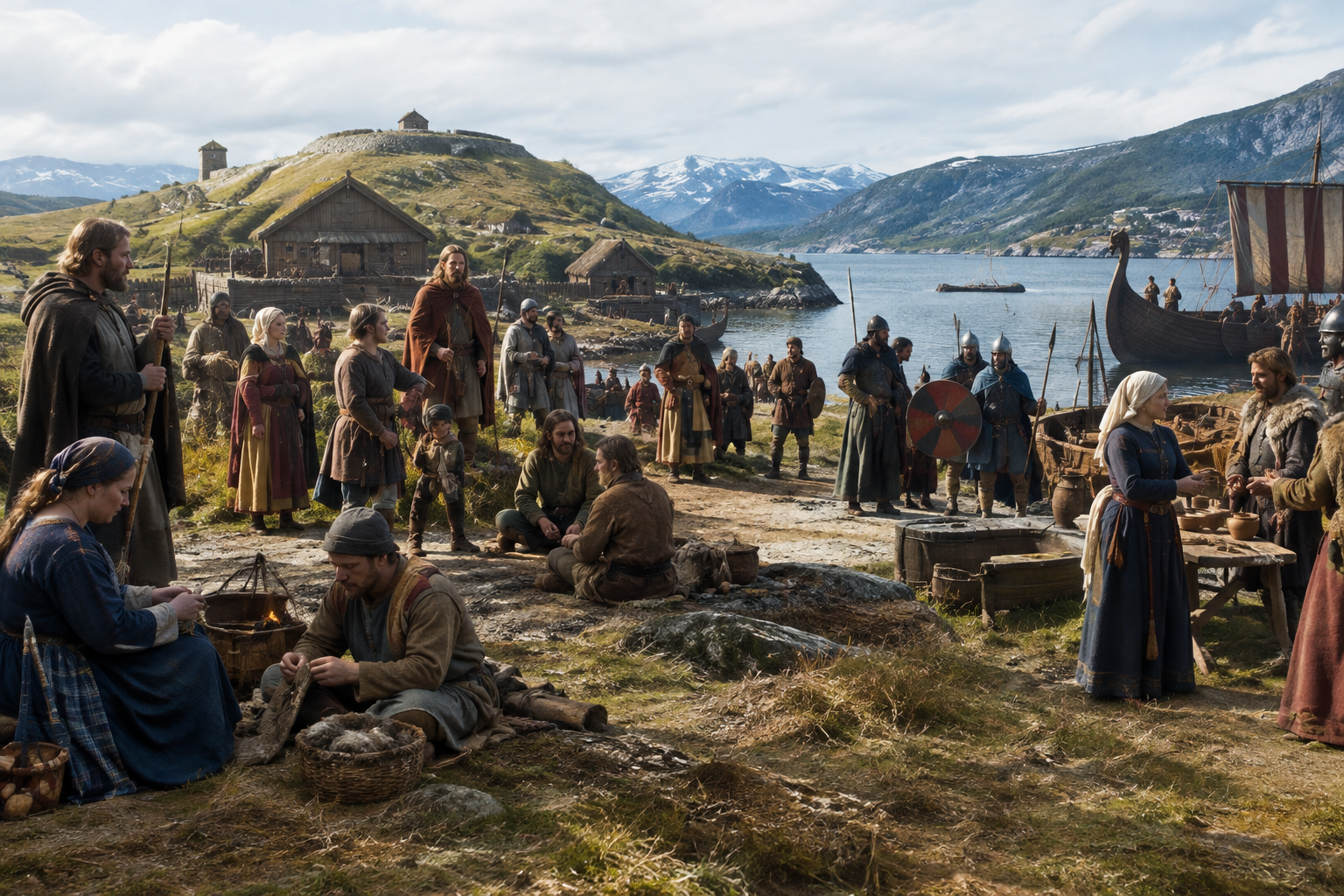
Some Y-chromosome lineages arrive in the ancient DNA record like a single dramatic king in a chronicle. Others appear more like a long trail of footprints around the shores of the North Sea and the Baltic. The haplogroup R1b1a1b1a1a1b1a1a belongs to the second kind. What makes it historically interesting is not one isolated discovery, but a pattern: Iron Age men in Denmark, later individuals in Norway and Sweden, an early Anglo-Saxon era presence in England, Viking Age finds across the North Atlantic world, and even a Merovingian-period Frankish sample in Germany.
That does not mean everyone with this Y-DNA belongs to one people, one kingdom, or one noble house. Far from it. Y-DNA traces only a direct paternal line, one line among countless ancestors. But when a lineage keeps turning up in archaeologically important burials and settlements across centuries, it becomes a useful guide to the movement of men, families, war bands, settlers, and local communities through history. In this case, the evidence points strongly toward a northern European story, especially one tied to Scandinavia and the wider North Sea world.
This haplogroup is a very narrow subclade within the immense Y-chromosome family of R1b. That broader family has a deep and complicated history across western Eurasia and later much of Europe. But with a branch as specific as R1b1a1b1a1a1b1a1a, it is important not to lazily assign to it the whole biography of R1b as a whole. What we can say more responsibly is that the supplied ancient evidence places this particular paternal line repeatedly in Scandinavian and North Sea settings from the Roman Iron Age onward.
The concentration is striking. Several of the earliest samples come from Sjaelland in Denmark: CGG107411 from Varpelev dated 146 AD, CGG107419 from Hastrup dated 256 AD, CGG107489 from Mosede Mose dated 175 AD, CGG107495 from Mosede Fort dated 175 AD, CGG106728 from Kalundborg Simonsborg dated 175 AD, and CGG019442 from Sanddal dated 150 AD. Alongside them stand CGG019091 from Engbjerg dated 362 AD and CGG107387 from Allerslev dated 550 AD. Even before the Viking Age, then, this lineage is already visible in eastern Denmark over several centuries.
That kind of continuity matters. It suggests that this was not a fleeting arrival in one episode, but part of the paternal landscape of southern Scandinavia across the Iron Age.
Explore Denmark's deeper genetic past
If we follow the samples forward, the geography widens. In southern Sweden there is CGG105928, from Albacksbacken, Maglarp in Scania, dated 86 AD. In Norway we find VK418, an Iron Age warrior from Steigen dated 350 AD, and CGG107015 from Fore Island in northern Norway, associated in the input with the Adogit tribe and dated 425 AD. There is also CGG107007 from Langenes, Skongeneshelleren in western Norway, dated 550 AD.
By the time we reach the Viking Age, the pattern has become unmistakably maritime. VK204 appears in Orkney at Newark for Brothwell, dated 950 AD. VK170 comes from the Viking ship burial at Balladoole on the Isle of Man, dated 900 AD. VDP-A7 is from a Viking Gaelic boat burial in Iceland, dated 925 AD. Two men from Ridgeway Hill in England, VK259 and VK449, both dated 998 AD and identified in the input as Viking invaders, carry the same broad paternal signal. In Sweden, there are later Viking Age and early medieval appearances at Uppsala Gammelbyn Brstil (gam872, 1025 AD) and Skara Varnhem (VK308, 1050 AD).
Put bluntly, this is the sort of distribution you would expect from lineages embedded in the Scandinavian world as it expanded, traded, raided, intermarried, and settled abroad. That is not proof of one coherent ethnic identity, still less of a single dynasty. But it is exactly the sort of ancient DNA evidence that helps explain how paternal lines moved from Danish and Scandinavian homelands into Britain, the Isles, and the North Atlantic.
One especially useful bridge is HAD006 from Hatherdene Close, Cambridgeshire, dated 500 AD and described as Early Anglo Saxon Period. This sample reminds us that the North Sea story is not only about Vikings. Long before the famous longships of the 9th and 10th centuries, men from regions tied to the continental and Scandinavian North Sea zone were already reshaping eastern and southern Britain.
Read about Anglo-Saxon migration DNA
The outlier that sharpens the picture is Mln27, a Merovingian Period Frankish individual from Moemlingen, Germany, dated 650 AD. This does not somehow turn the haplogroup into a "Frankish haplogroup." Rather, it shows how lineages circulated across the fluid world of the early medieval north: Franks, Saxons, Danes, Swedes, Norwegians, and many others were never sealed biological boxes. Trade, warfare, alliance, migration, fosterage, and marriage all ensured overlap.
This is precisely why ancient DNA is so helpful. Written sources often classify people by political allegiance or by what their neighbours called them. Y-DNA, by contrast, follows one paternal thread through those changing labels. The result is sometimes messier than nationalist myths would like, but much closer to historical reality.
Even the latest sample in the list, kro001 from the Stora Kronan shipwreck at the Battle of Oland in 1676, has its place in the story. It shows that this paternal line did not vanish with the Viking Age. It remained part of Scandinavian populations into the early modern period, long after pagan boat burials had given way to royal navies and gunpowder war at sea.
Discover Viking Age genetic evidence
How does any of this connect with later noble families? Carefully. Ancient samples do not prove that a medieval clan or house descends directly from any one excavated individual. But they do place paternal lineages in the same broad regions that later became the homes of named families, castles, and lordships.
In Scotland, that regional continuity is especially evocative. Clan Cockburn is linked here with Cockburn Law in Berwickshire, an Iron Age hillfort commanding the eastern Borders. Its earthworks and evidence of rebuilding, timber structures, burning, and long occupation suggest a place of local power long before surnames like Cockburn existed. It is a useful reminder that medieval lineages often rooted themselves in landscapes that had already been politically important for many centuries.
Further up the east coast stands Dunbar Castle, associated with Clan Dunbar. Perched on a dramatic rock above the sea in East Lothian, it became one of the great frontier strongholds of Scotland. The castle later entered famous episodes of written history, including the 1338 defence by Agnes Randolph, Black Agnes, and its connections to Mary Queen of Scots. Yet its site may have been important far earlier. In that sense, it belongs to the same long northern coastal world that ancient DNA helps illuminate.
Clan Preston, associated with Craigmillar Castle near Edinburgh, takes us into a later medieval political landscape of tower houses, noble faction, and royal intrigue. Mary Queen of Scots stayed there in 1566, and the castle became linked to the Craigmillar Bond. The building itself is later than the Iron Age and Viking samples, of course, but it stands in a region deeply shaped by earlier North Sea contacts.
In northeast Scotland, Elsick House, associated here with Clan Carnegie, preserves another version of landed continuity: a tower house with medieval roots, altered across the 17th and 18th centuries, still bearing the marks of defense and status. And in Wales, the House of Meyrick at Bodorgan Hall offers a rather different but equally layered story - not a fortress, but a great estate linked to the medieval princes of Wales and later reshaped into a country house. Its presence in this group is a salutary warning not to reduce ancestry to one regional script. Noble families emerge from particular documentary and social histories, not from haplogroups alone.
So what does R1b1a1b1a1a1b1a1a reveal? At minimum, the supplied evidence places this paternal branch repeatedly in Scandinavia from the Iron Age onward, then across the Viking and North Sea world into England, Orkney, the Isle of Man, and Iceland, with an early medieval appearance in Frankish Germany as well. That makes it a particularly interesting lineage for anyone exploring paternal ancestry connected to northern Europe.
What it does not reveal, by itself, is a complete identity. It does not prove you are "a Viking," or "a Frank," or descended from Clan Dunbar, Clan Cockburn, the Prestons, the Carnegies, or the Meyricks. Shared haplogroups can link people at very different time depths, and many unrelated families can carry the same paternal branch.
Still, there is something wonderfully human in seeing the line appear again and again: in Roman Iron Age Denmark, in a Norwegian warrior, in an Anglo-Saxon burial in Cambridgeshire, in a Viking ship burial on the Isle of Man, in an Icelandic boat burial, in Orkney, in Uppsala, and in a Swedish warship sailor of 1676. That is not one man. It is a long history of men moving through northern Europe's harbours, farms, forts, kingdoms, and sea routes.
Explore North Sea migrations to Britain
If your own Y-DNA falls on a branch like this, MyTrueAncestry offers a way to place that paternal line beside real archaeological discoveries. Ancient DNA matches cannot prove direct descent from a Viking buried at Balladoole or a man from Iron Age Sjaelland, and they do not make anyone a member of a medieval noble house. But they can give you something nearly as interesting: a historically grounded view of the worlds in which your paternal line once moved.
Upload your DNA to explore whether your ancestry connects with ancient individuals, old populations, and the landscapes of forts, castles, and kingdoms discussed here.






Comments