Haplogroup R1a1a1b1a3a2c

– 5 min read


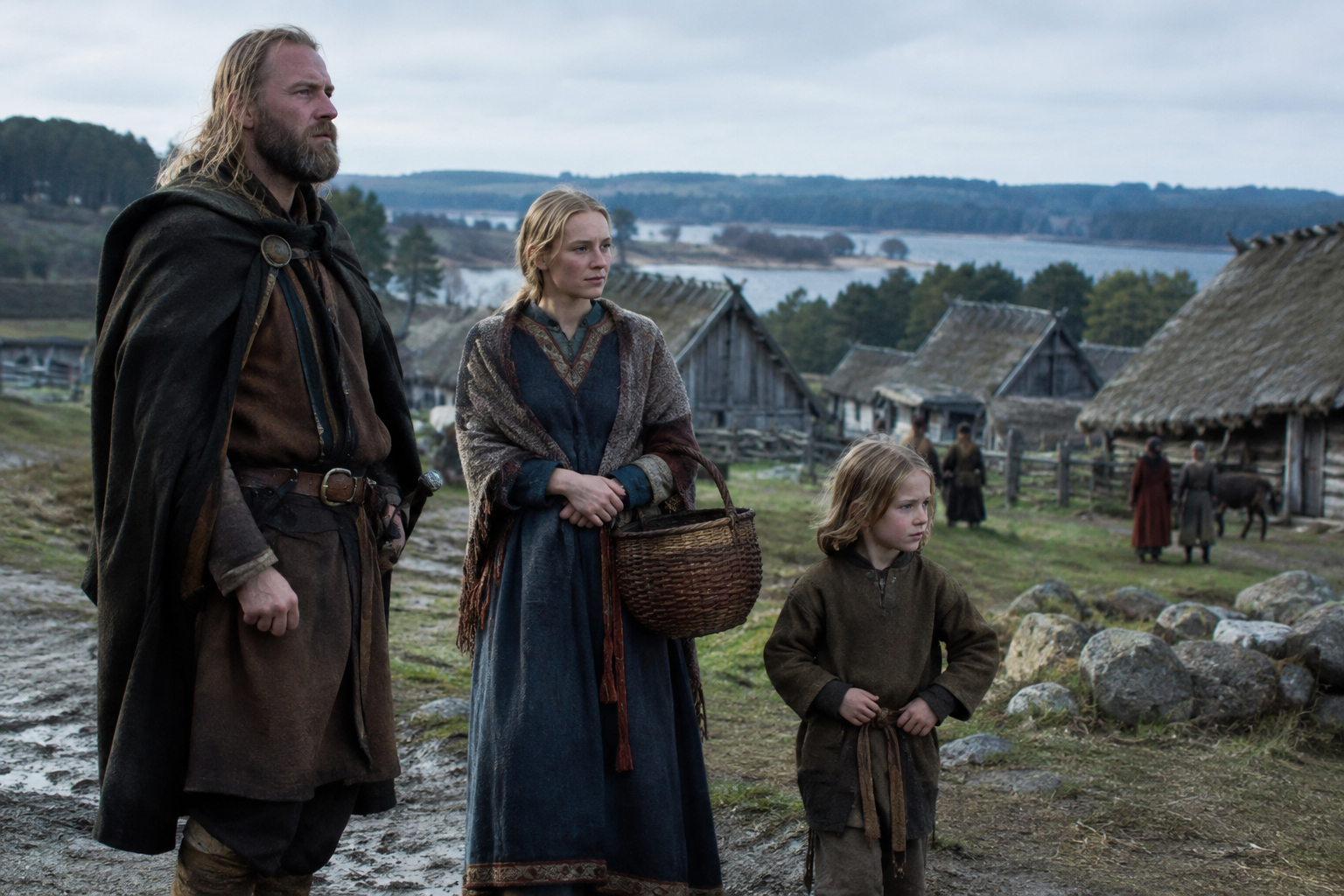
At Varnhem near Skara in western Sweden, archaeologists and geneticists have been piecing together the lives of people buried in the Viking Age and the centuries around it. One of the individuals from this landscape, sample VK401, is dated to about AD 1050. He matters here because he has been associated with the Y-DNA haplogroup R1a1a1b1a3a2c, a very specific branch on the paternal line.
That sounds forbiddingly technical, but the basic point is simple enough. Y-DNA follows one narrow thread: father to son, back through time. It does not tell us a person's whole ancestry, language, or identity, yet in the right archaeological setting it can anchor a very human question: which paternal lines were present in a place at a moment of major social change? In VK401's case, that place was Christianizing, connected, and very much part of the late Viking world.
Skara and Varnhem sit in one of the best-known early medieval regions of Sweden, in Vastergotland. By around AD 1050, this was no isolated frontier. It was a region tied into the growth of royal power, church organization, and the wider Scandinavian shift from older ritual landscapes to Christian burial grounds and institutions.
That is what makes VK401 interesting. He belongs not to the heroic age of later saga imagination, but to the historical hinge between Viking Age society and medieval Scandinavia. A paternal lineage such as R1a1a1b1a3a2c appearing here is therefore not just a dry genetic label. It is part of the evidence for which male lines were living in Sweden as old political and religious patterns were being reorganized.
A broader ancient DNA study of Viking and early medieval Scandinavia, available at https://www.biorxiv.org/content/10.1101/703405v1, helped bring exactly this kind of question into sharper focus by comparing individuals across sites and regions rather than treating "the Vikings" as one single biological population.
The haplogroup name itself tells us that we are dealing with a downstream branch of the much larger Y-DNA family R1a. That wider lineage appears in many parts of Eurasia, both in ancient and modern populations, and it has a long and complicated history. But that broad fame can be misleading. A very narrow branch like R1a1a1b1a3a2c should not be treated as if it automatically carries the entire story of R1a with it.
What we can say, more carefully, is that VK401 represents one late and localized appearance of this paternal line in Viking Age Sweden. That matters because the Scandinavian world of the 10th and 11th centuries was full of movement: trade across the Baltic, links west into the North Sea, service abroad, marriage alliances, church contacts, and local continuity all at once. A lineage present in that setting may reflect deep regional roots, more recent movement, or a combination of both. The archaeology has to lead, with genetics adding resolution rather than replacing history.
With only a single directly named ancient individual here, it would be quite wrong to build a grand tribal epic on top of him. VK401 does not stand for all Swedes, all Vikings, or all bearers of R1a-derived paternal lines. But single individuals are often where the real discipline of archaeogenetics begins. They force us to work from place, date, and context rather than from fantasy maps of migrating peoples.
In practical terms, VK401 tells us that this subclade was present in the Varnhem-Skara environment at roughly the moment when Scandinavian society was becoming more overtly Christian and institutionally medieval. That alone makes him a useful anchor point for anyone studying paternal continuity in Sweden. Instead of an abstract branch floating somewhere in prehistory, we have a man in a documented region, at a historically charged date, tied to an excavated burial landscape.
That kind of evidence has transformed Scandinavian archaeology over the last decade. Sites once discussed mainly in terms of art styles, conversion, or political history can now also be examined through kinship, ancestry, and paternal or maternal lineages.
One of the most useful corrections provided by ancient DNA is that Viking Age Scandinavia was not a sealed population block. Nor, for that matter, was it a simple export machine sending identical "Norse" people everywhere else. Different regions of Scandinavia show different mixtures of ancestry and different patterns of mobility, and burial communities could include people with quite varied backgrounds.
That wider point helps frame VK401 properly. A specific R1a-derived paternal line in western Sweden fits a world where lineages circulated across connected Baltic and North Sea societies, but where local communities also preserved their own histories. The result is not a neat slogan about "Viking DNA." It is something more interesting: a picture of medieval formation in which individual men, families, and communities carried different paternal legacies into the new Christian order.
This is also why direct comparisons with language or ethnicity must be handled carefully. A Y chromosome is inherited down one male line. It cannot by itself tell us whether a man spoke Old Norse, belonged to a local elite, came from a nearby district, or had one immigrant grandfather and three local ones. Archaeology, cemetery patterning, and broader genome-wide data are needed alongside the haplogroup.
Germanic languages and genomics
Varnhem has become important far beyond any single grave because it belongs to a Scandinavian conversation about continuity and change. The 11th century in Sweden saw older burial customs increasingly replaced or reshaped under Christian influence. At the same time, communities were not being biologically reinvented from scratch. Ancient DNA often shows a more subtle pattern: change in religion, institutions, and identities unfolding among people who were locally rooted but connected to wider networks.
That is the sensible historical value of VK401. He is evidence for one paternal line living through that transformation. If your own paternal ancestry falls on R1a1a1b1a3a2c, the relevance is not that you have found a named Viking ancestor. It is that your line belongs to the same narrow branch detected in an individual from late Viking Age Sweden, in a region central to the making of medieval Scandinavia.
For readers interested in how Swedish burials are being reinterpreted more broadly through genetics and kinship, there is useful context in the growing body of work on medieval and Viking-period cemeteries.
R1a1a1b1a3a2c is not a mythic badge and not a shortcut to ethnic certainty. What it does offer, through VK401 at Varnhem near Skara, is a concrete archaeological foothold in Sweden at about AD 1050. That places this paternal branch within the lived world of late Viking and early Christian Scandinavia: a world of local continuity, regional power, and wide connections across northern Europe.
For family historians, that is often the most valuable kind of ancient DNA evidence - not a grandiose claim, but a firmly dated human presence in a real landscape.






Comments