Haplogroup R1a1a1b1a3a

– 7 min read


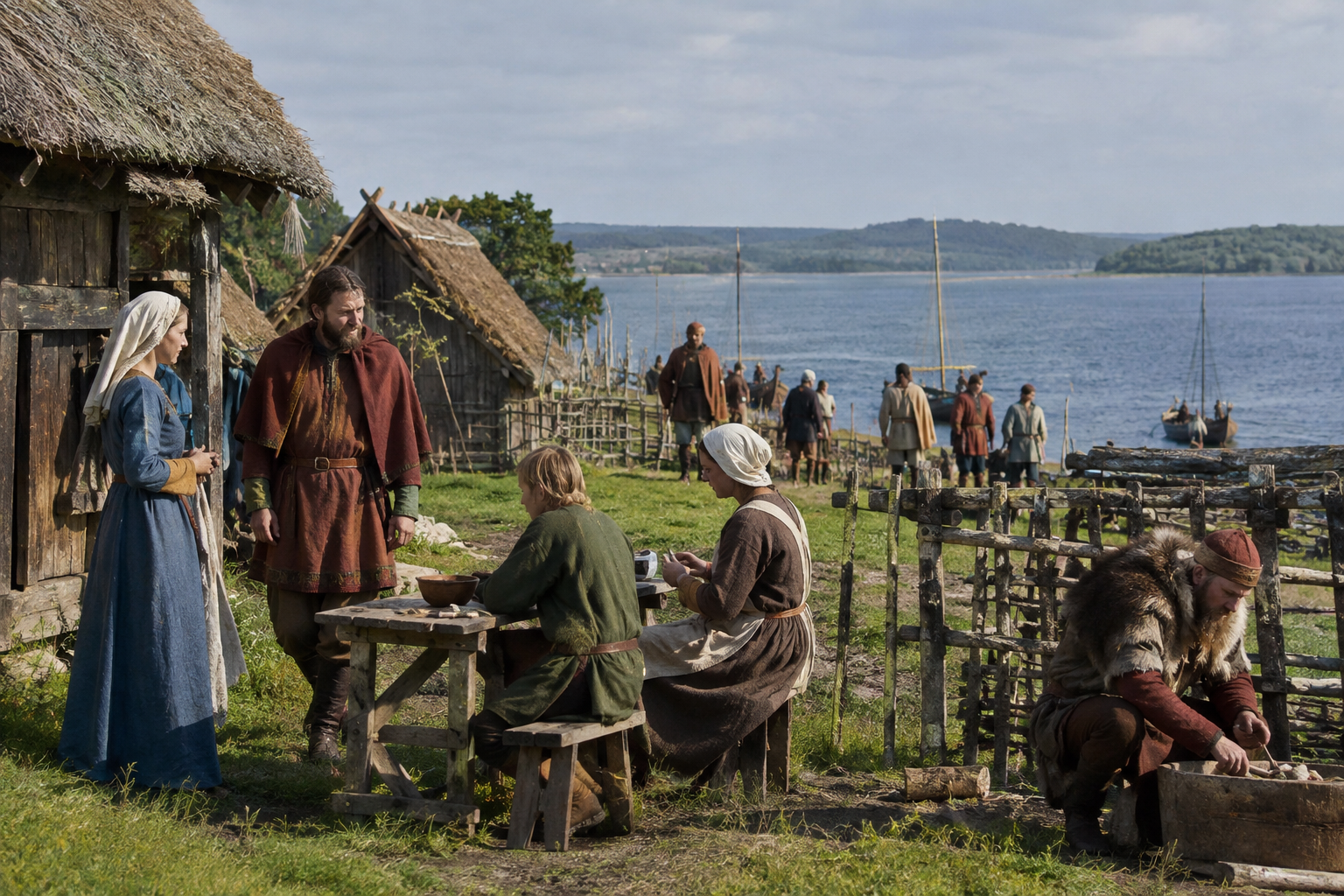
Some Y-chromosome lineages announce themselves in the historical record with a trumpet blast. Others appear more obliquely, in churchyards, shipwrecks, migration-era cemeteries, and the bones of men who left no written names behind. Haplogroup R1a1a1b1a3a belongs to the second sort. It is a very specific paternal branch, one that sits within the much larger R1a family, and its importance lies not in any single king or tribe but in the breadth of places where related lineages appear across northern and central Europe over a very long span of time.
That is what makes it historically interesting. Y-DNA traces one direct paternal line only: father to father to father. It does not describe a person's whole ancestry, culture, language, or identity. But when a lineage turns up in Bronze Age Norway, Iron Age Denmark, Viking Age Sweden and Norway, medieval Poland, England, and even colonial Maryland, it gives us something wonderfully concrete: a thread of male-line continuity and mobility running through the archaeology of Europe.
Because R1a1a1b1a3a is such a narrow subclade, we need to be careful. The broad history of R1a is much bigger than the history of this particular branch. In general terms, R1a lineages are well known across large parts of Eurasia and have often been discussed in connection with prehistoric steppe-related expansions and later movements across Europe and Asia. But it would be careless to pin all of that directly onto this one downstream branch without specific evidence.
What the supplied ancient samples do support is a strong north-central European story. The geography is striking: Norway, Sweden, Denmark, northern Germany, Poland, Slovakia, Hungary, England, Iceland, the Faroe Islands, and later the Atlantic world. Rather than a neat tale of a single migration, what emerges is something messier and more human: a paternal line present in communities shaped by Bronze Age settlement, Iron Age exchange, Migration Period upheaval, Viking mobility, medieval kingdom-building, and early modern seaborne expansion.
Readers interested in the deeper archaeological background to northern European population change may enjoy this broader look at Scandinavia before the historical kingdoms fully emerged.
Explore Scandinavia's Battle Axe ancestry
The earliest supplied evidence for this haplogroup reaches deep into prehistoric Scandinavia. In Norway, samples from Sund include CGG105608 dated to 1881 BC, CGG105623 dated to 1845 BC, CGG105628 dated to 1780 BC, and CGG105604 dated to 1706 BC. Nearby in the same wider northern world we also have CGG105916 from Nordic Early Bronze Age Fauskland, dated to 1986 BC, and CGG105636_CGG105637 from Bronze Age Norway Skjeggesnes, dated to 1125 BC. There is even ber1 from Bergsgraven in Oestergotland, Sweden, dated to 2570 BC.
One must not overstate what these early dates mean. They do not prove that the exact same family line marched unchanged from one fjord to the next for millennia. But they do show that related paternal branches associated with this haplogroup were present in Scandinavian settings long before the Viking Age. That matters. It suggests that when we later find the lineage in medieval and Viking contexts, we may be looking not only at mobility but at depth of local residence in parts of the north.
By the Iron Age, the picture broadens. In Denmark there are multiple relevant finds: CGG107490 from Sjaelland Mosede Mose dated to 175 AD, CGG107504 from South Sjaelland Holmegaard Toksvard By also dated to 175 AD, CGG107454 from Lillevasby dated to 175 AD, and CGG105327 from a Danii-associated context in Roskilde dated to 313 AD. In western Norway, CGG107004 from Skongeneshelleren is dated to 141 AD.
That cluster matters because it places the lineage in the world of Iron Age Scandinavian societies before the classic Viking horizon. These were communities of farmers, local elites, sailors, traders, and fighters, long connected across the Baltic and North Sea. We are not yet at saga literature, but we are certainly in the world that made the sagas possible.
The Migration Period and early medieval centuries are where this haplogroup becomes especially evocative. In Germany, DRH007 from Deersheim in Saxony-Anhalt, dated to 500 AD, comes from a Thuringii context. In the Carpathian Basin, SZL057 from Longobard Period Pannonia Savaria Szeleste Barbaricum Hungary and SZL101 from Post Roman Period Pannonia Savaria Szeleste Barbaricum Hungary are both dated to 525 AD. In Poland, PL067 from Maslomecz Wielbark, dated to 250 AD, comes from a Gothic Tribe context.
These are not trivial labels. They place related paternal lines in exactly the sort of frontier and migration-zone environments where Roman influence, post-Roman political collapse, and mobile warrior groups collided. Yet genetics is useful here precisely because it checks our tendency to imagine neat ethnic boxes. A Y-line can move with families, retainers, client groups, settlers, or mixed communities. It is a clue to movement, not a certificate of ethnicity.
Then come the Viking Age finds. Sweden gives us nuf030 from Sigtuna dated to 935 AD, als001 from Vendel Age Uppland Alsike dated to 588 AD, VK344 from Oland dated to 950 AD, and three individuals from Skara Varnhem dated to 1050 AD: VK35, VK397, and VK401. Norway adds CGG107030 from Halogaland Holm dated to 798 AD, CGG107011 from Engholmen dated to 725 AD, CGG107016 from Ytre Kvaroy Luroy dated to 725 AD, VK422 from Hedmark Amot dated to 900 AD, VK394 from Hedmark dated to 850 AD, and VK414, the Viking Age Axeman from Oppland dated to 1000 AD.
Beyond Scandinavia, the Viking sphere widens. There is VK145 from the St. Brice Massacre in Oxford dated to 1002 AD, VK264 from Ridgeway Hill in England dated to 998 AD, NNM-A1 from Viking Norse Iceland dated to 935 AD, GTE-A1 from Viking Gaelic Mix Iceland also dated to 935 AD, and VK18 from Staraya Ladoga dated to 1000 AD. That is the Norse world in miniature: England, Ireland, Iceland, Russia, mainland Scandinavia, and the islands between.
If you want a fuller look at how ancient DNA is reshaping what we know about this seaborne world, this related article is well worth reading.
The medieval record is just as revealing because it shows this paternal line not only in raiders and migrants, but in settled Christian communities. England provides ATP_PSN_943 from Cherry Hinton dated to 1055 AD, ATP_PSN_916 from Cherry Hinton dated to 1120 AD, SED006 from Anglo-Saxon Sedgeford dated to 600 AD, and POH006 from Polhill Kent dated to 600 AD. Denmark gives us KPN002 from St Clemen on Zealand dated to 1100 AD and CGG101808 from Ahlgade Holbaek dated to 1375 AD. Belgium contributes ST2653 from Sint-Truiden Groenmarkt dated to 1090 AD. Slovakia adds I4803 from early medieval Bratislava dated to 1250 AD.
Sweden is especially rich. The Vasterhus material includes wes007 dated to 1213 AD and a whole cluster dated to 1313 AD: mbv250, mbv142, mbv181, mbv201, mbv281, mbv190, mbv252, mbv253, mbv331, mbv123, and mbv180. Whatever the exact family relationships among them may or may not have been, this concentration suggests that in at least one medieval Swedish community, closely related paternal branches were common enough to leave a notable archaeological footprint.
For readers drawn to that Swedish evidence, this community article offers an excellent parallel on how burials and DNA illuminate medieval lives in Scandinavia.
Read about medieval Swedish genomes
That Swedish concentration makes the association with the Hellenstierna family especially interesting in a regional sense. The supplied setting is Tuna Church in Uppland, a place with roots in an older sacred landscape, close to prehistoric graves and traces of elite settlement. The present stone church was built in the late 12th century, in the era when Christianity was being rooted firmly into Swedish soil, but the site mattered long before the first mass was sung there. It is one of those places where archaeology reminds us that conversion did not erase older landscapes of power; it built on them.
That matters for a haplogroup like R1a1a1b1a3a. The value is not that a church proves a DNA lineage - it cannot - but that the landscape around Tuna shows exactly the kind of deep regional continuity that ancient DNA often uncovers. A medieval noble family associated with such a place stood in a world layered over much older patterns of settlement and elite presence.
The Scottish side of the story is very different, and no less compelling. Clan MacDonald is linked here with Finlaggan on the Isle of Islay, one of the chief power centers of the Lords of the Isles from the 13th to the 15th centuries. Finlaggan was not merely a residence. Set on islands in Loch Finlaggan, it was a ceremonial and political focus where chiefs and nobles met for councils, feasts, and judgments. Little survives above ground, but archaeology has revealed buildings, defenses, and signs of high-status life.
Again, one must keep one's head. An association between a haplogroup and a noble clan does not prove that every MacDonald male bore that lineage, nor that an ancient Scandinavian sample is an ancestor of the Lords of the Isles. But the broader historical frame is irresistible: a paternal lineage strongly represented in the Viking and medieval north, later appearing in the Hebridean world where Norse and Gaelic histories became tightly entangled.
Readers who want to explore that Hebridean dynasty in more detail can continue with this related clan article.
The story does not stop in medieval Europe. There are later appearances in the North Atlantic and beyond, including VK45, VK238, and VK244 from Sandoy Church in the Faroe Islands dated to 1600 AD, kro010 and kro012 from the Stora Kronan shipwreck at the Battle of Oland in 1676 AD, and I15285 from St. Mary City Chapel Field Cemetery in Maryland dated to 1634 AD.
That last sample is particularly evocative. A paternal lineage visible in prehistoric Scandinavia, in Iron Age Denmark, in Viking mobility, and in medieval Christian Europe also turns up in one of England's early colonial settings in North America. Not as proof of one unbroken documented genealogy, of course, but as evidence that the same broad paternal branch travelled with the peoples who crossed oceans and remade worlds.
For that Atlantic extension, this article on the colonial cemetery at St. Mary's City makes an excellent companion piece.
Explore colonial St. Mary's DNA
So what does R1a1a1b1a3a reveal? First, that a paternal lineage can be both old and mobile: rooted in parts of northern Europe by prehistory, yet perfectly capable of appearing in migration-period cemeteries, Viking burials, medieval parish communities, noble landscapes, and colonial settlements. Second, that ancient DNA is often most useful when it complicates easy stories. It does not tell us that one haplogroup equals one people. It shows instead how lineages persist through changing languages, religions, and political identities.
Traditional genealogy begins with names in records. Ancient DNA begins with unnamed men in graves. The exciting thing about MyTrueAncestry is that it lets those two kinds of history speak to one another. You may discover that your paternal line has echoes in medieval Sweden, Viking England, or the North Atlantic world. That would not prove descent from a noble family or a particular warrior. But it would place your direct male line inside one of the most richly documented historical landscapes in ancient DNA research.
If you want to see whether your own DNA shows connections to ancient individuals like nuf030, VK145, PL067, or the men of medieval Vasterhus, MyTrueAncestry can help you explore those links for yourself.






Comments