Haplogroup R1a1a1b1a2b3a3a1a2c2a

– 6 min read


Some Y-DNA haplogroups arrive with a neat historical label attached to them. This one does not. R1a1a1b1a2b3a3a1a2c2a is such a narrowly defined paternal branch that it sits at the far twigs of a very large family tree, and that is precisely what makes it interesting. It reminds us that ancient DNA is not only about sweeping stories of continents and empires. It is also about the survival of very specific paternal lines through centuries of war, migration, settlement, and social change.
At its broadest level, this lineage belongs within haplogroup R1a, one of the major Y-chromosome branches found across parts of Europe and Eurasia. But caution matters here. The long downstream label does not mean we can simply assign to it the entire history of all R1a men from prehistory onward. Y-DNA traces one direct paternal line only: father to son to son. It is valuable for reconstructing paternal ancestry, yet it represents just one narrow thread within a person's full family history.
The wider R1a family is often discussed in connection with eastern and central Europe, the Eurasian steppe, and later historical populations spread across a very wide zone. Ancient DNA has shown again and again that paternal lines in this broader family appeared in different times and places, sometimes associated with mobile Bronze Age societies, sometimes with early medieval communities, and sometimes with later ruling elites. But a highly specific branch such as R1a1a1b1a2b3a3a1a2c2a has to be treated more carefully. Its story is not the whole story of R1a. It is one later chapter within it.
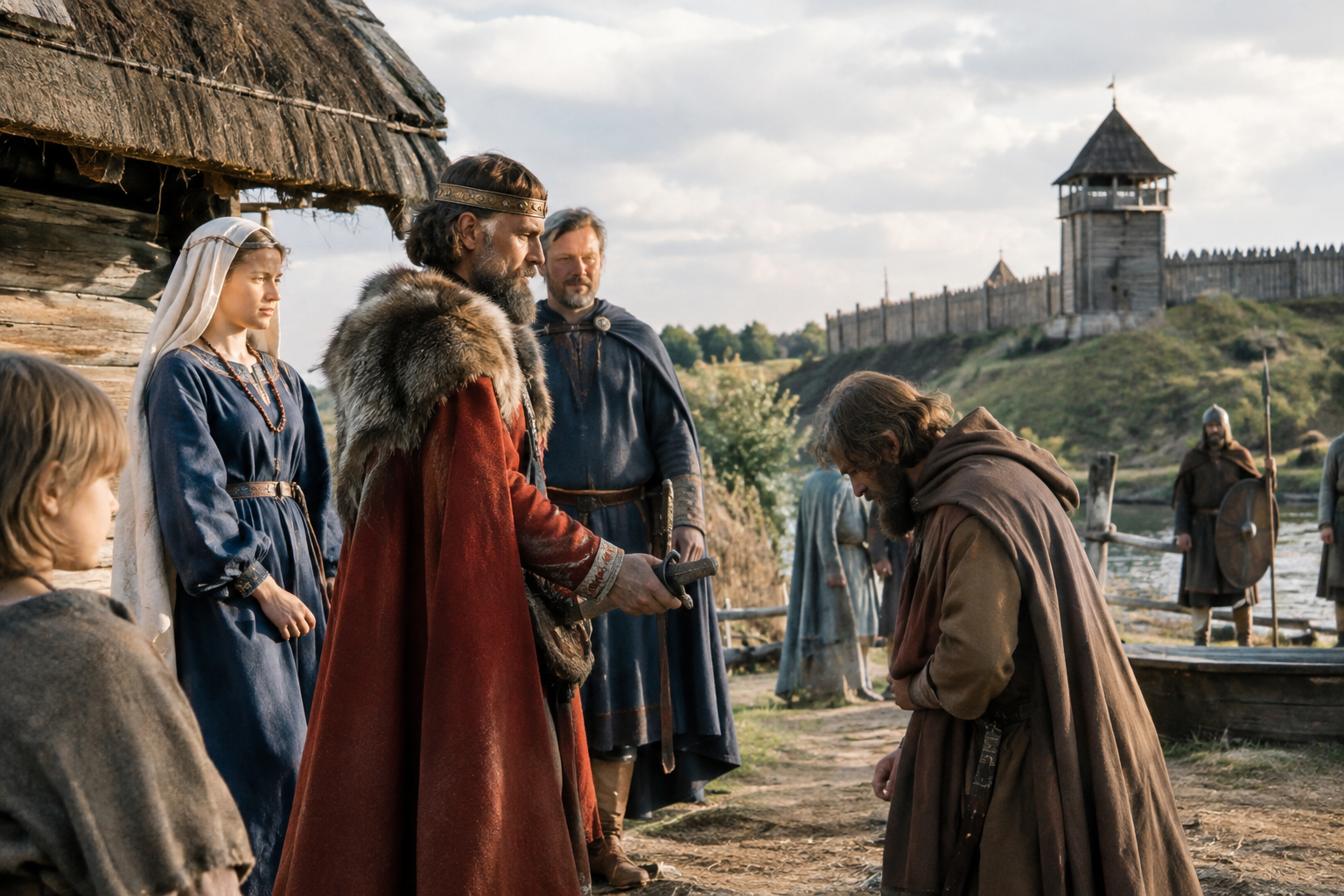
That chapter is best approached through geography and chronology rather than mythology. The evidence supplied here places this lineage, or at least a very close paternal context for it, in medieval Poland. That already tells us something important. By the 10th century, in the age when the Early Kingdom of Poland was taking shape, this paternal line was present in a region that sat at the meeting point of Slavic political consolidation, Christianization, and older networks stretching across central and eastern Europe.
Explore Piast genetic connections
The most concrete anchor in this story is PCA0167, listed as Medieval Poland Early Kingdom of Poland Year:971 AD. One can easily pass over a sample code like that as if it were merely a laboratory label. But it represents a real man who lived in a formative period of Polish history, around the time when dynastic power, church structures, and regional identities were being fixed more firmly into the landscape.
971 AD is not a vague prehistoric horizon. It is historical time. Written rulers, military frontiers, tribute, ecclesiastical power, and expanding royal authority all belong to this world. A paternal lineage found in that setting matters because it gives us a direct male-line datapoint from the age of state formation in central Europe. It does not prove that later families descended from him, nor that he belonged to any named noble house. But it does show that this branch was part of the human fabric of medieval Poland.
Ancient DNA is particularly good at doing this: not confirming romantic legends, but quietly pinning lineages to real places and dates. Sample PCA0167 helps move this haplogroup out of abstraction. Instead of a string of letters and numbers, we can now place it in the political world of the first Polish kingdom, where local lineages, incoming influences, and long-established communities were all being folded into new structures of power.
Read about medieval Polish rulers
The temptation, of course, is to run backward from 971 AD and declare a complete migration map. History is rarely so obliging. What we can say responsibly is that broader R1a paternal lines are deeply entangled with the population history of central and eastern Europe. Ancient DNA from that wider region has often pointed to continuity mixed with movement: not a single migration replacing everyone, but repeated layers of contact and reshaping across the Bronze Age, Iron Age, and medieval centuries.
For a subclade this specific, medieval evidence is especially valuable because it places one branch of that wider paternal tradition within an unmistakable historical context. If we imagine the larger R1a tree as an oak, PCA0167 is one surviving leaf still attached in 10th-century Poland. It tells us that at least one narrow branch endured through the upheavals that separated Bronze Age mobility from medieval kingdoms.
That is also why comparisons with other regional studies can be useful. Poland did not exist in isolation. The lands around the Baltic, the North European Plain, and the eastern frontier zones were full of movement, alliance, and overlap. Ancient paternal lines could persist locally while populations around them changed in language, religion, or political allegiance.
Explore Baltic age population change
At first glance, medieval Poland and a Norman tower house in County Mayo may seem to have little to do with one another. Yet this is where the MyTrueAncestry style of inquiry becomes especially interesting. The supplied noble association here is Clan Burke, linked with Castleburke Castle on the shore of Lough Carra in County Mayo.
Castleburke Castle is described as a late medieval tower house associated with the Burke family, one of the great Norman dynasties in the west of Ireland after their arrival in the 13th century. It served both as residence and stronghold, belonging to a world of local lordship, feuding, and shifting alliances in Gaelic and Anglo-Norman Mayo. In time it lost its military role and fell into ruin, but it still preserves the memory of Burke power in a region where settler ambition and native Irish tradition became tightly entangled.
That last point is the important one. Castles are never just piles of stone. They are records of how families rooted themselves in contested landscapes. Yet they are not genetic proof. We cannot say, from the information supplied, that the Burkes carried this exact Y-DNA branch, still less that every Burke male did. Norman families often had complex biological and social histories, and surnames, lordships, and Y-chromosome lines do not always match neatly over the centuries.
Still, there is a meaningful historical parallel. The Burke story in Mayo shows how paternal lineages can become wrapped in new identities. A family arriving in Ireland in the 13th century could become part of a local political order that was neither purely Norman nor purely Gaelic. In much the same way, Y-DNA lineages survive by passing through changing cultures. The chromosome remains one line of descent; the historical identity around it can change dramatically.
Castleburke Castle stands as a useful reminder of what historical evidence and genetic evidence each do best. Written records, architecture, and family tradition tell us who held power, where they lived, and how lordship worked in a given region. Ancient DNA tells us about biological ancestry and paternal continuity. Put together, they make the past far more vivid. Kept separate, they save us from fantasy.
So the responsible conclusion is not that a 10th-century man in Poland was an ancestor of the Burkes of Mayo, nor that a Norman dynasty in Ireland can be assigned a Polish medieval Y-line. The real lesson is subtler, and more interesting. Europe's noble houses, castles, and kingdoms were built in a world already full of old paternal lineages. Some of those lineages passed quietly through transformations of language, faith, and power. Genetics lets us glimpse those long continuities, even when documents do not.
If you are interested in how Norman families fit into the genetic complexity of medieval Britain and Ireland, another useful comparison is the broader picture of conquest and mixture in the insular world after 1066.
R1a1a1b1a2b3a3a1a2c2a is historically interesting not because it comes with an easy ethnic label, but because it resists one. Through sample PCA0167, we can place this paternal branch in Medieval Poland in 971 AD, in the era of the Early Kingdom of Poland. Through the Burke association, we can set that evidence beside the later world of castles, dynasties, and regional lordship in medieval Ireland. The two are not a proven genealogy. They are a historically suggestive juxtaposition: ancient paternal continuity on one side, documented medieval family power on the other.
That is often how the best archaeogenetics works. It does not flatten history into a slogan. It shows how one paternal line can survive through enormous social change, and how bones in a medieval grave can speak to questions that no chronicle ever asked.
If your own Y-DNA belongs somewhere within the vast R1a tree, discoveries like PCA0167 offer a valuable kind of perspective. They may not tell you the surname of your remote ancestor, but they can place your paternal line within the lived history of real ancient and medieval populations.
Upload your DNA to MyTrueAncestry to explore whether your results show connections to ancient individuals, historical populations, and archaeological discoveries like these. Such matches can offer striking clues about the deeper history of your paternal line, even when they do not prove direct descent from a specific ancient person or noble family.






Comments