Haplogroup R1a1a1b1a2a1

– 5 min read


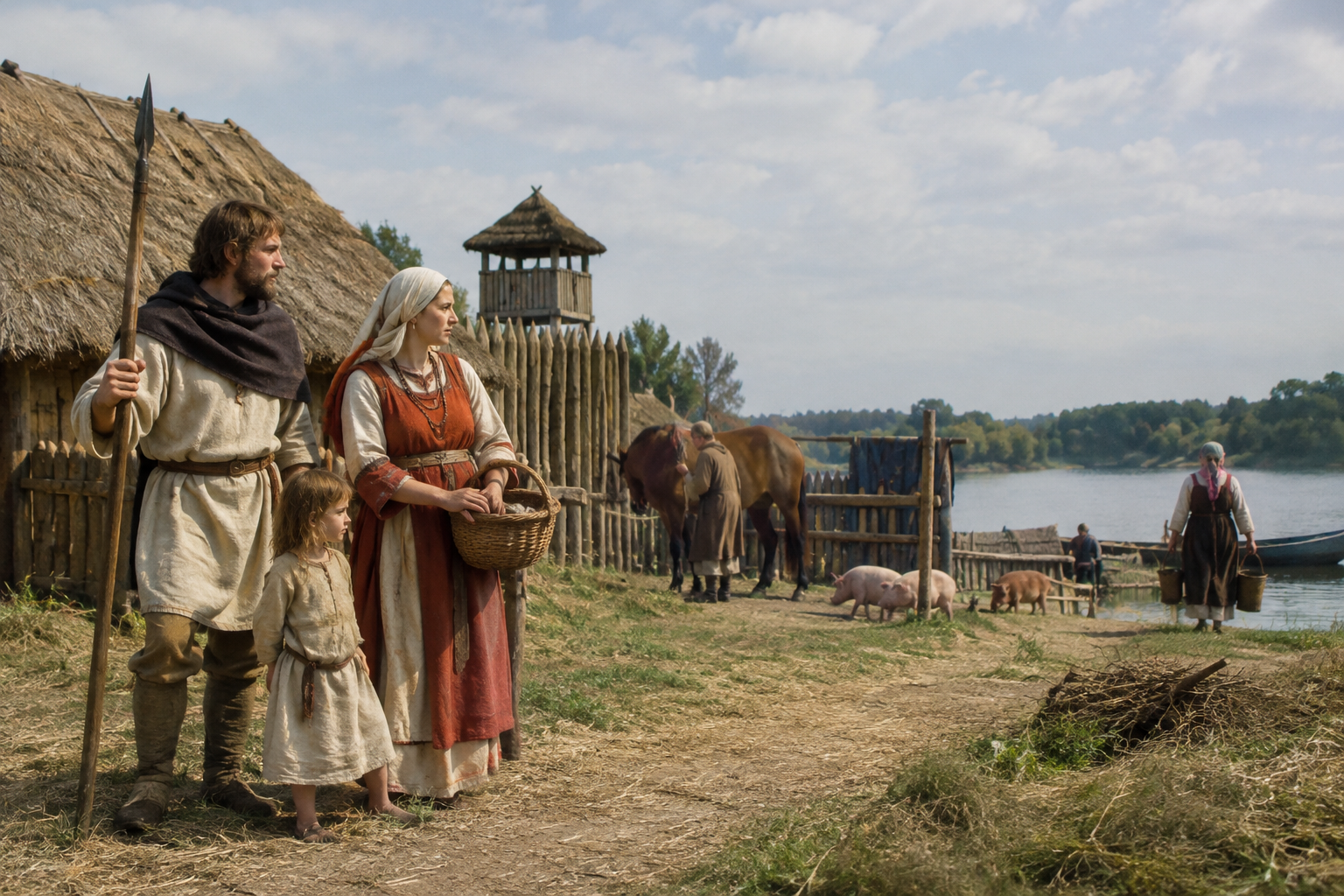
At Pohansko in Moravia, one early medieval male sample stands out for anyone tracing the paternal branch R1a1a1b1a2a1: individual POH28, dated to around AD 975. That is a tantalisingly precise moment in Central European history. Great Moravia had already fallen, the Premyslid realm in Bohemia was rising, Christianity was spreading more firmly across the region, and older local traditions were still very much alive on the ground.
What makes POH28 interesting is not that one grave can explain a whole people. It cannot. But this individual places the wider R1a paternal world, and a reported connection to the narrower branch R1a1a1b1a2a1, inside a real archaeological landscape: Moravia in the late 10th century, when political frontiers, elite networks, and village life were all being rearranged. Y-DNA follows one direct male line only, not a person's full ancestry, yet even that single line can anchor family history to a vivid historical setting.
Pohansko, near Breclav in today's Czech Republic, is one of the best-known early medieval sites in Moravia. It has long been important to archaeologists because it was not just a cemetery or a stray settlement. It was a substantial power center associated with the world of late Great Moravia, a place where fortification, settlement, burial, and political change all intersected.
By the time of POH28, around AD 975, Pohansko belonged to a landscape that had already seen the collapse of the great 9th-century Moravian polity. That collapse did not empty the region. On the contrary, places like this show continuity as well as change: people still lived, buried their dead, maintained communities, and adapted to new rulers and new forms of authority. For a paternal lineage such as R1a1a1b1a2a1, that matters. It situates the line not in a mythic migration tale but in the everyday and political realities of a major early medieval center.
A useful companion to this context is MyTrueAncestry's discussion of Moravian population change in Unveiling the Slavs: Ancient DNA Illuminates Shifts in Moravian Populations.
The haplogroup name here is very narrow: R1a1a1b1a2a1. That sits within the much broader Y-DNA family R1a, one of the major paternal lineages found across large parts of Eurasia, especially in Central and Eastern Europe and beyond. But broad fame is not the same thing as specific evidence. One should not simply pour the entire prehistoric and historic story of R1a into every one of its downstream branches.
For POH28, the cautious point is this: the sample links this paternal line to an early medieval Moravian setting. That is already valuable. It tells us that by the late 10th century, men belonging to this part of the wider R1a family were present in the population of a key Central European region shaped by Slavic polities, Christianisation, and post-Carolingian politics.
That is also why archaeology matters so much. A haplogroup on its own is just a branching label in a paternal tree. A haplogroup attached to POH28 at Pohansko becomes historical evidence: one male line, one place, one time, one community.
There is a habit in popular history of treating early medieval Central Europe as if neat ethnic or national boxes already existed. The archaeology is much less tidy, and much more interesting. In the century around POH28, Moravia was a region of shifting overlordship and overlapping identities, with local communities carrying traditions forward even as larger political structures changed.
That is precisely the sort of environment in which paternal lineages can persist through upheaval. A Y-chromosome branch does not need a dynasty, an epic migration, or a royal pedigree to survive. It survives because fathers had sons, households endured, and local populations were not simply replaced whenever a kingdom rose or fell. POH28 therefore suggests continuity at the level of male descent within a region that was politically unsettled but demographically resilient.
For readers interested in how ancient genomics has been used to think about language spread and population movement more broadly, there is a useful parallel in Tracing the spread of Germanic languages using ancient genomics. Different region, different language history, but the same basic caution applies: genes, languages, and identities overlap only imperfectly.
One sample can never stand for all Moravia, let alone all Slavic-speaking populations. Even so, POH28 is the sort of finding that becomes more valuable over time, because ancient DNA works cumulatively. A solitary early medieval male from a major site may later be joined by more individuals from nearby cemeteries, more refined subclade assignments, and better comparisons across Bohemia, Poland, Austria, Hungary, and the Balkans.
In that sense, POH28 is a fixed point. If your paternal line falls under R1a1a1b1a2a1, this sample does not prove descent from one Moravian man, nor does it identify a tribe or noble house. What it does offer is something more solid than romance: evidence that a branch associated with your line was present in the central European world of the late 10th century, at a site of major archaeological importance.
This is exactly the kind of pattern that becomes clearer when archaeologists compare cemeteries across the post-Roman and early medieval centuries. MyTrueAncestry's Ancient DNA and Genetic Diversity in Post-Roman Central Europe explores that wider setting.
The wider importance of lineages under R1a in Central and Eastern Europe has often encouraged sweeping stories about vast migrations and simple ethnic blocs. Ancient DNA has made those stories both richer and messier. Populations moved, certainly, but communities also mixed, persisted, reorganised, and adopted new identities without erasing every earlier paternal line.
That is why the setting of Pohansko is so apt. It was part of a connected world reaching across river corridors, fortified centers, rural settlements, and church networks. By AD 975, Moravia was not isolated. A man like POH28 belonged to a region drawn into wider currents of trade, power, and belief, while still rooted in local social structures that archaeology can detect more clearly than medieval political labels sometimes allow.
Another helpful comparison comes from Medieval DNA and Isotope Evidence for the Local Origins of Berlin's First Townspeople, which shows how early urban and regional communities in Central Europe can look both mobile and local at once.
The most responsible way to read R1a1a1b1a2a1 here is through POH28 at Pohansko: not as a claim to a crown, not as a shortcut to ethnicity, but as a documented paternal thread running through late 10th-century Moravia. It places this line in a real early medieval community at a moment when Central Europe was being remade after the age of Great Moravia. For anyone researching their father's father's line, that is the real excitement: not fantasy prestige, but a genuine encounter with one identifiable man from the archaeological record.






Comments